
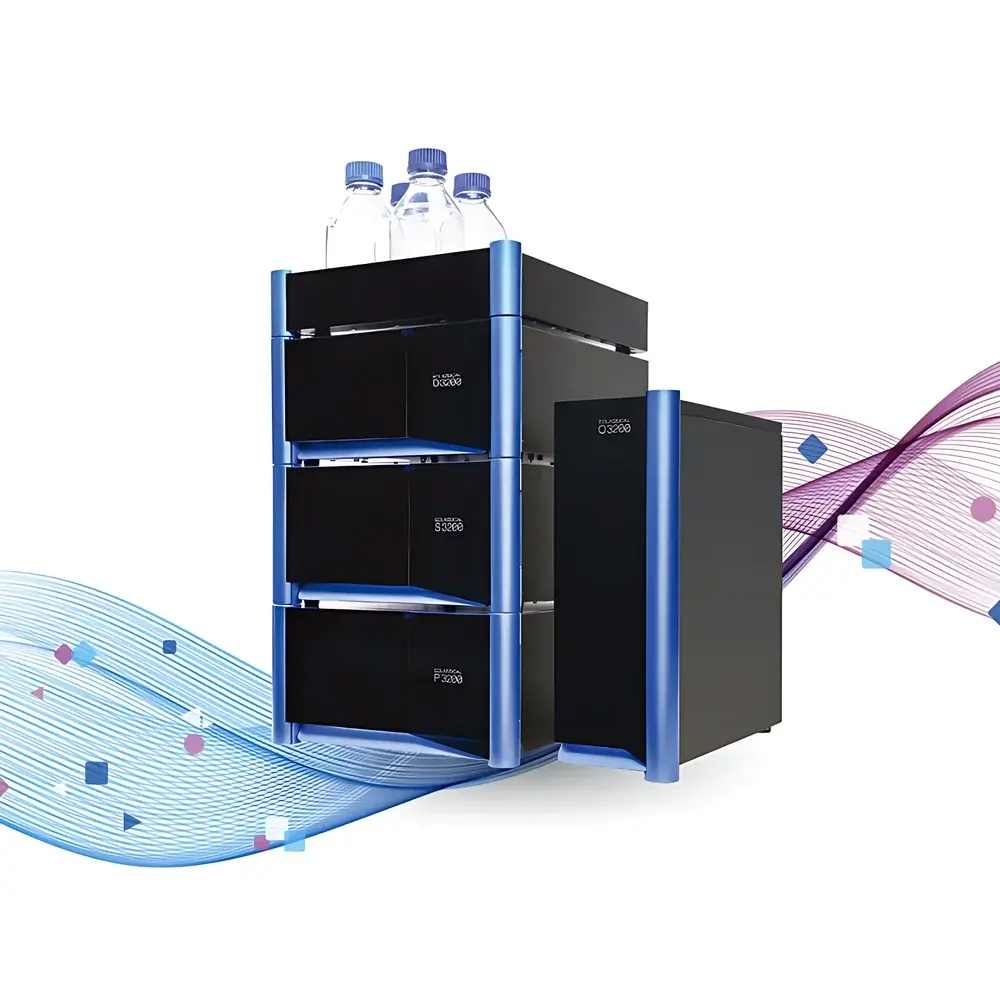
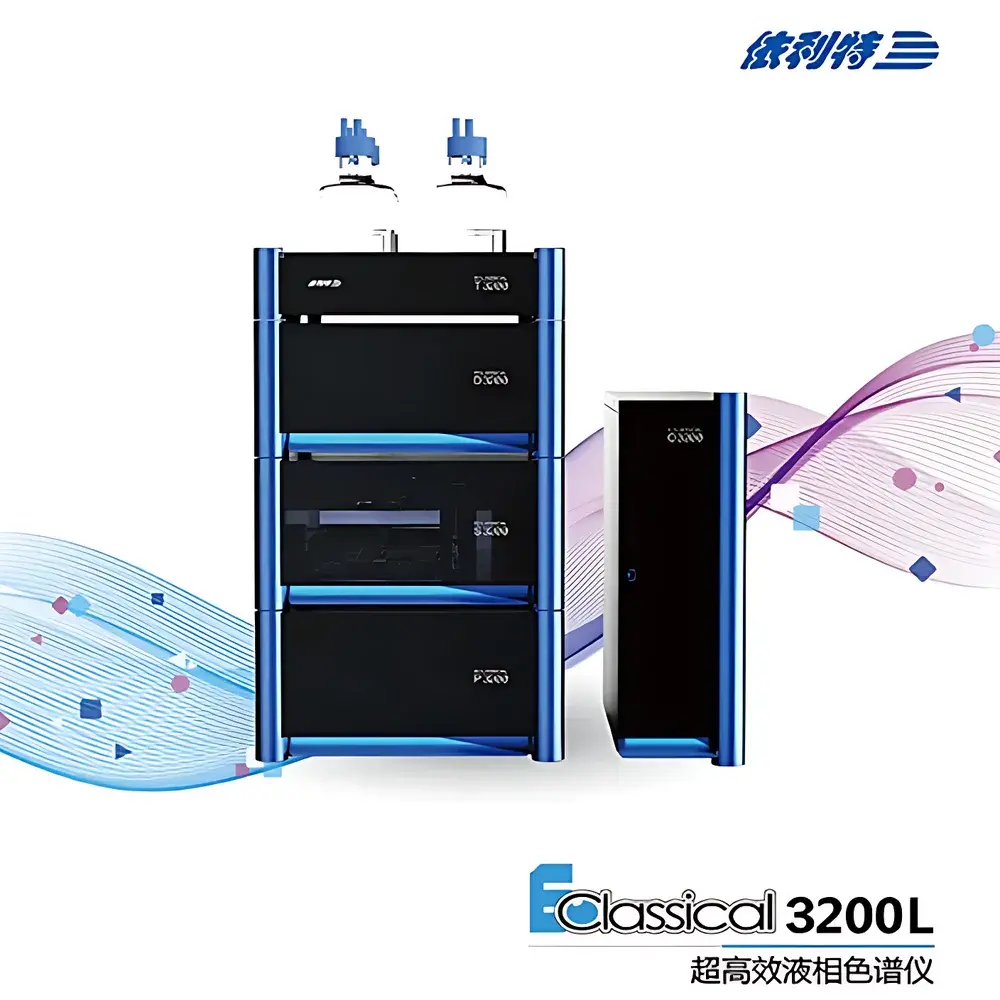
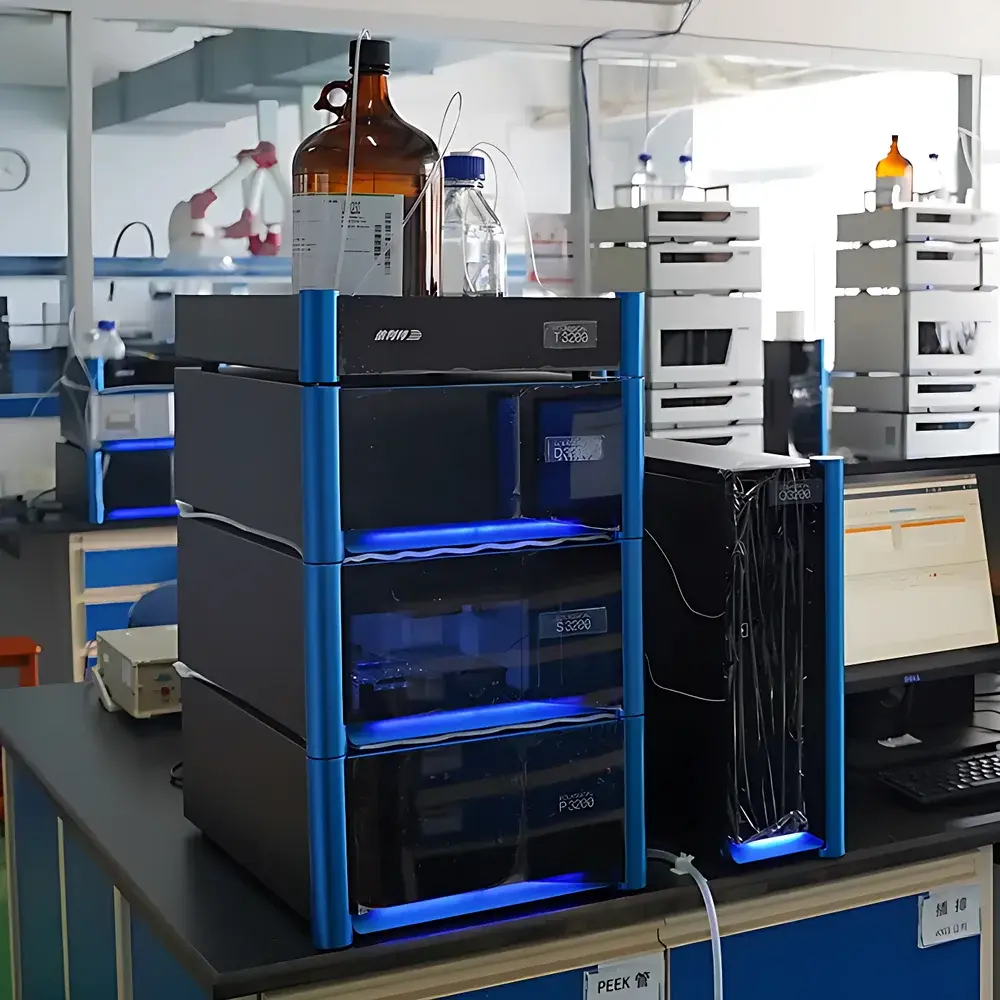
Elite EClassical 3200L Ultra-High Performance Liquid Chromatograph (UHPLC)
| Brand | Elite |
|---|---|
| Origin | Liaoning, China |
| Manufacturer Type | Direct Manufacturer |
| Instrument Category | Domestic |
| Model | EClassical 3200L |
| Instrument Type | Ultra-High Performance Liquid Chromatograph (UHPLC) |
| Application Scope | General-Purpose Analytical Platform |
| Flow Rate Range | 0.001–10.000 mL/min |
| Maximum Operating Pressure | 130 MPa |
| Injection Volume Range | 0.1–100 µL (standard configuration) |
| Column Oven Temperature Range | Ambient +5°C to 85°C |
| UV-Vis Wavelength Range | 190–800 nm |
Overview
The Elite EClassical 3200L Ultra-High Performance Liquid Chromatograph (UHPLC) is an engineered analytical platform designed for high-resolution, high-throughput separation of small molecules, peptides, and thermally labile compounds under elevated backpressure conditions. Built upon a modular architecture, it employs dual-gradient high-pressure pumping with active solvent compressibility compensation, enabling precise gradient delivery at flow rates down to 0.001 mL/min and system pressures up to 130 MPa—fully compatible with sub-2-µm particle-packed columns and narrow-bore capillary formats. Its core separation performance is anchored in robust hydraulic integrity, low dwell volume (< 120 µL), and real-time pressure feedback control, ensuring retention time reproducibility ≤ 0.15% RSD across multi-day sequences. The system operates under ISO/IEC 17025-aligned design principles and supports method transfer from HPLC to UHPLC via scalable flow and gradient scaling algorithms.
Key Features
- High-Pressure Binary Gradient Pump System: Delivers stable flow with ≤ 0.07% RSD at 0.1 mL/min and ≤ 0.03% RSD at ≥ 1.0 mL/min; integrated pulse dampening and solvent degassing modules reduce baseline noise and improve gradient fidelity.
- Intelligent Column Oven with Multi-Mode Thermal Control: Supports heating-only, cooling-only, and adaptive thermal regulation modes; temperature uniformity ±0.2°C across the column bed; optional Peltier-based cooling extends operational range to ambient +5°C, critical for biomolecule stability during extended runs.
- Ultra-Fast Autosampler with Sub-Second Injection Cycle: Achieves ≤ 1.0 s injection cycle time in “TurboInject” mode; needle wash station with dual-solvent rinse minimizes carryover (< 0.005%); sample tray temperature control (4–40°C optional) preserves integrity of labile analytes.
- UV-Vis Photodiode Array Detector (PDA): 190–800 nm spectral acquisition at 10–100 Hz scan rate; optical path length 10 mm; baseline noise < 0.5 × 10⁻⁵ AU at 254 nm; drift < 1.0 × 10⁻⁴ AU/h; independent air-cooled optical cavity isolates detector electronics from thermal fluctuations.
- EMC-Compliant System Architecture: Meets IEC 61326-1 Class A requirements for electromagnetic compatibility; fully shielded fluidic manifolds, grounded chassis, and optically isolated digital I/O prevent signal interference in shared laboratory environments.
Sample Compatibility & Compliance
The EClassical 3200L accommodates a broad spectrum of sample matrices—including pharmaceutical actives, natural product extracts, clinical biofluids (plasma, urine), environmental water extracts, and polymer degradation products—without hardware modification. It supports standard 4.6 mm × 150 mm analytical columns as well as microbore (1.0 mm i.d.) and capillary (0.3 mm i.d.) configurations. All modules are compliant with GLP/GMP documentation requirements: audit trail logging (user actions, method changes, calibration events), electronic signatures per FDA 21 CFR Part 11 (when paired with validated Elite ChromaLink LMS software), and traceable calibration records aligned with ASTM E2656 and ISO 17025 clause 6.5. Column oven and autosampler temperature logs are timestamped and exportable in CSV or PDF format for regulatory submission.
Software & Data Management
Controlled via Elite ChromaLink™ v3.x chromatography data system (CDS), the EClassical 3200L provides method editor with gradient optimizer, peak integration engine with adaptive baseline correction, and automated system suitability testing (SST) per USP and EP 2.2.46. Raw data are stored in vendor-neutral .cdf format (compatible with Open Chromatography Data Format standards). The CDS includes built-in report templates compliant with ICH M4 and FDA eCTD specifications, batch processing workflows for QC release, and secure user role management (administrator, analyst, reviewer) with password policy enforcement and session timeout. Data archiving supports network-attached storage (NAS) and SQL Server 2019+ repositories with automatic backup scheduling.
Applications
The platform is routinely deployed in pharmaceutical QC laboratories for assay quantitation of APIs per USP monographs, dissolution profile comparison, and stability-indicating method development. In academic proteomics, it couples with electrospray ionization (ESI) sources for LC-MS peptide mapping and post-translational modification analysis. Environmental labs apply it to multi-residue pesticide screening using QuEChERS extraction followed by UHPLC–PDA quantification (EPA Method 1694). Additionally, it serves as a reference system for method validation studies—particularly in assessing resolution, sensitivity, and robustness under Design of Experiments (DoE) protocols per ICH Q2(R2).
FAQ
Is the EClassical 3200L compatible with mass spectrometry interfaces?
Yes—it features standard ESI and APCI source mounting brackets, low-dead-volume transfer lines, and synchronized timing signals for seamless LC-MS coupling.
Can the system be operated remotely via network?
Yes—ChromaLink CDS supports secure remote access via TLS 1.2-encrypted HTTP(S) connection; instrument status, real-time chromatograms, and queue management are accessible through web browser on Windows/macOS/Linux.
What column oven accessories are available?
Optional accessories include column switching valves (6-port/10-port), pre-heater modules, and low-volume heat exchangers for ultra-fast thermal equilibration.
Does the autosampler support 96-well and 384-well plate formats?
Standard configuration supports 100-position 2-mL vials; 96-well and 384-well plate adapters are available as field-installable kits with robotic arm positioning calibration.
How is system suitability verified during routine operation?
Built-in SST routines execute automatically before each sequence: resolution test (e.g., USP tailing factor on caffeine/acetaminophen), precision check (6 injections), and sensitivity assessment (LOQ verification)—all logged with pass/fail flags and statistical summaries.




