
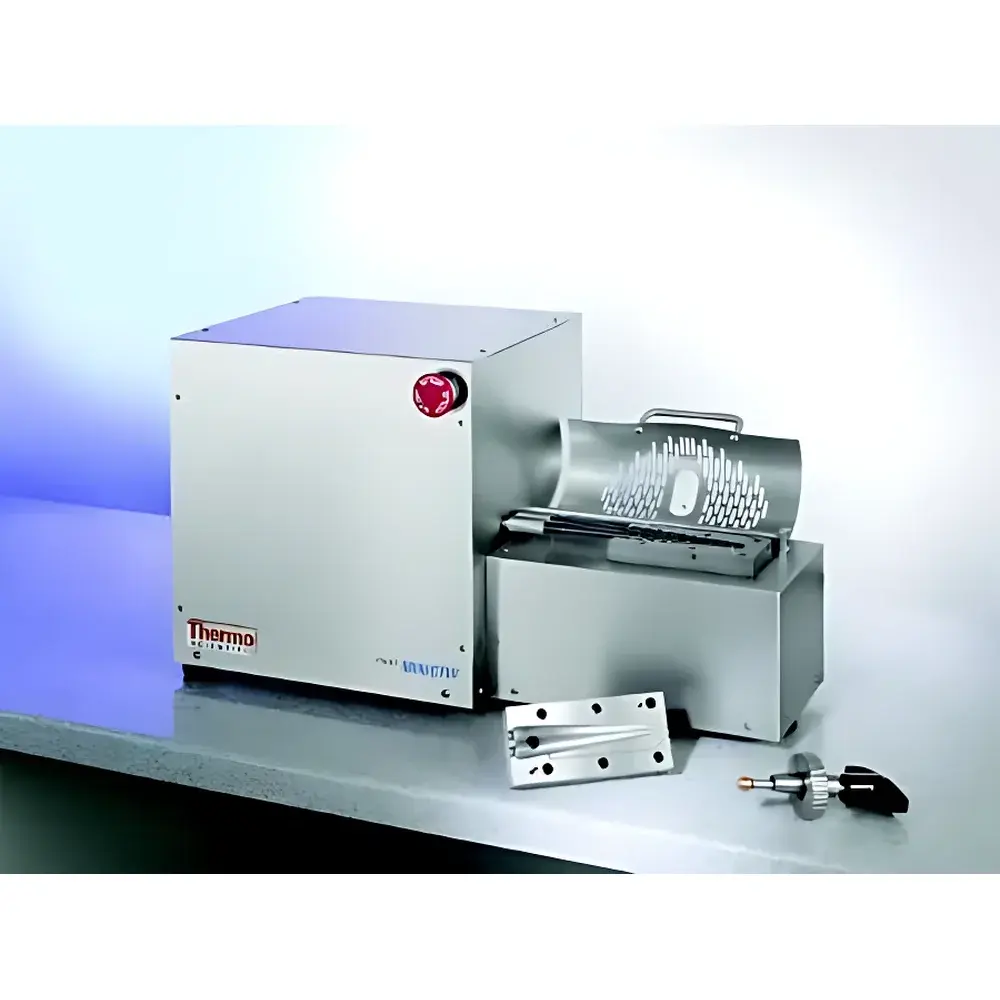
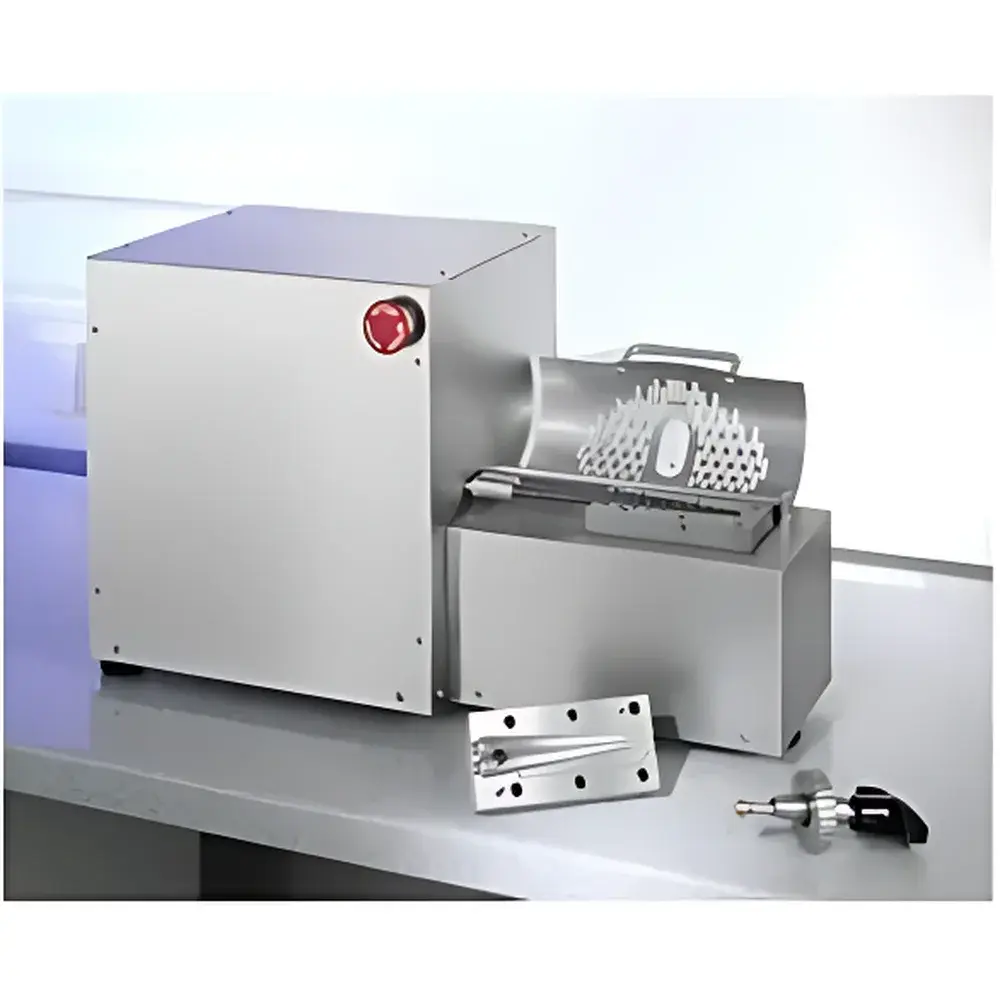
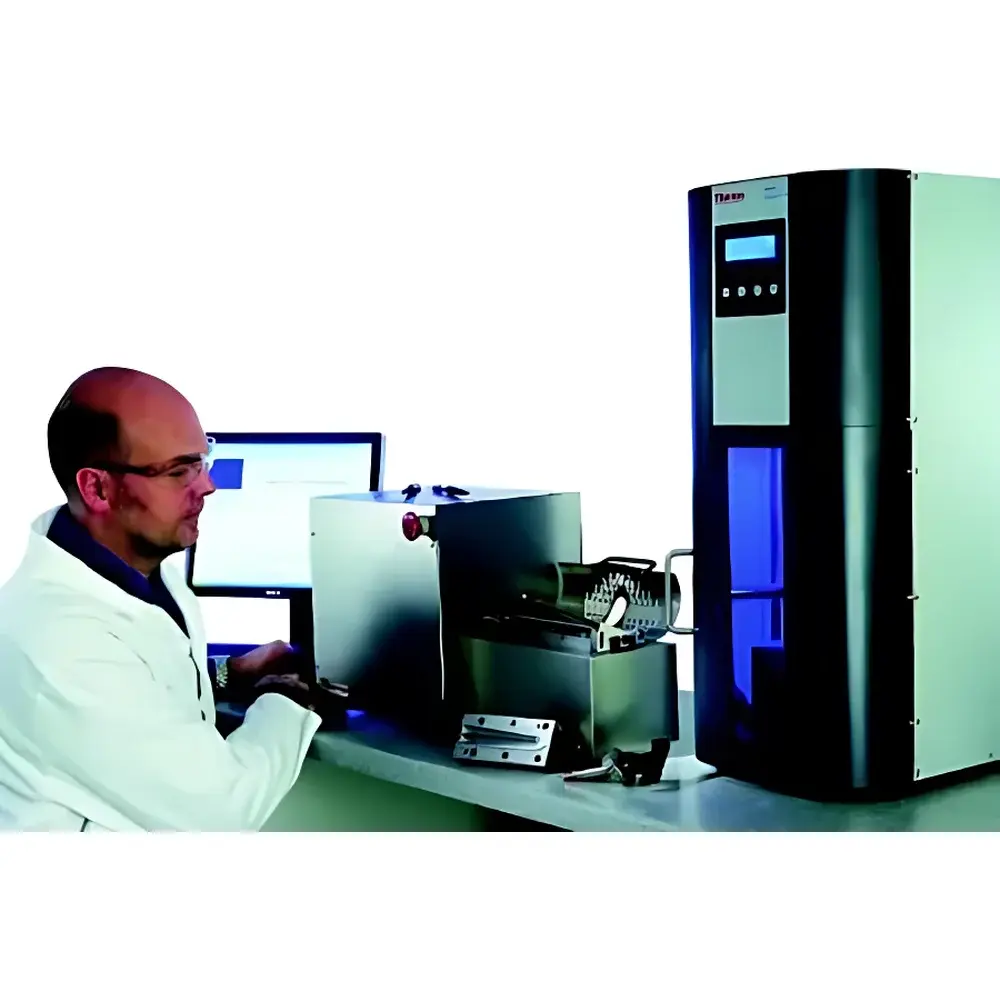
HAAKE MiniCTW Micro Compounder by Thermo Fisher Scientific
| Brand | Thermo Fisher Scientific |
|---|---|
| Origin | Germany |
| Manufacturer Type | Original Equipment Manufacturer (OEM) |
| Country of Origin | Imported |
| Model | HAAKE MiniCTW |
| Motor Power | 400 W |
| Speed Range | 1–360 rpm |
| Max Temperature | 300 °C |
| Max Pressure | 200 bar |
| Screw Geometry | Conical Twin-Screw |
| Screw Rotation | Co-rotating or Counter-rotating Configurable |
| Screw Material | Stainless Steel 1.4122 (X46Cr13) |
| Barrel Material | High-Performance Plastic Mold Steel (ASSAB M340) |
| Heating Time | < 10 min (80–240 °C) |
| Feeding Method | Manual Feeder (Optional: HAAKE Forced Feeder) |
Overview
The HAAKE MiniCTW Micro Compounder is a benchtop twin-screw extrusion system engineered for precise, small-scale reactive compounding and melt processing of thermoplastics, elastomers, and polymer blends. Developed by Thermo Fisher Scientific in Germany, it operates on the principle of controlled shear and residence time distribution within a conical twin-screw geometry—enabling high-viscosity melt mixing with exceptional thermal and mechanical stability. Unlike conventional micro-extruders, the MiniCTW integrates real-time torque monitoring as a direct proxy for rheological evolution during chemical reactions (e.g., grafting, crosslinking, or transesterification), making it particularly valuable for formulation screening, kinetic studies, and process window definition in R&D laboratories. Its compact footprint, rapid thermal response (<10 min ramp from 80 to 240 °C), and modular screw configuration support both co-rotating and counter-rotating operation—allowing users to systematically investigate dispersion efficiency, distributive mixing intensity, and degradation thresholds under defined shear history.
Key Features
- Conical twin-screw architecture with adjustable intermeshing geometry for optimized conveying efficiency and self-wiping action at low throughputs (5–50 g/h typical)
- High-torque DC motor (400 W) delivering stable rotational control across 1–360 rpm with ±0.2% speed accuracy
- Integrated pressure transducer (up to 200 bar full scale) and temperature sensors (±0.5 °C accuracy) mounted directly in the die adapter zone
- Heated barrel assembly fabricated from ASSAB M340 mold steel, offering superior thermal conductivity, wear resistance, and compatibility with abrasive fillers (e.g., glass fiber, carbon black)
- Screw elements manufactured from corrosion- and wear-resistant stainless steel 1.4122 (X46Cr13), heat-treated to ≥52 HRC
- Closed-loop PID temperature control across four independently regulated heating zones (barrel + die)
- Software-controlled bypass valve enabling clean, low-shear strand extrusion post-test without disassembly
Sample Compatibility & Compliance
The HAAKE MiniCTW accommodates a broad spectrum of polymeric systems—including polyolefins (PP, PE), engineering thermoplastics (PA6, PC, PBT), thermoplastic elastomers (TPEs), biopolymers (PLA, PHA), and filled composites (nanoclays, mineral fillers, conductive additives). Its design conforms to ISO 1133-2 (plastic flow properties), ASTM D3835 (extrusion plastometer testing), and supports GLP-compliant workflows via audit-trail-enabled software logging. All thermal and mechanical safety interlocks meet CE Machinery Directive 2006/42/EC and IEC 61000-6-2/6-4 electromagnetic compatibility standards. Optional forced feeder integration enables consistent feeding of low-bulk-density or cohesive powders—critical for reproducible masterbatch development.
Software & Data Management
Controlled via Thermo Fisher’s proprietary HAAKE PolyLab Software (Windows® 10/11 compatible), the MiniCTW provides synchronized acquisition of torque, pressure, temperature, and rotational speed at up to 10 Hz sampling rate. Test protocols are programmable in multi-step sequences—including ramp-hold-ramp profiles, constant-torque modes, and time-triggered valve actuation. Raw data exports to CSV and HDF5 formats; metadata (user ID, timestamp, instrument ID, calibration status) are embedded per test file. The software supports 21 CFR Part 11-compliant user access levels (administrator, operator, reviewer), electronic signatures, and immutable audit trails—facilitating regulatory submissions and internal QA/QC documentation.
Applications
- Kinetic profiling of reactive extrusion processes (e.g., maleic anhydride grafting onto polyolefins)
- Evaluation of dispersion quality and interfacial adhesion in nanocomposites using in situ torque evolution
- Thermal stability assessment of heat-sensitive polymers under shear stress
- Optimization of screw configuration and processing parameters prior to pilot-scale extrusion trials
- Development of recyclate-compatible formulations with controlled contamination tolerance
- Validation of compatibilizer efficacy in immiscible polymer blends (e.g., PP/PA6)
FAQ
What distinguishes the MiniCTW from the MiniLab II?
The MiniCTW omits the automated gravimetric feeder and advanced inline rheometry module of the MiniLab II, retaining core extrusion functionality while reducing cost and complexity for labs prioritizing reaction kinetics and qualitative melt behavior over absolute rheological quantification.
Can the MiniCTW operate in continuous mode?
No—it is designed exclusively for batch-mode reactive compounding with defined residence time windows; continuous operation requires external feeding and pelletizing systems not integrated into this platform.
Is screw cleaning required between runs?
Yes—due to its conical geometry and tight clearances, thorough mechanical cleaning (e.g., purging with HDPE or LDPE followed by manual brush removal) is recommended before each new formulation to prevent cross-contamination and torque drift.
Does the system support nitrogen purge capability?
Yes—standard gas inlet ports are provided on the feed throat and die head for inert atmosphere operation during oxygen-sensitive reactions such as free-radical grafting or polymerization.
What calibration documentation is supplied?
Each unit ships with factory calibration certificates for temperature sensors (traceable to PTB), pressure transducer (traceable to DKD), and torque measurement chain (traceable to NIST-equivalent standards via Thermo Fisher’s accredited metrology lab).






