
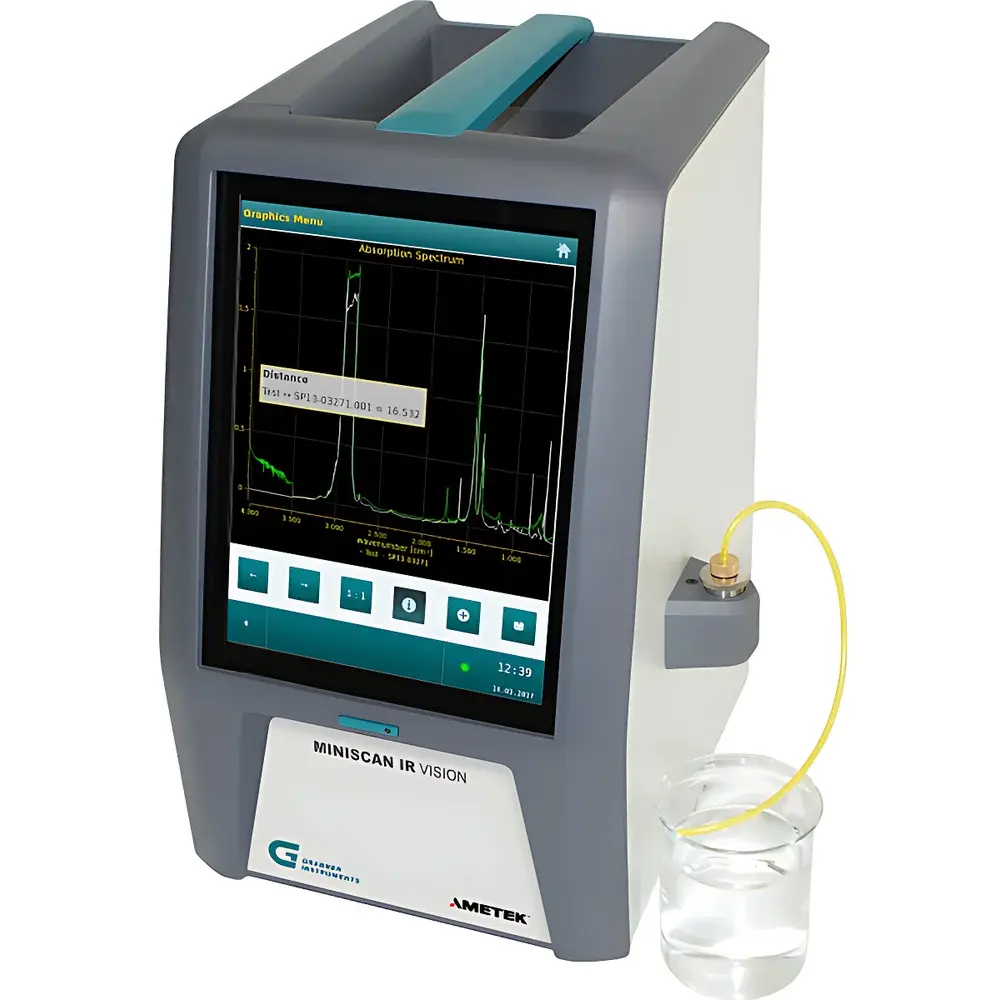
GRABNER MINISCAN IR Vision Portable Mid-IR Fuel Analyzer for Gasoline Octane and Diesel Cetane Determination
| Brand | GRABNER |
|---|---|
| Origin | Austria |
| Model | MINISCAN IR Vision |
| Application | Gasoline Octane Number (RON/MON), Diesel Cetane Number (CN) |
| Portability | Portable |
| Measurement Range | 70–110 |
| Measurement Accuracy | ±1 unit |
| Analysis Time | <5 min |
| Sample Volume | 6 mL |
| Compliance | GB/T 33648–2017, ASTM D5845, ASTM D6277, EN 238, SH/T 0797, EN 14078, ASTM D7806, GB/T 23801, ASTM E1655, GB/T 29858 |
| Spectral Technology | Fourier Transform Mid-Infrared (FT-MIR) with Dual Interferometer Architecture |
| Calibration Method | Partial Least Squares (PLS) Multivariate Quantitative Analysis |
| Integrated Density Measurement | Thermoelectrically Controlled Oscillating U-tube Densitometer |
| Operating Interface | 10-inch Industrial Capacitive Touchscreen (Multi-language: English, Chinese, German) |
| Data Storage | Internal SSD with Full Spectrum Archiving |
| Connectivity | 2× USB 3.0, 2× Gigabit Ethernet |
| Power Supply | 100–264 V AC, 47–63 Hz, 130 W |
| Optional Mobile Power | 12 V DC Vehicle Adapter |
| Dimensions | 293 × 390 × 280 mm |
| Weight | 12 kg |
Overview
The GRABNER MINISCAN IR Vision is a portable, field-deployable Fourier Transform mid-infrared (FT-MIR) fuel analyzer engineered for rapid, laboratory-grade quantification of critical hydrocarbon fuel parameters—including gasoline research octane number (RON), motor octane number (MON), and diesel cetane number (CN)—in under five minutes. Unlike conventional wet-chemistry or single-wavelength NIR analyzers, the MINISCAN IR Vision acquires full-range mid-IR spectra (typically 4000–600 cm⁻¹) with high signal-to-noise ratio, enabling robust multivariate calibration models based on partial least squares (PLS) regression. Its optical architecture features a dual interferometer system with automated mirror alignment compensation—ensuring spectral stability after mechanical shock or thermal drift during transport or on-site operation. The instrument integrates a thermoelectrically controlled oscillating U-tube densitometer, delivering simultaneous density measurement at user-defined temperatures (±0.01 g/cm³ repeatability), essential for volume- and mass-based concentration calculations in regulatory-compliant fuel analysis.
Key Features
- Portable FT-MIR platform with ruggedized aluminum chassis, certified to MIL-STD-810G for shock and vibration resistance
- 10-inch industrial-grade capacitive touchscreen with glove-compatible interface, supporting English, Chinese, and German languages
- Automated, bubble-free metallic sample introduction system with precision 6 mL volumetric dosing
- Thermoelectric temperature control across sample cell, interferometer, and integrated densitometer (±0.1 °C stability)
- Dual-interferometer design with real-time intensity auto-calibration—maintains spectral fidelity after transit over rough terrain
- Onboard SSD storage with full spectral archiving: raw interferograms, processed absorbance spectra, and quantitative reports
- Comprehensive regulatory compliance: fully aligned with ASTM E1655 (standard practice for MIR multivariate analysis), GB/T 29858 (Chinese national standard for molecular spectroscopy), and ISO/IEC 17025 traceability requirements
Sample Compatibility & Compliance
The MINISCAN IR Vision is validated for gasoline, diesel, and aviation turbine fuel (Jet A-1), covering >100 physicochemical parameters including total aromatics, total olefins, oxygenates (MTBE, ethanol, methanol, DMC, methylal), benzene, and fatty acid methyl esters (FAME). All calibrations are built from SGS-verified reference samples representing real-world compositional variability across global refineries and blending terminals. The instrument satisfies mandatory testing requirements per GB/T 33648–2017 (detection of non-conventional additives in automotive gasoline), ASTM D5845 (oxygen content), ASTM D6277/EN 238/SH/T 0797 (benzene), and EN 14078/ASTM D7806/GB/T 23801 (biodiesel blend verification). Its PLS models undergo continuous performance monitoring per ASTM D6708 (standard practice for statistical assessment of calibration transfer), ensuring long-term reproducibility across instruments and laboratories.
Software & Data Management
GRABNER’s proprietary VisionSoft™ software provides full lifecycle data governance—from method setup and calibration validation to audit-ready reporting. Each analysis generates a timestamped, digitally signed result file containing raw spectral data, PLS prediction confidence intervals, density values, and metadata (operator ID, location GPS tag, ambient conditions). The system supports 21 CFR Part 11-compliant electronic signatures, role-based user access control, and immutable audit trails for GLP/GMP environments. Data export options include CSV, XML, and ASTM D7811-compliant LIMS integration via TCP/IP or direct LAN connection. Remote firmware updates and calibration model downloads are performed securely over HTTPS without requiring local IT intervention.
Applications
- Real-time refinery blending control: immediate feedback on octane/cetane response to additive injection or feedstock changes
- Terminal and depot quality assurance: rapid verification of specification compliance prior to distribution
- Regulatory inspection and customs clearance: on-the-spot screening for illicit oxygenates or aromatic adulterants
- Field service diagnostics: mobile labs performing roadside fuel audits or forensic investigations
- R&D formulation support: high-throughput screening of novel biofuel blends and synthetic hydrocarbons
- Aviation fuel integrity checks: detection of contamination or misblending at remote airfields
FAQ
What standards does the MINISCAN IR Vision comply with for gasoline octane determination?
It meets ASTM D2699 (RON) and ASTM D2700 (MON) correlation requirements through PLS models trained on primary reference fuels and verified against NIST-traceable standards.
Can the instrument be used without external power in remote locations?
Yes—it operates continuously on 12 V DC via included vehicle adapter, with battery backup options available for extended off-grid deployment.
How is calibration traceability maintained across multiple instruments?
Each unit ships with factory-certified calibration sets; inter-instrument transfer is validated using ASTM D6708 protocols and supported by GRABNER’s global calibration network.
Is spectral data exportable for third-party modeling?
Raw interferograms and absorbance spectra are fully exportable in JCAMP-DX format, enabling independent reprocessing or custom PLS development.
Does the system support multi-user environments with audit trail requirements?
Yes—VisionSoft™ implements full 21 CFR Part 11 functionality, including electronic signatures, session logging, and tamper-evident record retention.





