
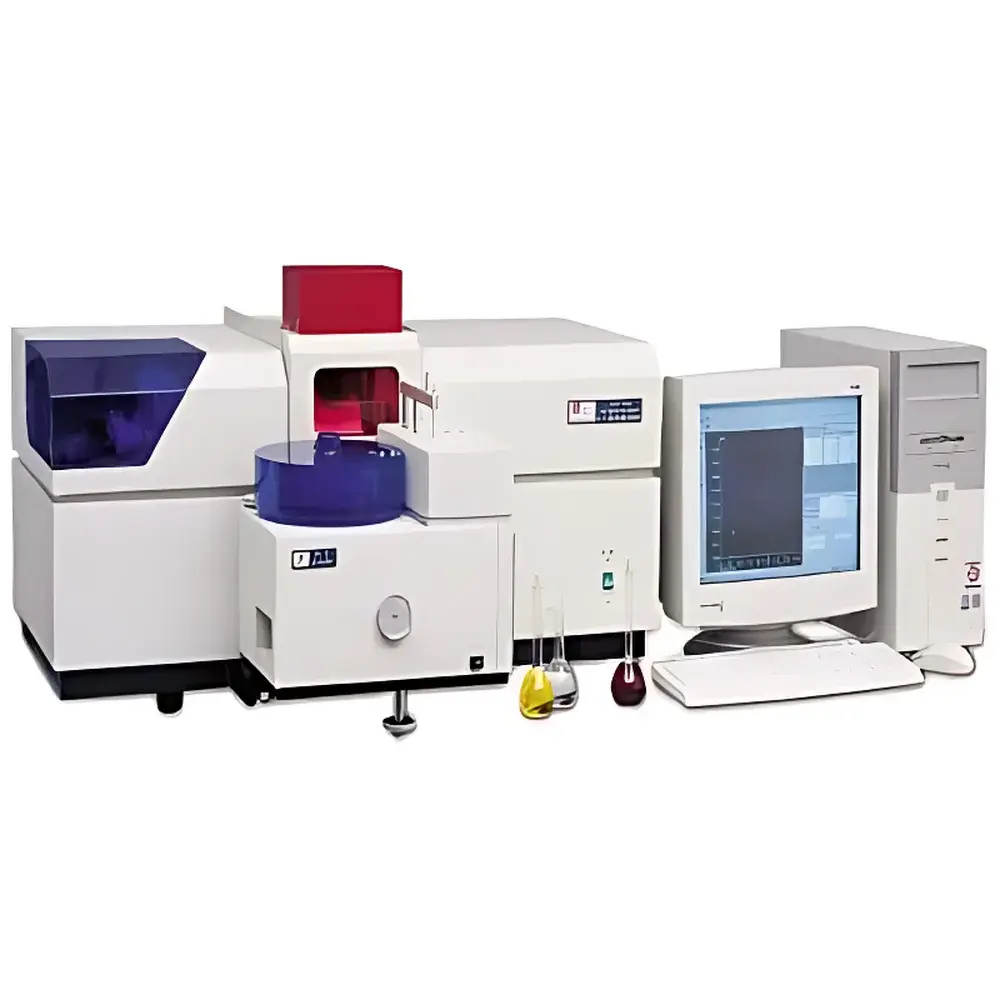
Beifen Ruili WFX-210 Flame and Graphite Furnace Atomic Absorption Spectrometer
| Brand | Beifen Ruili |
|---|---|
| Origin | Beijing, China |
| Model | WFX-210 |
| Instrument Type | Flame and Graphite Furnace AAS |
| Monochromator | Plane Grating |
| Optical System | Single-Beam |
| Detector | Photomultiplier Tube (PMT) |
| Resolution | Resolves Mn 279.5 nm and 279.8 nm doublet with valley energy <36% |
| Sensitivity | Flame mode — Cu: 0.04 µg/mL per 1% absorption |
| Graphite furnace mode — Cd | ≤0.9 pg |
| Precision (RSD) | Flame mode ≤0.9% |
| Detection Limit | Flame mode — Cu: 0.007 µg/mL |
| Graphite furnace mode — Cd | ≤4.0 pg |
Overview
The Beifen Ruili WFX-210 Flame and Graphite Furnace Atomic Absorption Spectrometer is a dual-mode analytical instrument engineered for quantitative elemental analysis across environmental, geological, pharmaceutical, clinical, and industrial laboratories. It operates on the fundamental principle of atomic absorption spectroscopy (AAS), where ground-state free atoms in a gaseous state absorb characteristic radiation emitted by a hollow cathode lamp. The WFX-210 integrates flame atomization (FAAS) and electrothermal graphite furnace atomization (GFAAS) within a single platform, enabling trace-level detection (sub-pg range) and routine ppm-level quantification in liquid samples. Its core innovation lies in the patented oxygen-enriched air–acetylene flame system (Patent No. ZL9210560.7), which elevates flame temperature to 2300–2950 °C—sufficient for refractory elements including Ca, Al, Ba, W, Mo, Ti, and V—without requiring hazardous nitrous oxide. This eliminates toxic gas handling, reduces operational cost, and extends the accessible elemental range beyond conventional FAAS limitations.
Key Features
- Oxygen-enriched flame technology: Replaces N2O–C2H2 with safer, lower-cost air–acetylene mixtures while maintaining high-temperature stability for refractory element analysis.
- Integrated dual-atomization system: Seamless switching between flame and graphite furnace modes via motorized positioning; no manual realignment required.
- Flame emission capability: Interchangeable burner head supports flame photometric analysis of alkali and alkaline earth metals (e.g., K, Na) without hardware modification.
- Full automation suite: Auto-wavelength scanning and peak search; automatic lamp selection and current optimization; dynamic slit width adjustment; auto-ignition and gas flow regulation.
- Graphite furnace precision control: FUZZY-PID optical feedback combined with constant-voltage heating ensures ≤1% thermal accuracy; pneumatic pressure-locking graphite tube assembly guarantees rapid ramp rates and superior temperature reproducibility.
- Advanced safety architecture: Real-time monitoring of fuel gas leakage, airflow deficiency, flame-out events (flame mode); low carrier gas pressure, insufficient cooling water, and overheating (graphite furnace mode) — all triggering audible/visual alerts and hardware interlocks.
Sample Compatibility & Compliance
The WFX-210 accommodates aqueous solutions, acid-digested environmental or biological matrices, and diluted industrial process streams. Sample introduction is compatible with standard nebulizers (flame) and programmable autosamplers (graphite furnace). While not pre-certified to ISO/IEC 17025 or FDA 21 CFR Part 11 out-of-the-box, its automated parameter logging, audit-trail-capable software architecture, and deterministic calibration protocols support laboratory compliance with GLP and GMP requirements when implemented within validated SOPs. The instrument meets general performance criteria outlined in ASTM D1688 (copper in water), ISO 11171 (metal impurities), and USP for elemental impurity testing when operated under method-qualified conditions.
Software & Data Management
The BRAIC operating software—designed for Windows 98/Me/XP environments—provides localized Chinese interface with full English documentation. It enables method-driven workflow management: automatic calibration curve generation (linear/non-linear), background correction (D2 deuterium), drift compensation, and integrated QC flagging. All instrument parameters—including lamp current, slit width, integration time, and furnace temperature program—are stored with timestamps and user IDs. Raw spectral data, absorbance/time profiles, and final concentration reports are exportable in CSV and TXT formats for LIMS integration. Though lacking native 21 CFR Part 11 electronic signature functionality, the software supports manual audit trail review and data archiving consistent with laboratory data integrity best practices.
Applications
- Environmental monitoring: Quantification of heavy metals (Pb, Cd, Cr, Ni, As) in drinking water, wastewater, and soil extracts per EPA Method 7000B.
- Geochemical analysis: Determination of Ca, Mg, Fe, Mn, and rare earth elements in rock digests and sediment leachates.
- Pharmaceutical quality control: Elemental impurity screening in APIs and excipients per ICH Q3D guidelines.
- Clinical toxicology: Measurement of therapeutic/toxic metals (e.g., Li, Cu, Zn) in serum and urine.
- Metallurgical QA/QC: Trace alloying element verification in aluminum, steel, and titanium alloys.
FAQ
Does the WFX-210 support hydride generation or cold vapor techniques?
No — the WFX-210 is configured exclusively for flame and graphite furnace atomization. Hydride generation and cold vapor modules are not supported.
What is the typical analysis time per sample in graphite furnace mode?
With optimized temperature programming and autosampler operation, total cycle time ranges from 60–120 seconds depending on matrix complexity and required sensitivity.
Is the instrument compliant with modern cybersecurity standards for networked lab environments?
The BRAIC software predates contemporary network security frameworks; standalone operation is recommended. Network connectivity requires isolation via VLAN or air-gapped deployment.
Can the WFX-210 be upgraded to support Zeeman background correction?
No — the optical design employs fixed D2 background correction only; Zeeman-compatible optics and electronics are not available as retrofit options.
What maintenance intervals are recommended for the graphite furnace components?
Graphite tubes should be replaced after 200–500 firings depending on sample matrix; platform and probe tips require inspection every 50 runs; furnace alignment verification is advised quarterly or after mechanical disturbance.





