
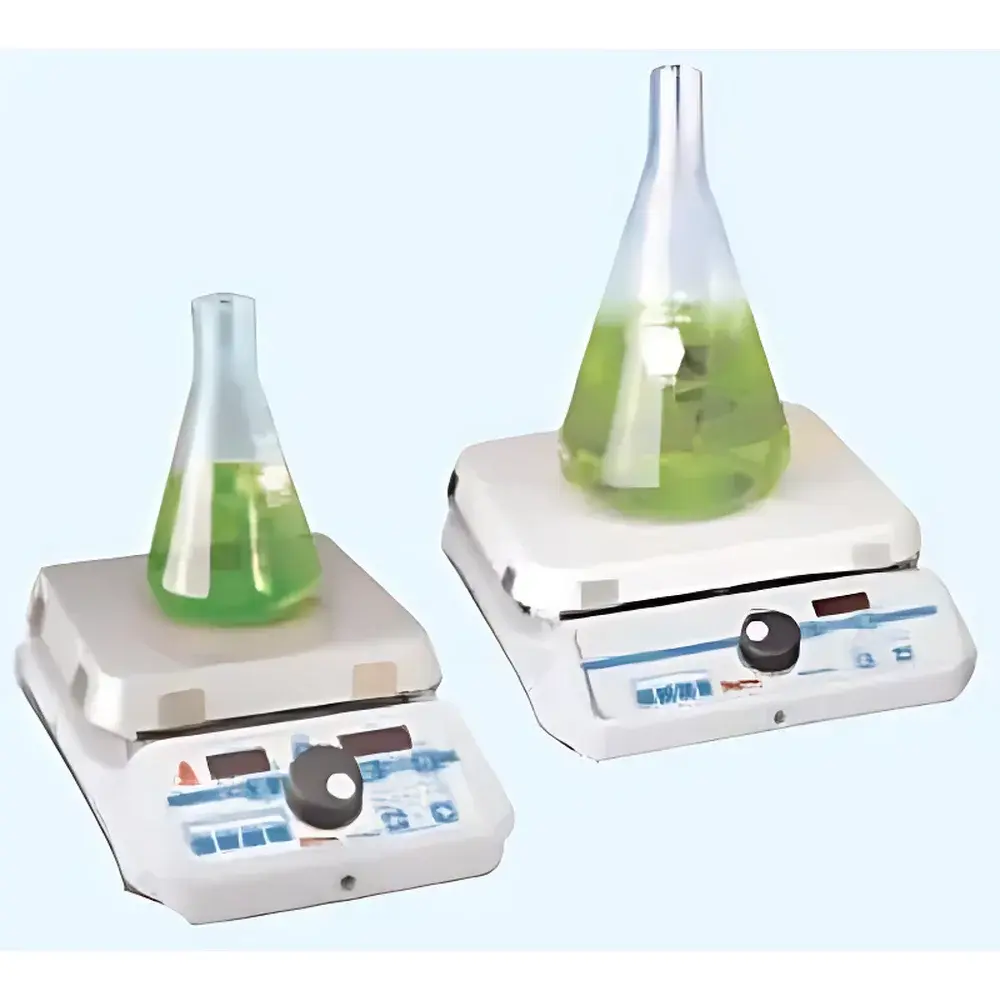
Thermo Scientific Super-Nuova Series Electric Heating Plate
| Origin | USA |
|---|---|
| Manufacturer Type | Authorized Distributor |
| Origin Category | Imported |
| Model | Super-Nuova Series |
| Pricing | Available Upon Request |
Overview
The Thermo Scientific Super-Nuova Series Electric Heating Plate is a precision-engineered laboratory heating platform designed for reproducible, stable thermal control in sample preparation, digestion, evaporation, and reaction support applications. Built on robust microprocessor-based temperature regulation architecture, the system delivers accurate surface heating across a wide operational range (5–370 °C) with ±1 °C thermal stability under controlled ambient conditions (0–27 °C, ≤80% RH). Unlike basic resistive hotplates, the Super-Nuova series integrates advanced thermal uniformity management via high-conductivity ceramic or anodized aluminum heating surfaces—ensuring minimal radial temperature gradients (<±3 °C at 200 °C over full plate area) critical for consistent digestion kinetics and solvent reflux control. Its modular design supports standalone heating, magnetic stirring, or simultaneous heating/stirring configurations—including a dedicated four-position variant enabling parallel processing of up to four independent samples under identical thermal profiles.
Key Features
- Microprocessor-controlled temperature regulation with real-time feedback loop and adjustable ramp rate
- Dual-display LCD interface showing simultaneous setpoint/actual temperature (resolution: 1 °C) and stir speed (resolution: 1 rpm)
- StirTrac™ intelligent stirring algorithm ensuring smooth torque delivery and stable magnetic coupling—even with viscous or dense suspensions
- HOT TOP™ safety system automatically activates visual/audible alerts when surface temperature exceeds 50 °C, preventing accidental contact burns
- Independent adjustable over-temperature protection with user-defined cutoff limit (up to 370 °C), compliant with IEC 61010-1 safety standards
- Four programmable memory presets for rapid recall of frequently used temperature/stir speed combinations
- RS232 serial interface supporting time-stamped data logging of temperature, stir speed, runtime, and alarm events for GLP/GMP traceability
- Single-knob dual-function control with mechanical lockout to prevent inadvertent parameter changes during operation
- Durable, chemically resistant ceramic or anodized aluminum top plate—resistant to corrosion from acids, bases, and organic solvents commonly used in EPA Method 3050B/3051A, ISO 11466, and ASTM D5511 digestions
Sample Compatibility & Compliance
The Super-Nuova series accommodates a broad range of vessel geometries and capacities—from 10 mL test tubes to 6 L round-bottom flasks—via configurable plate sizes (18.4 × 18.4 cm, 26 × 26 cm, and 4-position 26 × 26 cm layouts). Maximum load capacity ranges from 11.3 kg to 15.9 kg depending on configuration, supporting heavy-walled digestion vessels and multi-vessel racks. All models comply with UL/CSA 61010-1, CE marking requirements, and RoHS directives. The RS232 data export functionality enables integration into laboratory information management systems (LIMS) and satisfies audit-trail requirements under FDA 21 CFR Part 11 when paired with validated software protocols. Calibration is supported via external Pt100 probe input, facilitating traceable verification per ISO/IEC 17025 calibration guidelines.
Software & Data Management
While the Super-Nuova operates as a standalone instrument, its RS232 port allows connection to host PCs running custom or third-party data acquisition software (e.g., LabVIEW, MATLAB, or Thermo’s optional LogView Suite). Logged parameters include elapsed time, current temperature, setpoint, stir speed, and system status flags (e.g., HOT TOP activation, over-temp event, preset recall). Timestamped CSV exports support retrospective analysis of thermal profiles during method development or troubleshooting. Firmware supports firmware-upgradable logic for future protocol enhancements—ensuring long-term compatibility with evolving lab informatics infrastructure.
Applications
- Acid digestion of environmental soils and sediments (EPA 3050B, 3051A, 3052)
- Sample evaporation and concentration prior to ICP-MS or AAS analysis
- Controlled reflux reactions in synthetic chemistry and polymerization studies
- Pre-heating and temperature equilibration of reagents and standards in QC/QA workflows
- Parallel digestion of clinical tissue homogenates under standardized thermal protocols
- Supporting ASTM D86, D1298, and ISO 3675 density and distillation preparatory steps
FAQ
What temperature accuracy and stability can be expected during extended operation?
The system maintains ±1 °C setpoint accuracy with short-term stability of ±0.5 °C over 30 minutes at 200 °C, verified using NIST-traceable PT100 reference probes.
Is the unit compatible with corrosive reagents such as aqua regia or hydrofluoric acid?
Ceramic-top models (e.g., HP131720-33Q, SP131820-33Q) provide excellent resistance to HF and mixed acids; aluminum-top variants are recommended only for non-halogenated, low-pH applications.
Can the four-position model operate each station at different temperatures or speeds?
No—temperature and stirring parameters are synchronized across all four positions to ensure inter-sample comparability in regulatory-compliant workflows.
Does the RS232 interface support real-time remote control or only data logging?
The interface supports both bidirectional communication: remote parameter adjustment and real-time monitoring, subject to host software implementation.
What maintenance is required to sustain calibration integrity over time?
Annual verification using external calibrated thermometers and stir speed tachometers is recommended; no internal consumables require replacement under normal use conditions.



