
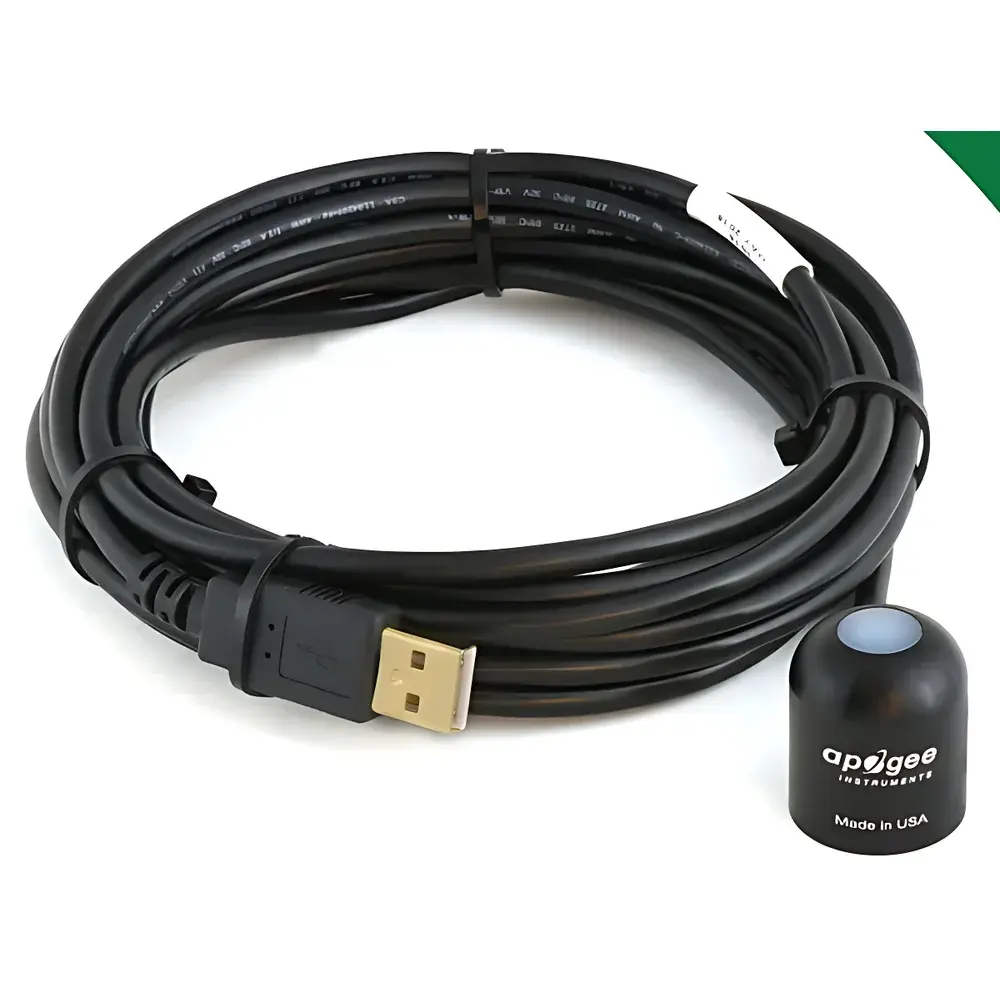
Apogee SQ-420 Portable Quantum Sensor for Photosynthetic Photon Flux Density (PPFD) Measurement
| Brand | Apogee |
|---|---|
| Origin | USA |
| Model | SQ-420 |
| Spectral Range | 410–655 nm |
| Calibration Uncertainty | ±5% |
| Repeatability | <1% |
| Long-Term Drift | <2% per year |
| Nonlinearity | <1% (up to 3000 µmol·m⁻²·s⁻¹) |
| Response Time | 1 s |
| Directional Error | ±5% (at 75° zenith angle) |
| Temperature Dependence | 0.06 ± 0.06 %/°C |
| Operating Environment | −40 to +70 °C, 0–100% RH |
| Submersible Depth | <30 m |
| Field of View | 180° |
| Resolution | 0.1 µmol·m⁻²·s⁻¹ |
| Internal Memory Capacity | 10,000 measurements |
| Sampling Interval | 1 s to 1440 min (user-configurable) |
| Power Supply | USB 5 VDC |
| Current Draw | 5.1 mA |
| Probe Dimensions | 60 mm (diameter) × 70 mm (height) |
| Cable Length | 4.6 m |
| Weight | 90 g |
Overview
The Apogee SQ-420 Portable Quantum Sensor is a precision-calibrated, self-contained instrument engineered for accurate and reliable measurement of Photosynthetic Photon Flux Density (PPFD) in the 400–700 nm photosynthetically active radiation (PAR) spectral band. Unlike conventional quantum sensors requiring external data loggers or analog signal conditioning, the SQ-420 integrates digital signal processing, on-board memory, and USB-powered operation into a single compact probe. Its optical design employs a cosine-corrected diffuser and spectrally matched silicon photodiode optimized for the PAR range—specifically calibrated across 410–655 nm to ensure high fidelity under both natural sunlight and artificial lighting sources (e.g., LED, fluorescent, and HID grow lamps). The sensor operates on the fundamental principle of photon counting: converting incident photons within the biologically relevant wavelength band into quantifiable electrical current, which is then linearized, temperature-compensated, and digitized at the source. This architecture eliminates analog transmission errors and enables direct, high-integrity data acquisition without signal degradation over cable length.
Key Features
- Integrated USB 2.0 interface for simultaneous power delivery and bidirectional data communication—no external power supply or data logger required.
- On-board non-volatile memory stores up to 10,000 timestamped PPFD measurements with user-defined sampling intervals from 1 second to 24 hours.
- Factory-calibrated individual calibration coefficient stored in firmware; selectable sun- or lamp-based calibration mode via Apogee’s free PC software.
- Cosine angular response optimized to ±5% error up to 75° zenith angle—critical for accurate hemispherical irradiance integration under variable sky conditions.
- Robust environmental rating: operational from −40 °C to +70 °C and 0–100% relative humidity; submersible to 30 meters for aquatic plant physiology studies.
- Low power consumption (5.1 mA @ 5 VDC) enables extended field deployment using USB power banks, wall adapters, or computer ports—ideal for remote greenhouses, growth chambers, and mobile research platforms.
Sample Compatibility & Compliance
The SQ-420 is validated for quantitative PPFD assessment across diverse sample environments: open-field canopies, multi-layer greenhouse installations, controlled-environment growth chambers, hydroponic and aquaponic systems, and submerged macrophyte habitats. Its 180° field of view and spectral responsivity conform to the CIE 1931 photopic luminosity function adaptation for photosynthesis (ISO 17166:1999/E:2020, Annex B), and its calibration traceability aligns with NIST-traceable standards. While not certified for regulatory submission per se, the sensor’s documented repeatability (<1%), long-term stability (<2%/yr), and temperature compensation support GLP-compliant experimental protocols. Data integrity is preserved through firmware-level timestamping and internal error-checking—essential for longitudinal agronomic trials or peer-reviewed ecological monitoring where auditability matters.
Software & Data Management
Apogee provides a freely downloadable Windows-based application that supports real-time data visualization, graphical trend analysis, CSV export, and firmware configuration—including calibration mode selection, sampling interval adjustment, and memory readout. All logged data retain embedded metadata: UTC timestamps, sensor ID, and firmware version. Though the SQ-420 does not implement FDA 21 CFR Part 11 electronic signature controls, its deterministic sampling logic, immutable internal memory structure, and absence of post-acquisition data manipulation pathways make it suitable for preliminary data capture in GMP-aligned cultivation workflows. For integration into larger SCADA or LIMS ecosystems, raw USB serial output (ASCII format) is accessible via third-party scripting (Python, LabVIEW, MATLAB) using standard CDC ACM drivers.
Applications
- Quantifying light-use efficiency (LUE) in crop phenotyping trials across diurnal and seasonal cycles.
- Validating uniformity and spectral output of horticultural LED arrays prior to commercial deployment.
- Monitoring underwater PAR attenuation profiles in freshwater and marine mesocosms.
- Calibrating and cross-verifying pyranometers and spectroradiometers in field intercomparison studies.
- Supporting ISO 21732-compliant lighting assessments for vertical farming facility certification.
- Enabling student-led inquiry in plant physiology labs with plug-and-play accessibility and low technical barrier to entry.
FAQ
Can the SQ-420 be used underwater? How deep?
Yes—the sensor housing is rated for continuous submersion to 30 meters. Ensure the USB connector remains above water or use a waterproof USB extension housing for deeper deployments.
What is the difference between sun and lamp calibration modes?
Sun calibration uses a reference spectrum approximating global horizontal irradiance; lamp mode applies a correction factor optimized for narrowband or phosphor-converted LED sources—select based on dominant light source in your measurement environment.
Does the sensor require periodic recalibration?
Apogee recommends annual verification against a reference standard; long-term drift is specified at <2% per year under normal operating conditions.
Is the USB cable shielded for electromagnetic interference in high-noise environments?
The standard 4.6 m cable includes twisted-pair construction and foil shielding, minimizing noise coupling in proximity to ballasts, inverters, or RF transmitters.
How is directional error minimized during installation?
Mount the sensor horizontally with the cable oriented toward true north (Northern Hemisphere) or true south (Southern Hemisphere) to reduce azimuthal asymmetry in cosine response.
Related Products







