
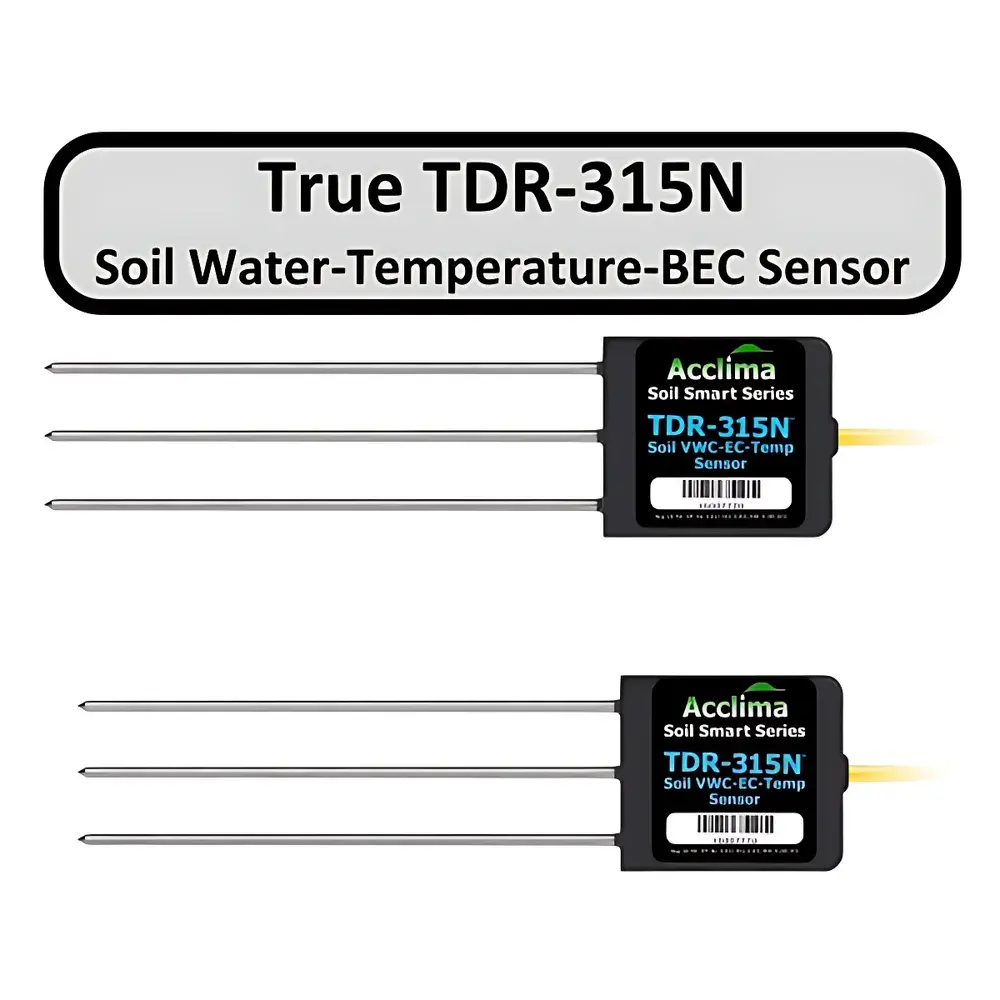
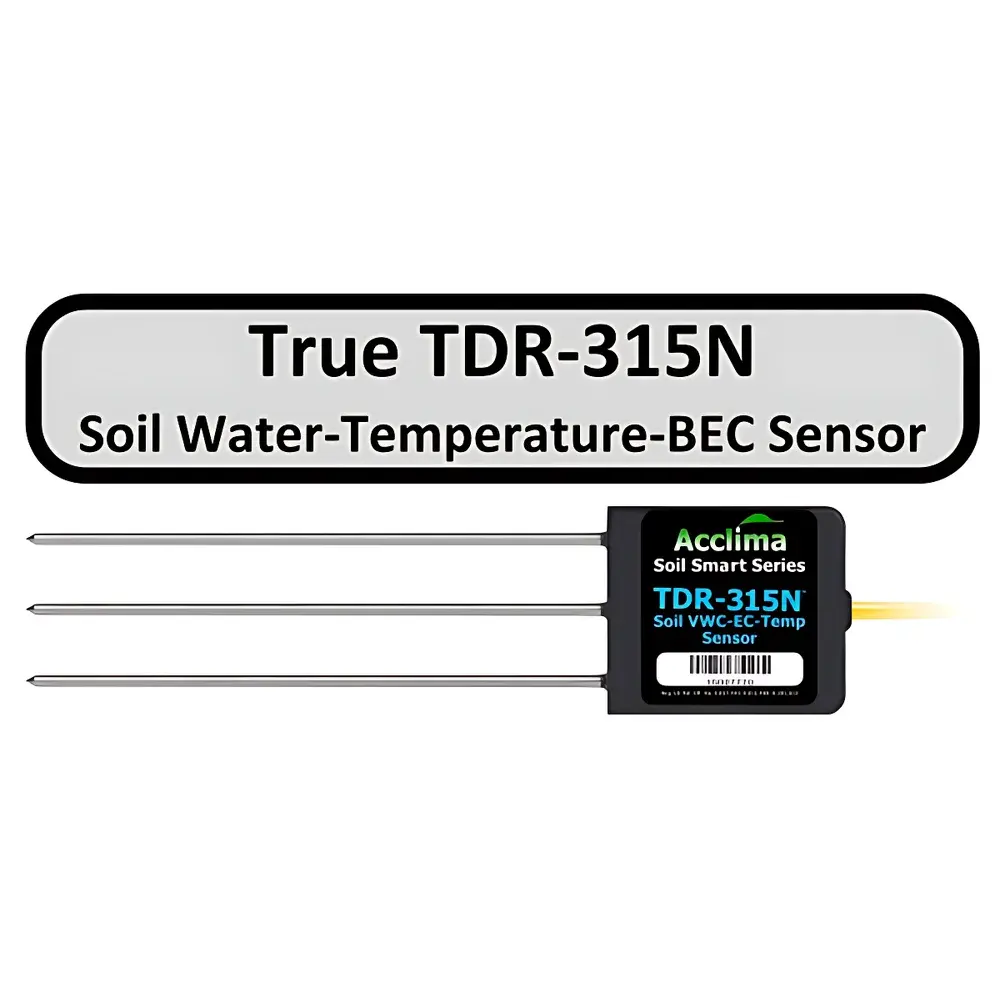
Acclima TDR315N Integrated Soil Moisture, Temperature & Electrical Conductivity Sensor
| Brand | Acclima, Inc. |
|---|---|
| Origin | USA |
| Model | TDR315N |
| Instrument Type | Soil Moisture / Water Potential Analyzer |
| Volumetric Water Content Range | 0–100% VWC |
| Resolution | 0.1% VWC |
| Accuracy | ±2% FS |
| Dielectric Constant Range | 1–100 |
| Resolution | 0.1 |
| Accuracy | ±2% |
| Bulk EC Range | 0–6000 µS/cm |
| Pore Water EC (Hilhorst Model) | 0–55,000 µS/cm |
| EC Resolution | 1 µS/cm |
| EC Accuracy | ±25 µS/cm (0–1000 µS/cm), ±2.5% (1000–2000 µS/cm), ±5% (2000–5000 µS/cm) |
| Temperature Range | −40 to +60 °C |
| Temp Accuracy | ±0.25 °C (5–35 °C), ±0.5 °C (−15 to +50 °C) |
| Temp Resolution | 0.1 °C |
| Rise Time (20–80%) | 300 ps |
| Waveform Digitization Resolution | 5 ps |
| Input Voltage | 6.5–15 V DC |
| Quiescent Current | 10 µA |
| Active Current | 118 mA @ 12 V DC |
| Output Interface | 3-wire SDI-12 v1.4 compliant |
| Probe Dimensions | 15 mm L × 3.5 mm Ø |
| Sensor Body | 210 mm × 53 mm × 20 mm |
| Weight (bare) | 105 g |
| Cable Length | 5 m standard (10 m optional) |
| Enclosure | Waterproof epoxy-filled housing |
Overview
The Acclima TDR315N is a fully integrated, high-fidelity time-domain reflectometry (TDR) sensor engineered for simultaneous, in-situ measurement of volumetric water content (VWC), soil temperature, and bulk electrical conductivity (EC). As the direct successor to the TDR315L and an evolution beyond the TDR315H, the TDR315N incorporates enhanced high-voltage waveform generation—enabling robust signal propagation and accurate dielectric analysis even in high-salinity or clay-rich soils where conventional low-energy TDR systems exhibit signal attenuation or distortion. Its core architecture embeds ultra-fast analog circuitry with a 5-picosecond resolution timebase, coupled with proprietary firmware that performs real-time, full-waveform digitization and advanced reflection analysis—not merely peak detection or travel-time averaging. This enables true time-domain characterization of electromagnetic wave propagation through heterogeneous soil matrices, supporting rigorous interpretation of both water content and pore-water chemistry via the Hilhorst model.
Key Features
- High-voltage TDR excitation (2.3 V amplitude) optimized for reliable operation in conductive soils up to 6000 µS/cm bulk EC
- 5 ps waveform digitization resolution ensures sub-nanosecond timing fidelity for precise dielectric constant (Ka) derivation
- Integrated triple-parameter sensing: VWC (0–100% VWC), temperature (−40 to +60 °C), and bulk EC (0–6000 µS/cm)
- SDI-12 v1.4-compliant 3-wire interface compatible with all industry-standard dataloggers—including Campbell Scientific, Onset HOBO, Decagon (now METER), and Delta-T systems
- Optimized mechanical design: 34 mm flat-bottom spiral auger compatibility for vertical installation in pre-bored holes; keyed alignment with 1″–40 PVC conduit used as depth-adjustable handling sleeve
- Epoxy-filled, IP68-rated housing with stainless-steel probe rods (15 mm × 3.5 mm Ø) for long-term burial stability and corrosion resistance
- Ultra-low power profile: 10 µA quiescent draw supports multi-year deployments on solar-recharged or battery-limited stations
Sample Compatibility & Compliance
The TDR315N is validated for use across mineral soils, organic substrates, and engineered growing media—including sandy loams, silty clays, peat-based potting mixes, and hydroponic aggregates. Its high-voltage TDR architecture maintains measurement integrity under field conditions where bulk EC exceeds 3000 µS/cm—a threshold at which many legacy sensors suffer from reflected-signal degradation or false saturation artifacts. All calibration references trace to NIST-traceable standards for dielectric permittivity and thermal response. The sensor complies with ASTM D5778 (Standard Test Method for Electronic Friction Cone and Piezocone Penetration Testing) for waveform-based geotechnical interpretation, and its SDI-12 implementation conforms to ANSI/TIA-568-C.2 and ISO/IEC 11801 for structured cabling interoperability. While not intrinsically certified for hazardous locations, its epoxy encapsulation meets UL 94 V-0 flammability requirements for embedded environmental instrumentation.
Software & Data Management
Data acquisition occurs exclusively via SDI-12 command protocol—requiring no proprietary drivers or vendor-specific software. Each measurement cycle returns ASCII-encoded values for Ka, VWC, temperature, and bulk EC, enabling seamless ingestion into custom Python, R, or MATLAB pipelines. When deployed with GLP/GMP-compliant dataloggers (e.g., Campbell CR6 with audit-trail firmware), timestamped readings support 21 CFR Part 11–aligned data integrity workflows—including electronic signatures, immutable storage, and change history logging. Acclima provides open-source calibration coefficients and Hilhorst model parameters for pore-water EC derivation, facilitating transparency in post-processing. No cloud dependency or subscription service is required; raw waveform metadata (e.g., rise time, reflection amplitude) remains accessible via extended SDI-12 diagnostics commands for advanced users performing spectral or dispersion analysis.
Applications
- Irrigation scheduling and precision agriculture decision support systems requiring concurrent VWC–EC–temperature inputs
- Soil salinity monitoring in arid-zone agriculture, coastal reclamation sites, and reclaimed mine tailings
- Long-term ecological research on soil moisture–temperature–conductivity coupling in climate change observatories
- Calibration and validation of satellite-based soil moisture products (e.g., SMAP, Sentinel-1) at in situ reference sites
- Hydrological modeling input for vadose zone flux estimation using Richards’ equation solvers
- Green infrastructure performance assessment—e.g., bioswale infiltration rates, rain garden retention dynamics, and permeable pavement drainage efficiency
FAQ
What distinguishes the TDR315N from earlier Acclima TDR models?
The TDR315N introduces higher-voltage waveform generation (2.3 V), improved noise immunity in high-conductivity soils, and tighter timing resolution (5 ps) compared to the TDR315L and TDR315H—enabling more stable Ka extraction and reduced sensitivity to electrode polarization effects.
Can the TDR315N be installed horizontally or only vertically?
It is mechanically optimized for vertical insertion using a 34 mm auger and 1″ PVC sleeve; horizontal deployment is not recommended due to asymmetric probe geometry and potential air-gap artifacts at the rod–soil interface.
Is pore-water EC calculated onboard or post-processed?
Bulk EC is measured directly; pore-water EC is derived in post-processing using the Hilhorst mixing model and user-supplied soil-specific textural parameters—no onboard computation is performed.
Does the sensor require factory recalibration after field deployment?
No routine recalibration is specified; Acclima’s epoxy-sealed construction and drift-stabilized timing circuitry maintain metrological stability over 5+ years under typical field conditions, per accelerated aging tests per IEC 60068-2-30.
How does temperature compensation affect VWC accuracy?
Temperature-dependent dielectric dispersion is corrected in firmware using dual-point Ka–T lookup tables; residual error after correction is included in the ±2% FS VWC accuracy specification across the full operating range.
Related Products







