
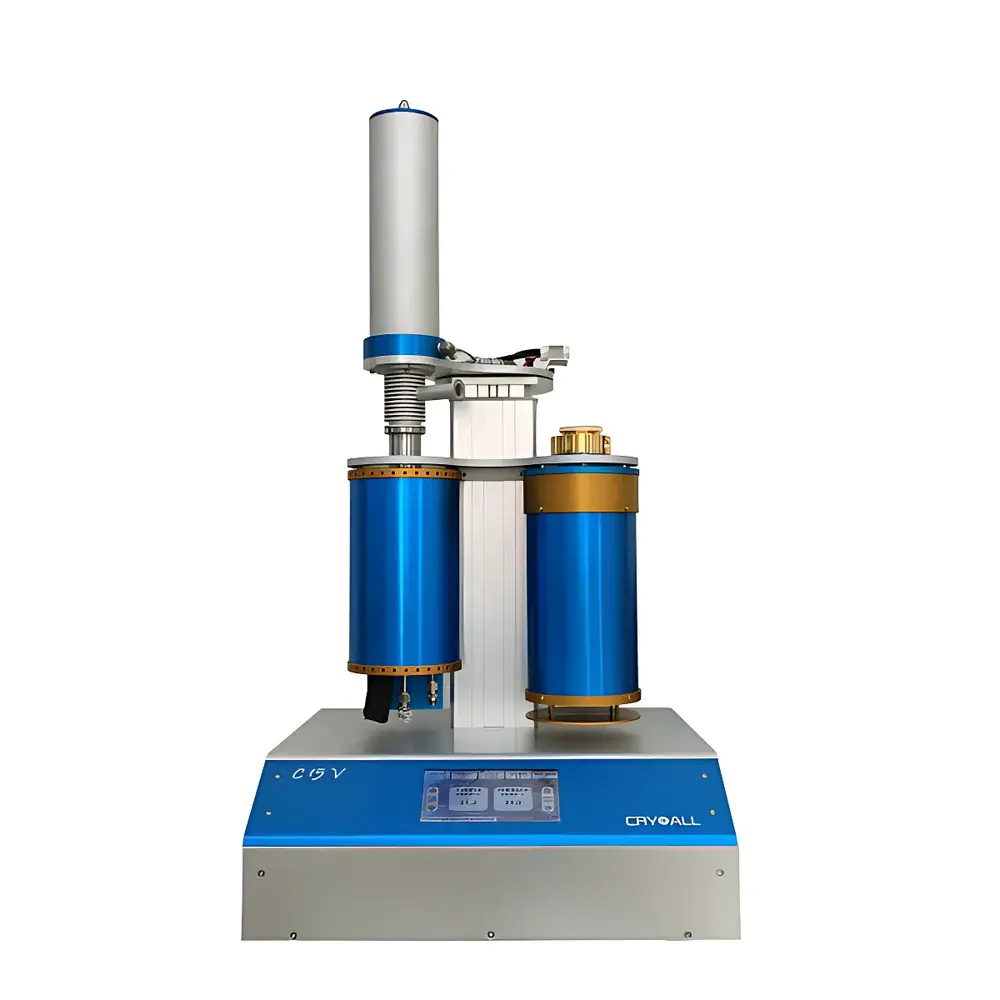
CRYOALL C15V-Pro Cryogenic Dilatometer with Liquid Helium Cooling
| Brand | CRYOALL |
|---|---|
| Origin | Beijing, China |
| Model | C15V-Pro |
| Temperature Range | −263 °C to RT (10 K to ~25 °C) |
| Heating Rate | 0–50 K/min |
| Temperature Accuracy | ±0.1 K |
| Sample Length | ≤50 mm |
| Measurement Range | 0–5000 µm |
| Resolution | 0.125 nm |
| Atmosphere Options | Vacuum (1×10⁻⁵ mbar), O₂, N₂, Ar, He, H₂, forming gas |
| Contact Force | 0.01–2.5 N (motorized, programmable) |
Overview
The CRYOALL C15V-Pro is a high-precision vertical dilatometer engineered for cryogenic thermal expansion characterization down to 10 K (−263 °C), enabled by an integrated pulse-tube cryocooler and liquid helium-compatible thermal architecture. Unlike conventional dilatometers limited to liquid nitrogen temperatures, the C15V-Pro employs a closed-cycle refrigeration system that eliminates dependency on bulk liquid helium refills while maintaining stable, vibration-isolated measurement conditions essential for nanoscale displacement resolution. It operates on the principle of contact-based linear displacement transduction—using a high-stability capacitive or optical encoder system to detect minute dimensional changes (ΔL/L₀) in solid, powder, paste, or sintered samples under precisely controlled thermal programs. The instrument is designed for rigorous R&D and quality control environments where traceable, low-temperature coefficient-of-thermal-expansion (CTE) data are critical—particularly in aerospace-grade superalloys, low-α glass-ceramics, high-temperature ceramics, battery electrode materials, and advanced polymer composites.
Key Features
- True cryogenic capability: Stable operation from 10 K to ambient temperature, with <0.1 K temperature accuracy and <0.01 K short-term stability over 1-hour dwell periods.
- Vertical dual-furnace configuration: Standard lower-furnace design optimized for powders and pastes; optional interchangeable upper/lower furnace modules enable extended range configurations (e.g., −263 °C to 1750 °C).
- Nanometer-scale metrology: 0.125 nm digital resolution with <0.002% absolute ΔL/L₀ accuracy and <0.001% repeatability across repeated thermal cycles.
- Programmable contact force control: Motor-driven loading mechanism delivers precise, repeatable axial forces from 0.01 N to 2.5 N—critical for minimizing creep artifacts in soft or porous samples.
- Multi-atmosphere compatibility: Integrated vacuum system (1×10⁻⁵ mbar base pressure) with dual-channel manual gas manifold; optional mass flow controllers (Bronkhorst EL-FLOW Select) support dynamic gas switching during ramping.
- Zero-torque, frictionless measurement train: Linear guide system with ceramic bearings and non-contact position sensing ensures minimal mechanical hysteresis and long-term calibration stability.
Sample Compatibility & Compliance
The C15V-Pro accommodates rods, discs, pellets, granules, and pastes up to 50 mm in length and 20 mm in diameter. Custom sample holders—including fused quartz (Heraeus), high-purity alumina (Morgan Advanced Materials), and high-density graphite—are supplied to match thermal expansion matching requirements and chemical inertness. The system complies with ASTM E228 (linear thermal expansion of solids), ASTM E831 (linear thermal expansion of plastics), ASTM D3386 (coefficient of linear thermal expansion of rigid cellular plastics), and DIN 51045 (dilatometric determination of thermal expansion). All temperature and displacement calibrations are traceable to NIST standards via certified reference materials (e.g., SRM 735a Invar, SRM 736a fused quartz). Data acquisition and reporting support GLP/GMP audit trails per FDA 21 CFR Part 11 when configured with secure user authentication and electronic signature modules.
Software & Data Management
The C15V-Pro is operated via CRYOALL’s DilSoft™ workstation software (Windows 10/11 compatible), which provides full IEC 61508-compliant control logic, real-time PID optimization, and synchronized multi-parameter logging (T, ΔL, dL/dt, d²L/dt², atmosphere composition, load force). Key analytical modules include: RCS (Ramp-Controlled Sintering) for kinetic densification analysis; C-DTA (Dilatometric Differential Thermal Analysis) for phase transition identification; and density evolution modeling based on volume change integration. Raw data export is supported in ASCII, CSV, and HDF5 formats; batch processing scripts (Python API) enable automated CTE calculation per ISO 11359-2. Audit logs record all parameter modifications, calibration events, and user actions with timestamps and operator IDs.
Applications
- Low-temperature CTE mapping of NbTi and MgB₂ superconductors for magnet coil design
- Sintering shrinkage kinetics of SiC and ZrO₂ ceramics under controlled pO₂
- Thermal mismatch evaluation in multilayer ceramic capacitors (MLCCs) and LTCC substrates
- Phase-transition-induced expansion anomalies in shape-memory alloys (NiTi, CuAlBe)
- Decomposition onset detection in energetic materials via abrupt dilation signatures
- Thermal aging studies of polymer electrolyte membranes (PEMs) in fuel cell stacks
FAQ
What cryogenic cooling method does the C15V-Pro use?
It integrates a Gifford-McMahon or pulse-tube cryocooler (no liquid helium dewar required), enabling continuous 10 K operation with <5 W heat lift at 20 K.
Can the system perform simultaneous TMA and DTA-like analysis?
Yes—the built-in C-DTA algorithm derives apparent heat flow signals from second derivatives of dilation curves, supporting qualitative transition identification without a separate DTA sensor.
Is vacuum integrity maintained during rapid heating above 500 °C?
Yes—the all-metal sealed furnace chamber and differential pumping architecture maintain ≤2×10⁻⁵ mbar throughout the full −263 °C to 1000 °C range.
How is thermal drift compensated during long-duration isotherms?
An active reference arm with matched thermal mass and independent temperature feedback loop enables real-time baseline correction with sub-nanometer residual drift over 24-hour holds.
Does the software support automated compliance with ASTM E228 Annex A1?
Yes—DilSoft™ includes preconfigured test templates, uncertainty propagation engines, and report generation aligned with ASTM E228 Section A1 (CTE calculation methodology and error estimation).



