
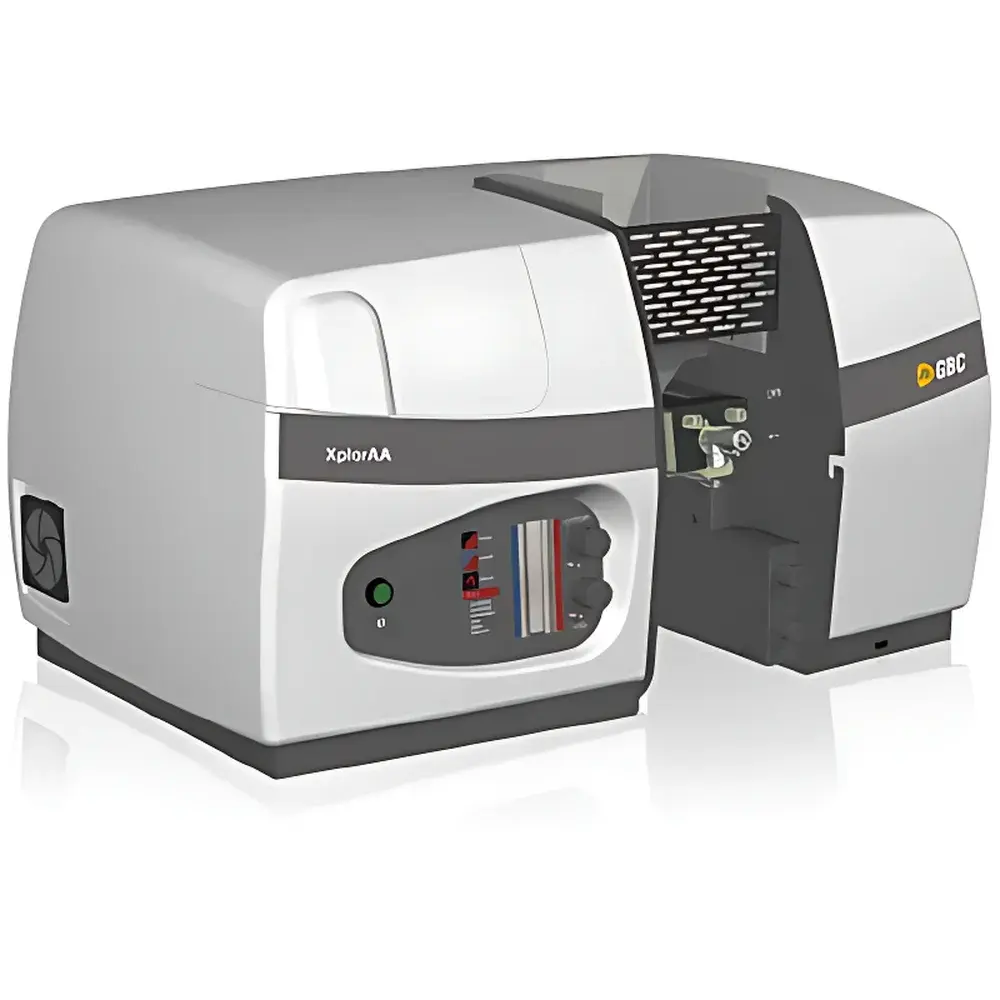
GBC XplorAA Compact Flame-Graphite Furnace Atomic Absorption Spectrometer
| Brand | GBC |
|---|---|
| Origin | Australia |
| Model | XplorAA |
| Instrument Type | Flame and Graphite Furnace AAS |
| Monochromator | Plane Grating |
| Optical System | Double-Beam |
| Detector | Photomultiplier Tube (PMT) |
| Background Correction | Deuterium Lamp |
| Resolution | <0.2 nm |
| Sensitivity | >0.8 A for 5 mg/L Cu solution |
| Precision (RSD) | <0.45% |
| Detection Limit | Sub-ppb for most elements with graphite furnace |
| Software Control | Handheld PC-based interface |
| Lamp Positions | 2 fixed hollow cathode lamp slots |
| Upgrade Path | Field-upgradable to graphite furnace and hydride generation systems |
Overview
The GBC XplorAA Compact Flame-Graphite Furnace Atomic Absorption Spectrometer is a purpose-engineered analytical platform designed for high-reproducibility elemental quantification in routine quality control, environmental monitoring, and industrial materials testing laboratories. Based on the fundamental principle of atomic absorption spectroscopy—where ground-state free atoms in a flame or graphite furnace absorb characteristic radiation emitted by element-specific hollow cathode lamps—the XplorAA delivers robust, trace-level metal analysis with metrological integrity. Its dual-mode architecture supports both flame atomization (for higher concentration samples, typically µg/mL to mg/mL range) and electrothermal graphite furnace atomization (for sub-ppt detection capabilities), enabling seamless method transition without hardware replacement. The instrument employs a double-beam optical design to compensate for source drift and lamp intensity fluctuations, while its plane grating monochromator ensures spectral purity and long-term wavelength stability. All core optical components—including the PMT detector and deuterium background correction system—are factory-aligned and thermally stabilized to maintain calibration fidelity across extended operational cycles.
Key Features
- Compact benchtop footprint engineered for space-constrained QC labs and production floor environments
- Dual-atomization capability: integrated flame system with optional field-installable graphite furnace module
- Two-position fixed hollow cathode lamp turret optimized for rapid switching between primary and secondary analytes (e.g., Fe/Cu, Zn/Pb)
- Deuterium arc background correction providing accurate compensation for structured molecular absorption up to 2.5 A
- Double-beam optical path with real-time reference beam monitoring to minimize baseline drift and enhance signal-to-noise ratio
- Handheld PC-based control interface with intuitive graphical workflow navigation and method template libraries
- Modular architecture supporting future expansion with hydride generation accessories (As, Se, Sb, Bi, Te) and flow injection systems
- Rugged mechanical construction using corrosion-resistant alloys and sealed optical compartments for stable operation in non-climate-controlled settings
Sample Compatibility & Compliance
The XplorAA accommodates liquid samples across diverse matrices—including aqueous standards, digested environmental soils, pharmaceutical excipients, food extracts, and metallurgical leachates—provided they meet standard acid digestion protocols (e.g., EPA Method 3050B, ISO 11047). Flame mode supports direct aspiration of solutions with total dissolved solids (TDS) ≤0.2%, while graphite furnace analysis requires matrix modifiers and platform-assisted pyrolysis for complex organics. The system complies with key international performance verification standards: ASTM D3694 (trace metals in water), ISO 8288 (nickel and cobalt in ores), and USP (heavy metals in pharmaceuticals). Data acquisition and storage support audit-trail functionality aligned with GLP and FDA 21 CFR Part 11 requirements when paired with validated software configurations.
Software & Data Management
Instrument control and data processing are executed via GBC’s proprietary AAS software suite, deployed on a Windows-based handheld PC. The interface provides full parameter definition (lamp current, slit width, integration time, temperature ramp profiles), real-time spectral visualization, and automated calibration curve generation using linear or quadratic regression. All measurement events—including lamp alignment status, gas flow validation, and background correction residuals—are timestamped and logged with user ID attribution. Raw absorbance data, peak area integrals, and QC check results are exportable in CSV and XML formats compatible with LIMS integration. Software updates are delivered through secure firmware update packages with version-controlled release notes and backward-compatible method file handling.
Applications
- Quality assurance of raw materials and finished products in metal plating, battery manufacturing, and catalyst production
- Regulatory compliance testing for Pb, Cd, As, and Hg in consumer electronics (RoHS), toys (EN71-3), and packaging materials (FDA CPG 7107.05)
- Environmental monitoring of trace metals in wastewater effluents, drinking water sources, and soil porewater per EPA Methods 7000B and 7130
- Geochemical screening of exploration samples using rapid flame-AAS screening followed by furnace-AAS confirmation
- Pharmaceutical excipient certification per ICH Q2(R2) guidelines for elemental impurities (Category 1 and 2 elements)
FAQ
Can the XplorAA operate exclusively in flame mode without graphite furnace installation?
Yes—the base configuration includes a fully functional flame atomization system; the graphite furnace is an optional upgrade kit installed post-purchase.
Is deuterium background correction sufficient for high-salt matrices like seawater digests?
For moderate salt content (<1% NaCl), D2 correction performs reliably; for extreme matrices, Zeeman background correction (available on higher-tier GBC models) is recommended.
What maintenance intervals are specified for the PMT detector and burner head?
PMT gain calibration is recommended every 6 months; stainless steel burner heads require cleaning after every 50–100 analyses using 10% HNO3 immersion and ultrasonic agitation.
Does the handheld PC interface support remote diagnostics or networked instrument sharing?
Local USB tethering is standard; Ethernet connectivity and remote desktop access require optional GBC Network Interface Module (NIM-1) and IT-approved firewall configuration.
Related Products




