
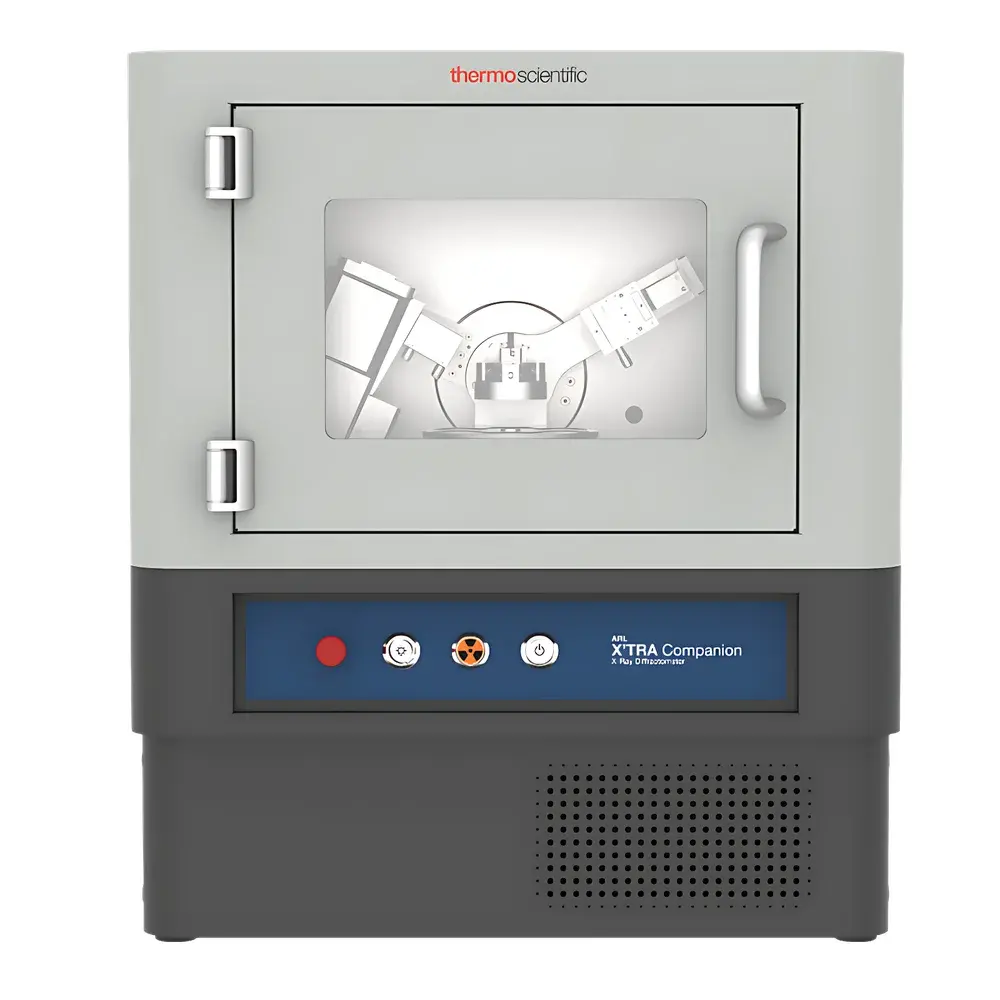
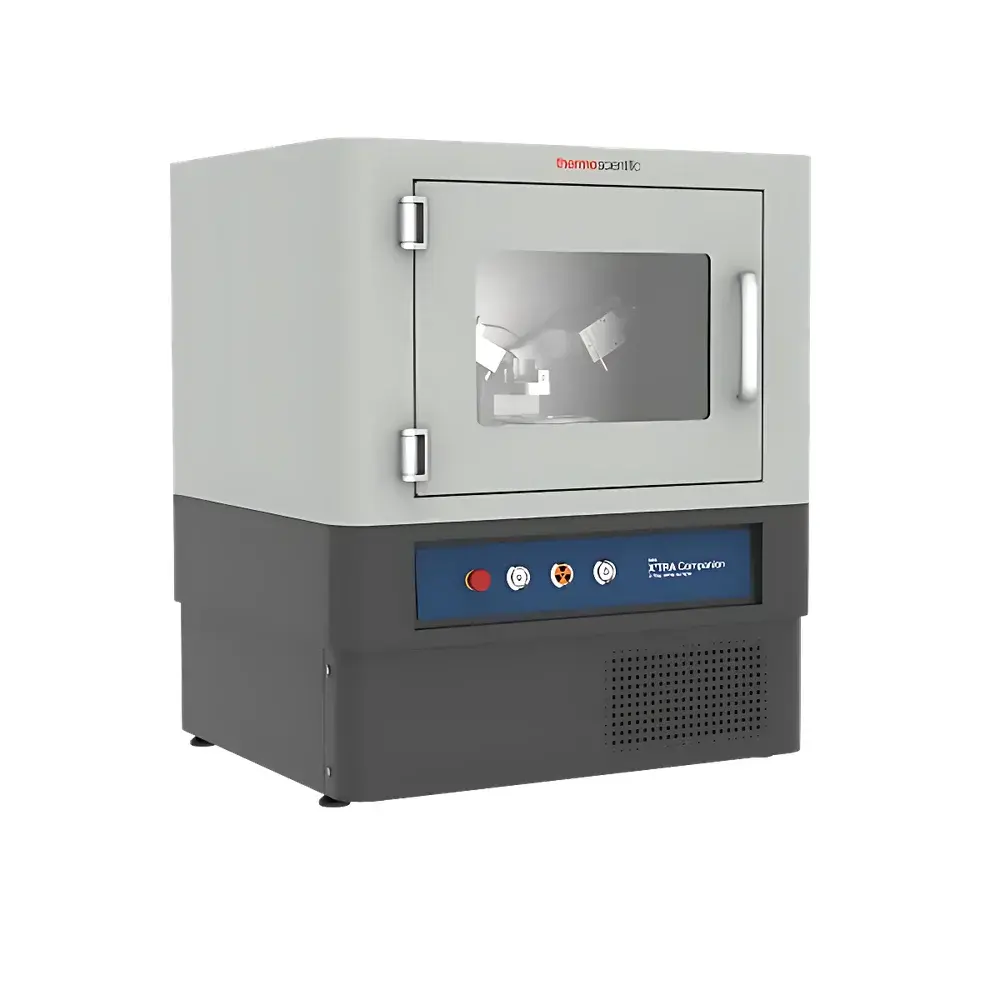
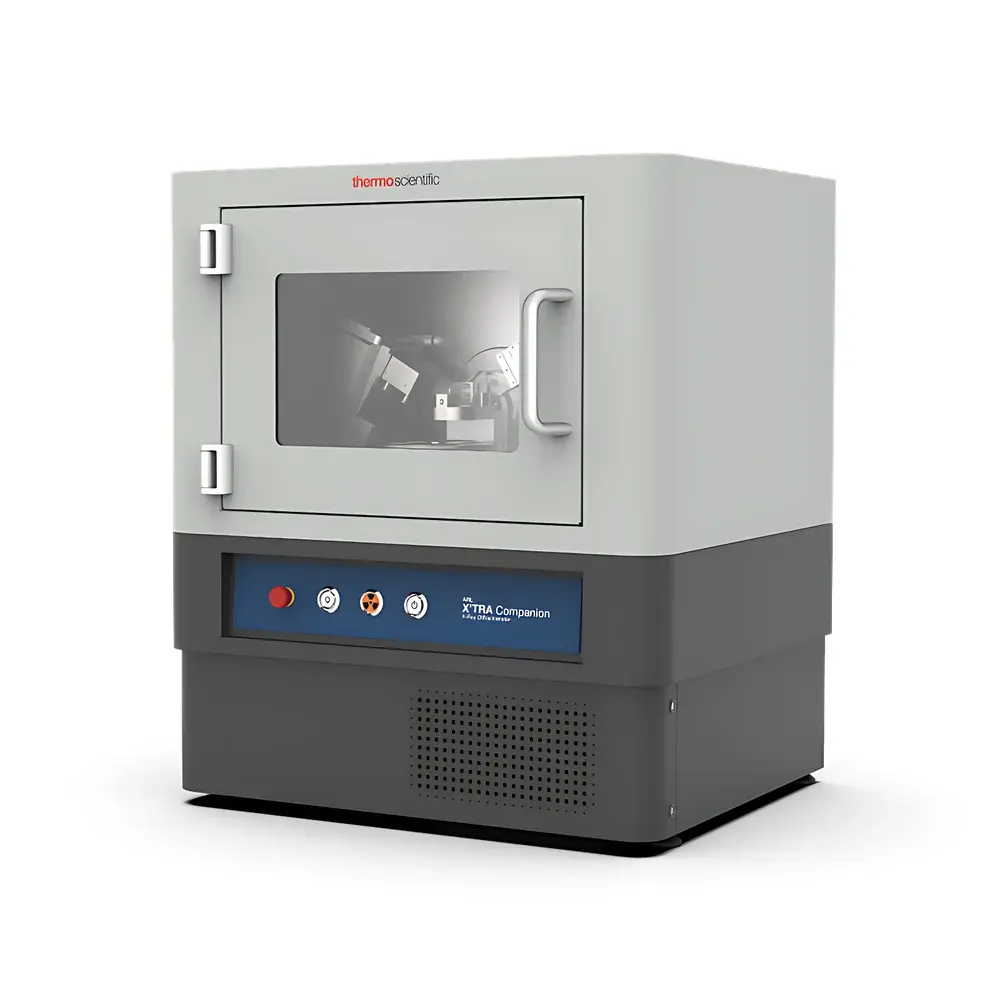
Thermo Fisher ARL X’TRA Companion Benchtop X-ray Diffractometer
| Brand | Thermo Fisher |
|---|---|
| Origin | Switzerland |
| Manufacturer | Thermo Fisher Scientific |
| Instrument Type | Powder X-ray Diffractometer |
| Geometry | Bragg–Brentano θ/θ |
| Angular Accuracy | ±0.002° |
| Detector | Solid-state 2D pixel detector (55 × 55 µm pixel pitch) |
| Sample Handling | Manual 1-position holder or optional 6-position autosampler |
| X-ray Source | Cu or Co sealed-tube anode |
| Cooling | Optional water-cooling system |
| Data Output | Automated LIMS integration |
| Compliance | IEC 61000-4, IEC 62471, EN 61000-6-3, FDA 21 CFR Part 11 ready (with optional audit trail module) |
Overview
The Thermo Fisher ARL X’TRA Companion is a compact, benchtop powder X-ray diffractometer engineered for high-reproducibility phase identification and quantitative analysis in industrial quality control (QC) and routine research laboratories. Based on Bragg–Brentano θ/θ scanning geometry, it employs monochromatic Cu Kα or Co Kα radiation generated by a sealed-tube X-ray source, coupled with precision goniometry featuring dual stepper motors and dual optical encoders. Its angular accuracy of ±0.002° ensures robust peak position fidelity—critical for lattice parameter refinement, microstrain evaluation, and crystallite size determination via Scherrer or Williamson–Hall analysis. The instrument integrates a next-generation solid-state 2D pixel detector (55 × 55 µm pixel pitch), enabling rapid acquisition of high signal-to-noise diffraction patterns without the need for slits or scanning delays. Designed for operational simplicity and analytical rigor, the ARL X’TRA Companion delivers laboratory-grade XRD performance without requiring dedicated shielding rooms or high-power infrastructure.
Key Features
- Benchtop footprint with full Bragg–Brentano θ/θ optics and variable mechanical slits plus Soller collimators for optimized beam divergence control
- Dual optical encoder feedback on both incident and diffracted beam arms ensures traceable angular calibration and long-term stability
- High-sensitivity 2D pixel detector enables simultaneous collection across a wide 2θ range—reducing measurement time to under 3 minutes per sample for standard QC protocols
- One-click Rietveld quantitative analysis workflow compliant with ISO 17873 and ASTM E1421 standards for phase quantification and structural refinement
- Modular configuration options: selectable Cu or Co X-ray tube; optional water-cooling for extended duty cycles; 1-position manual stage or 6-position automated sample changer
- FDA 21 CFR Part 11–ready software architecture with electronic signatures, audit trails, and role-based access control—fully aligned with GLP/GMP environments
Sample Compatibility & Compliance
The ARL X’TRA Companion accepts standard 25 mm or 32 mm diameter powder holders (glass, silicon, or zero-background single-crystal Si), pressed pellets, and thin-film samples mounted on low-diffraction substrates. It supports both reflection and transmission geometries depending on sample form and application requirements. All hardware and firmware comply with international radiation safety directives including IEC 61000-4 (EMC), IEC 62471 (photobiological safety), and EN 61000-6-3 (emission limits). Radiation shielding meets IEC 61010-1 Class I requirements, allowing safe operation in shared laboratory spaces without additional vaulting. System validation documentation—including IQ/OQ/PQ templates—is provided to support regulatory submissions in pharmaceutical (USP , Ph. Eur. 2.9.31), materials, and mining sectors.
Software & Data Management
Operation is managed through Thermo Scientific™ ARL™ EQUINOX software, a Windows-based platform supporting method-driven workflows, real-time pattern visualization, and automated report generation. Quantitative analysis modules include Rietveld refinement (using TOPAS engine), whole-pattern fitting (WPF), and amorphous content estimation via internal standard or reference intensity ratio (RIR) methods. Data export formats include CIF, XYE, CSV, and XML—ensuring compatibility with third-party crystallographic databases (ICDD PDF-4+, COD) and enterprise systems. LIMS integration is achieved via standardized ODBC or HL7 interfaces, enabling direct result transfer to laboratory information management systems with metadata tagging (sample ID, operator, timestamp, instrument ID, calibration status). Audit trail logging records all user actions, parameter changes, and report exports for full traceability.
Applications
The ARL X’TRA Companion serves as a primary analytical tool for phase identification and quantification across diverse industrial verticals. In cement and mining, it performs clinker phase analysis (alite, belite, free lime), polymorph screening in carbonates and sulfates, and crystallinity assessment of slag and fly ash. In pharmaceutical development, it supports polymorph surveillance, hydrate/anhydrate differentiation, and stability-indicating assays per ICH Q5A and Q6A guidelines. Materials scientists apply it to characterize battery cathode materials (NMC, LFP), catalyst crystallinity, ceramic sintering behavior, and polymer crystallinity indices. Academic users leverage its accessibility for teaching crystallography fundamentals, teaching diffraction theory, and supporting undergraduate and graduate thesis work in solid-state chemistry and geosciences.
FAQ
Is the ARL X’TRA Companion suitable for GMP-regulated environments?
Yes—when configured with audit trail, electronic signature, and secure user authentication modules, it meets FDA 21 CFR Part 11 and EU Annex 11 requirements for regulated data integrity.
Can it perform in situ or time-resolved measurements?
While not designed for high-temperature or environmental cells, optional stages support ambient-temperature kinetic studies using sequential scanning and automated batch processing.
What maintenance is required for the X-ray tube?
Sealed-tube sources require no filament replacement or vacuum service; typical lifetime exceeds 10,000 operating hours with periodic warm-up cycles and voltage stabilization checks.
Does it support external database linking for phase matching?
Yes—the software includes native connectivity to ICDD PDF-4+ and allows custom database imports in CIF format for proprietary or niche material libraries.
How is angular calibration verified?
Calibration is performed using NIST-traceable SRM 660c (LaB₆) and validated against ISO 17873 procedures; results are stored in instrument metadata for audit readiness.





