
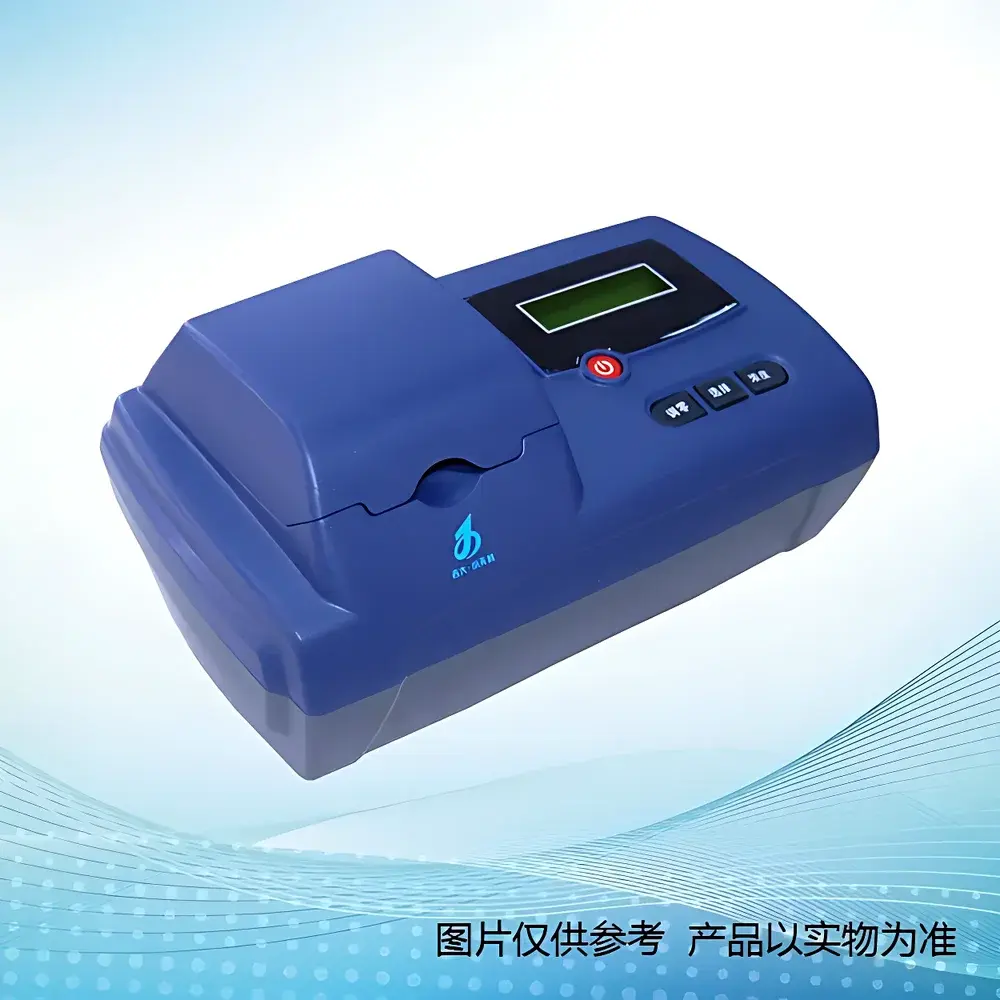
Jiada Xiaotian’e GDYS-104SM Effective Chlorine Analyzer
| Brand | Jiada Xiaotian'e |
|---|---|
| Origin | Jilin, China |
| Manufacturer Type | Direct Manufacturer |
| Country of Origin | China |
| Model | GDYS-104SM |
| Light Source | High-brightness LED |
| Wavelength | 510 nm |
| Detection Limit | 5 mg/L |
| Measurement Range | Low Range: 5.0–500.0 mg/L |
| High Range | 0.05–65% (requires sample dilution) |
| Accuracy | ±5% |
| Power Supply | DC 9 V |
| Dimensions | 190 × 110 × 95 mm |
| Weight | 0.4 kg |
Overview
The Jiada Xiaotian’e GDYS-104SM Effective Chlorine Analyzer is a compact, portable photometric instrument engineered for rapid, on-site quantification of available chlorine in disinfectants—both liquid solutions and solid formulations (e.g., calcium hypochlorite, sodium dichloroisocyanurate). It operates on the principle of colorimetric analysis using a fixed-wavelength LED photometer at 510 nm, where free chlorine or combined chlorine reacts with a proprietary DPD (N,N-diethyl-p-phenylenediamine) reagent to form a stable pink-colored complex proportional to concentration. This method aligns with standard water quality testing protocols referenced in ISO 7393-2:2018 (Water quality — Determination of free chlorine and total chlorine — Part 2: Colorimetric method using N,N-diethyl-p-phenylenediamine) and EPA Method 334.0 (Determination of Chlorine Residual in Drinking Water). The device is optimized for field deployment in municipal water utilities, wastewater treatment plants, swimming pool management, hospital sterilization units, and food processing facilities requiring routine verification of disinfectant efficacy.
Key Features
- Fixed-wavelength photometric detection at 510 nm ensures high spectral specificity for the DPD-chlorine chromophore, minimizing interferences from turbidity or background absorbance.
- Dual-range measurement capability supports both low-concentration applications (5.0–500.0 mg/L) and high-concentration disinfectant stock solutions (0.05–65%), with manual dilution guidance provided in the operator manual.
- Integrated LED light source offers long-term stability (>10,000 hours), eliminating lamp replacement cycles common in tungsten-based instruments and ensuring consistent photometric performance across extended operational periods.
- Compact ergonomic design (190 × 110 × 95 mm, 0.4 kg) enables handheld operation without external power infrastructure; powered by a standard 9 V DC battery for uninterrupted use in remote or mobile settings.
- Calibration-free operation for routine measurements—factory-calibrated using traceable NIST-traceable standards; optional user calibration verification via certified reference standards is supported.
- Rugged ABS housing provides IP54-rated protection against dust ingress and incidental water splashes, suitable for laboratory benchtop, field vehicle, or outdoor sampling environments.
Sample Compatibility & Compliance
The GDYS-104SM is validated for use with aqueous chlorine solutions (sodium hypochlorite, chlorine gas dissolution), solid chlorine-releasing compounds (trichloroisocyanuric acid, calcium hypochlorite), and stabilized chlorine tablets. Sample preparation follows standardized digestion and reagent addition protocols per APHA Standard Methods 4500-Cl G. Interference mitigation strategies are embedded in the assay protocol—including masking agents for oxidizing metals (e.g., Mn²⁺, Fe³⁺) and pH buffering to maintain optimal reaction kinetics. While not certified under FDA 21 CFR Part 11, the instrument supports GLP-compliant documentation when paired with laboratory notebooks or LIMS-integrated reporting workflows. Its measurement uncertainty (±5%) meets the performance criteria outlined in ISO/IEC 17025:2017 for routine environmental testing laboratories.
Software & Data Management
The GDYS-104SM operates as a standalone hardware platform with no embedded microprocessor or digital data storage. All measurements are displayed on a backlit LCD screen in real time, with results shown in mg/L or % (w/w), selectable via manual range switch. No proprietary software, drivers, or cloud connectivity are required. Users record readings manually or integrate into existing QA/QC systems via documented SOPs. For laboratories requiring electronic audit trails, the device is compatible with external barcode-scanned sample logging and timestamped entry in validated spreadsheet templates compliant with ISO 15197:2013 data integrity guidelines.
Applications
- Verification of chlorine concentration in potable water distribution systems prior to delivery.
- Monitoring residual chlorine levels during wastewater disinfection contact tanks (secondary effluent).
- Quality control of commercial bleach products during manufacturing and shelf-life assessment.
- Validation of disinfectant strength in healthcare settings (e.g., surface disinfection solutions, endoscope reprocessing).
- Field assessment of emergency water treatment kits deployed in disaster relief operations.
- Educational use in environmental science laboratories for teaching colorimetric analytical principles and water safety protocols.
FAQ
What reagents are required for operation?
The GDYS-104SM requires DPD-based reagent tablets or powders compatible with ISO 7393-2 methodology. Reagents are supplied separately and must be stored desiccated at 2–8 °C.
Can the instrument measure combined chlorine separately from free chlorine?
No—the GDYS-104SM measures total available chlorine. Differentiation between free and combined chlorine requires sequential DPD titration (APHA 4500-Cl G), which is not automated by this device.
Is the device suitable for seawater or brackish water samples?
High chloride matrix interference may affect accuracy; users should perform matrix spike recovery tests per ISO 8466-1 before deploying in saline environments.
Does it support GLP documentation requirements?
Yes—when used within a documented SOP framework that includes operator identification, calibration verification records, and raw data transcription, it fulfills core GLP elements for non-regulated environmental monitoring.
What is the recommended maintenance interval?
Optical path cleaning with lint-free tissue and isopropyl alcohol is advised after every 50 measurements; LED output verification using a neutral density filter is recommended annually.
Related Products







