
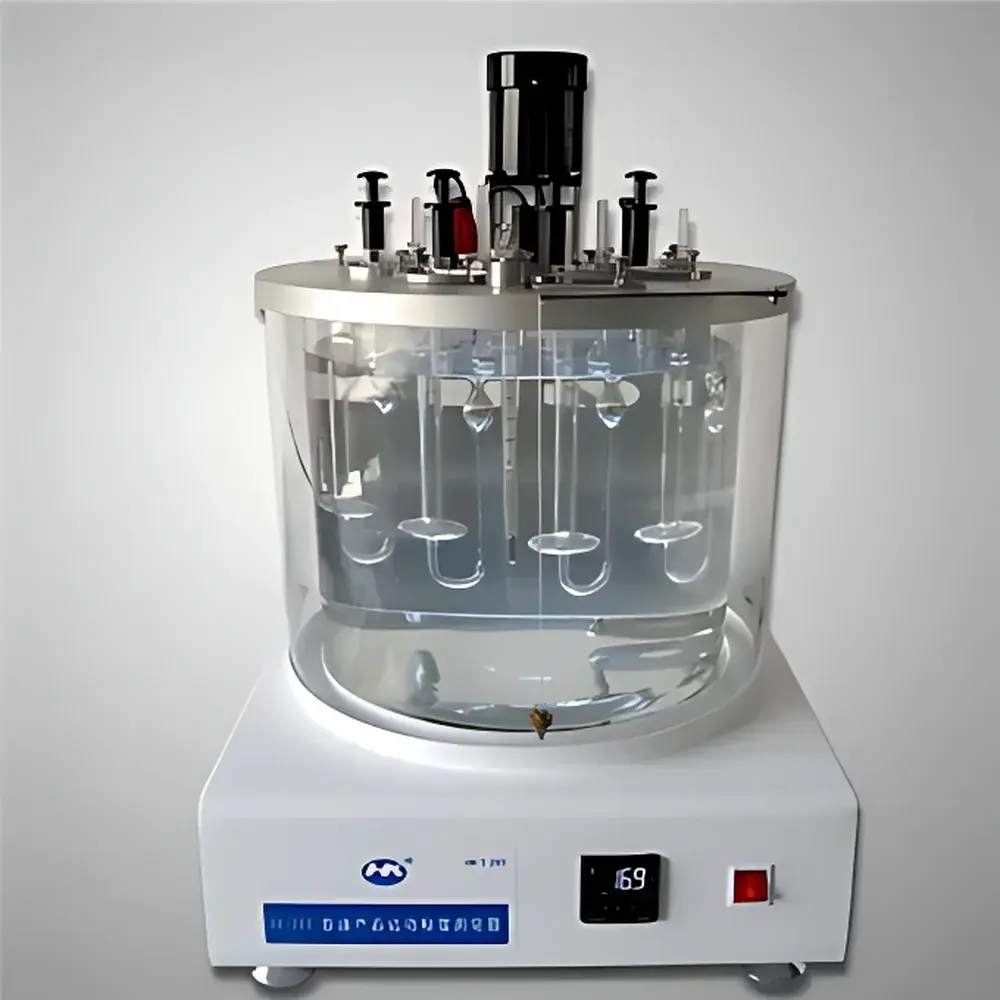
HK-265 Kinematic Viscosity Tester for Petroleum Products
| Brand | OEM |
|---|---|
| Origin | Imported |
| Manufacturer Type | Authorized Distributor |
| Model | HK-265 |
| Price | Upon Request |
| Power Supply | AC 220 V ±10%, 50 Hz |
| Temperature Control Range | 20–100 °C |
| Temperature Stability | ±0.1 °C (optional ±0.01 °C with HK-265A configuration) |
| Heating Power | 1800 W |
| Illumination | LED with silicone diffuser panel |
| Sample Holders | 4 capillary viscometer clamps |
| Safety Features | Liquid-level protection sensor |
| Cooling Interface | Dedicated external chiller port |
| Operating Environment | 5–40 °C, ≤85% RH |
Overview
The HK-265 Kinematic Viscosity Tester is a precision-controlled bath system engineered for the standardized determination of kinematic viscosity in Newtonian liquid petroleum products—such as base oils, distillates, lubricants, and fuel oils—according to internationally recognized test methods including ASTM D445, ASTM D446, ASTM D4603, and GB/T 265. It operates on the fundamental principle of gravity-driven capillary flow: a fixed volume of sample is drawn into a calibrated glass capillary viscometer, allowed to drain under gravity, and the efflux time is measured. Kinematic viscosity (ν, in mm²/s or cSt) is calculated as the product of the viscometer’s calibration constant (K) and the measured efflux time (t), i.e., ν = K × t. The HK-265 provides a thermally stable, optically optimized environment essential for high reproducibility in manual or semi-automated timing workflows. Its bath design ensures uniform temperature distribution across all four mounted capillaries, minimizing inter-sample thermal drift and supporting multi-laboratory method equivalency.
Key Features
- Four independent capillary viscometer clamps—enabling parallel analysis of up to four samples or replicate measurements within a single thermal cycle
- Digital PID temperature controller with real-time display and ±0.1 °C stability over the full 20–100 °C operating range (±0.01 °C achievable with HK-265A upgrade kit)
- Zero-drift thermal regulation architecture—eliminates long-term baseline drift during extended testing sessions (>8 h)
- LED illumination integrated with silicone diffuser panel—provides uniform, glare-free lighting ideal for precise meniscus observation and manual timing
- Dedicated external cooling port—compatible with recirculating chillers for rapid bath cooldown or sub-ambient stabilization when used with low-temperature viscometers (e.g., Cannon-Fenske Routine for 0 °C or −20 °C tests)
- Liquid-level safety sensor—automatically disables heating if bath fluid falls below minimum operational level, preventing dry-run damage to heater elements
- Robust stainless-steel bath chamber with corrosion-resistant finish—designed for continuous use with organic solvents, mineral oils, and cleaning agents common in refinery QC labs
Sample Compatibility & Compliance
The HK-265 supports all standard U-tube capillary viscometers—including Cannon-Fenske, Ostwald, Ubbelohde, and BS/IP variants—across nominal viscometer constants from 0.001 to 10.0 mm²/s². It is validated for use with transparent, Newtonian liquids meeting the scope definitions of ASTM D445 (Standard Test Method for Kinematic Viscosity of Transparent and Opaque Liquids) and GB/T 265 (Petroleum Products—Determination of Kinematic Viscosity). The system complies with ISO/IEC 17025 documentation requirements for temperature-controlled testing equipment when operated within specified environmental conditions (5–40 °C ambient, ≤85% RH). While the instrument itself does not embed electronic audit trails, its analog-digital hybrid control architecture allows integration into GLP-compliant workflows via external data loggers or timed video capture synchronized with laboratory information management systems (LIMS).
Software & Data Management
The HK-265 operates as a standalone hardware platform with no embedded firmware or proprietary software. All temperature setpoints, dwell times, and status indicators are managed via its front-panel digital display and tactile controls. This design minimizes validation overhead in regulated environments: no software qualification (IQ/OQ/PQ) is required under FDA 21 CFR Part 11, as no electronic records are generated internally. Users retain full control over data handling—efflux times are recorded manually or imported from external timers, stopwatch apps, or automated vision-based timing systems. Optional RS-232 or 4–20 mA analog outputs (available on HK-265A variant) enable connection to programmable logic controllers (PLCs) or SCADA systems for centralized thermal monitoring in refinery process labs.
Applications
- Quality control of crude oil fractions and refined distillates in upstream and midstream facilities
- Batch release testing of industrial lubricants per ISO 3104 and ASTM D445 specifications
- Viscosity grading of asphalt binders and cutback asphalts in pavement materials laboratories
- Stability assessment of fuel formulations—including biodiesel blends—during oxidation and thermal aging studies
- Educational demonstration of Newtonian fluid behavior and Hagen–Poiseuille law principles in university physical chemistry labs
- Method verification and instrument qualification per ASTM D446 (Standard Specification for Glass Capillary Kinematic Viscometers)
FAQ
What capillary viscometer types are compatible with the HK-265?
The unit accepts all standard U-tube viscometers with vertical mounting configurations, including Cannon-Fenske Routine, Ubbelohde dilution, and Ostwald types—provided they fit within the 4-clamp spacing and height constraints (max. 400 mm total length).
Can the HK-265 be used for non-Newtonian fluids?
No. Per ASTM D445 and GB/T 265, this system is validated exclusively for Newtonian liquids. Non-Newtonian samples (e.g., polymer-thickened oils, emulsions) require rotational rheometry (e.g., Brookfield DVNext) for apparent viscosity profiling.
Is external calibration certification included?
Calibration certificates for temperature sensors (traceable to NIST or national metrology institutes) are available upon request and must be performed by an accredited third-party lab; the instrument ships with factory verification data only.
Does the HK-265 meet ISO/IEC 17025 requirements for accredited testing?
Yes—when operated within defined environmental limits and paired with traceably calibrated viscometers and timers, the HK-265 satisfies clause 6.4.3 (Equipment) and 6.5.2 (Measurement Traceability) of ISO/IEC 17025:2017.
What maintenance is required for long-term reliability?
Monthly visual inspection of bath fluid clarity and level; biannual cleaning of heater surfaces and clamp mechanisms with isopropyl alcohol; annual verification of temperature sensor accuracy using a reference PRT or thermometer standard.





