
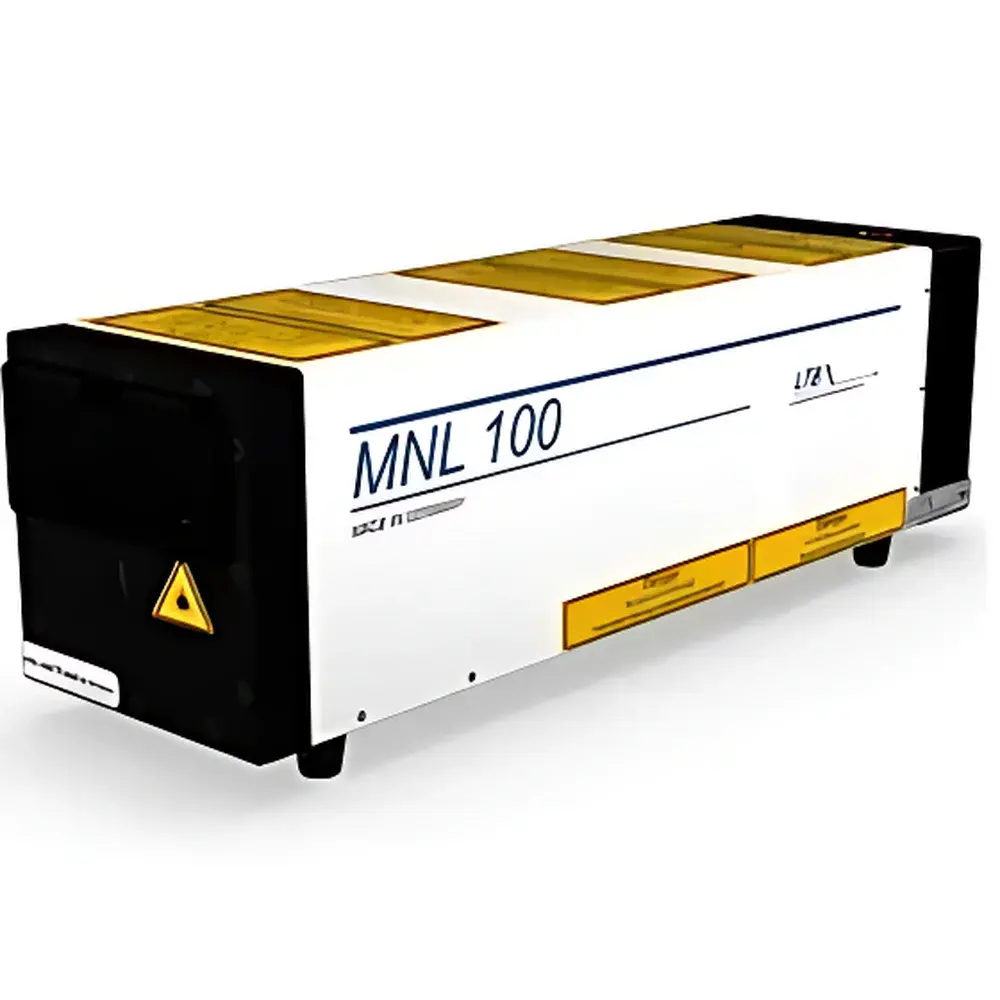
LTB MNL100 Industrial-Grade Nitrogen Molecular Laser
| Brand | LTB |
|---|---|
| Origin | Germany |
| Model | MNL100 |
| Laser Type | Pulsed Gas Laser (N₂) |
| Wavelength | 337.1 nm |
| Pulse Energy (guaranteed, ≥90% after 60M shots) | ≥140 µJ (MNL103-PD) / ≥120 µJ (MNL106-PD) |
| Pulse Width | ≤3 ns |
| Repetition Rate | 1–60 Hz |
| Beam Divergence | ≤3.5 × ≤3 mrad (standard) / ≤0.5 × ≤0.3 mrad (low-divergence variant) |
| Energy Stability | ≤2% RMS |
| Trigger Jitter (output sync) | <200 ps |
| Power Supply | 24 V DC (optional 100–240 V AC adapter) |
| Certification | CE, ETL (UL/CSA/VDE/Semco), RoHS, FDA-compliant |
| Laser Class | 3B (IEC 60825-1) |
| Warranty | 60 million pulses or 2 years (120 million / 3 years optional) |
Overview
The LTB MNL100 is a compact, air-cooled, pulsed nitrogen molecular laser engineered for demanding industrial and scientific applications requiring stable, high-repetition-rate ultraviolet (UV) radiation at 337.1 nm. Operating on the principle of supersonic nitrogen gas discharge in a sealed metal-ceramic cavity, the MNL100 delivers nanosecond-duration pulses with exceptional temporal stability and low spatial divergence. Its design eliminates reliance on consumable gas refills or external cooling systems—enabling continuous, maintenance-free operation over tens of millions of pulses. The laser’s core architecture integrates a solid-state switching power supply and embedded firmware-controlled electronics, ensuring precise pulse-to-pulse energy regulation, sub-nanosecond synchronization fidelity, and deterministic trigger response. As a Class 3B UV source, it complies fully with IEC 60825-1 safety requirements and is widely deployed as a pump source for tunable dye lasers, excitation source for fluorescence-based analytical systems, and primary emitter in time-of-flight mass spectrometry (TOF-MS) instrumentation.
Key Features
- Hermetically sealed metal-ceramic discharge cavity—resistant to thermal drift, humidity, and mechanical stress; enables >60 million guaranteed pulses (120 million optional)
- Direct-switching solid-state power supply delivering high pulse-to-pulse energy reproducibility (≤2% RMS stability)
- Integrated laser controller with onboard firmware supporting full parameter configuration via PC interface (DLL or serial protocol)
- Comprehensive trigger management: optical/electrical TTL input, jitter <2.5 ns (input-to-output), synchronous electrical output with <200 ps jitter relative to optical pulse
- Onboard pulse counter, energy monitor, and continuously variable internal attenuator (1:10,000 dynamic range)
- Optional low-divergence beam variant (<0.5 × 0.3 mrad) and fiber-coupled output (200–1000 µm core diameter)
- Compact form factor (321 × 95 × 95 mm, 3.5 kg) with 24 V DC operation; optional universal AC adapter (100–240 V, 50–60 Hz)
Sample Compatibility & Compliance
The MNL100 is compatible with a broad spectrum of UV-sensitive detection and excitation media—including organic dyes (e.g., Coumarin, Rhodamine), fluorescent proteins, semiconductor photodiodes, and phosphor-coated scintillators. Its narrow linewidth (~0.1 nm) and stable spectral centroid ensure consistent excitation efficiency across repeated measurements. Regulatory compliance includes CE marking per Directive 2014/30/EU (EMC) and 2014/35/EU (LVD); ETL certification to UL 61010-1, CSA C22.2 No. 61010-1, VDE 0411-1, and SEMKO EN 61010-1; RoHS 2011/65/EU; and FDA 21 CFR Part 1040.10/1040.11 for laser product safety. All units undergo factory calibration traceable to NIST-certified radiometric standards and support GLP/GMP-aligned audit trails when operated with validated control software.
Software & Data Management
Control is implemented via an integrated microcontroller running proprietary firmware, accessible through either a Windows DLL library (for integration into LabVIEW, MATLAB, or custom C/C++ applications) or ASCII-based RS232 serial commands (TTL-level, 9600 baud default). Optional USB-to-RS232 adapters simplify connectivity. The firmware supports automated energy ramping, pulse count logging, real-time energy monitoring, and user-defined trigger delay compensation. All configuration changes are non-volatile and persist across power cycles. For regulated environments, the system supports electronic signature-enabled parameter locking and timestamped event logging—fully compliant with FDA 21 CFR Part 11 requirements when paired with validated host software.
Applications
- Laser-Induced Fluorescence (LIF) spectroscopy in combustion diagnostics, environmental monitoring, and microfluidic cytometry
- Matrix-Assisted Laser Desorption/Ionization (MALDI) and ion trap mass spectrometry (MS) as a primary UV excitation source
- Pumping of tunable dye lasers covering 205–950 nm spectral range for multi-wavelength absorption and Raman studies
- UV micro-lithography, micromachining, and photoablation in semiconductor and MEMS fabrication
- Laser-Induced Breakdown Spectroscopy (LIBS) and Micro-LIBS for elemental analysis of solids, liquids, and aerosols
- Time-resolved fluorescence lifetime imaging (FLIM) and single-molecule detection platforms
FAQ
What is the typical lifetime of the MNL100 under continuous operation?
The MNL100 is rated for minimum 60 million pulses at ≥90% of initial energy output—or 2 years of operation—whichever occurs first. An extended warranty option covers 120 million pulses or 3 years.
Can the MNL100 be integrated into automated OEM instruments?
Yes. Its compact dimensions, 24 V DC power requirement, TTL-compatible triggering, and DLL/RS232 programmability make it suitable for embedded integration in analytical, medical, and industrial equipment.
Is fiber coupling available as standard or optional?
Fiber coupling is an optional configuration. Standard output is free-space; optional SMA-905 or FC/PC connectors support multimode fibers with core diameters from 200 µm to 1000 µm.
Does the laser require warm-up time before achieving specification performance?
No. The MNL100 achieves full operational stability within <20 seconds after power-on, with no thermal drift compensation required during normal duty cycles.
How is pulse energy calibrated and verified during manufacturing?
Each unit undergoes end-of-line calibration using NIST-traceable pyroelectric energy meters and spectral analyzers. Calibration data, including pulse energy vs. repetition rate curves and divergence maps, are provided in the certificate of conformance.




