
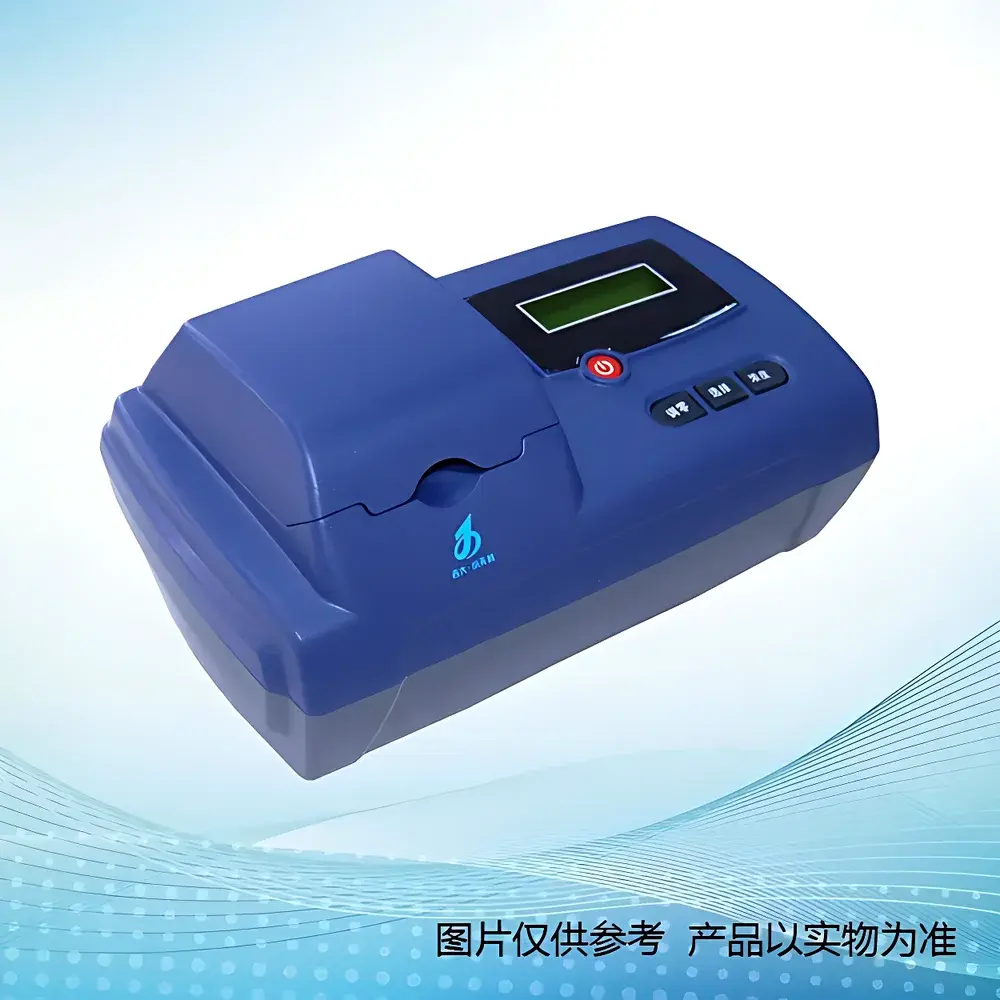
Jiada Xiaotianshe GDYS-101SN4 Portable Residual and Total Chlorine Analyzer
| Brand | Jiada Xiaotianshe |
|---|---|
| Origin | Jilin, China |
| Manufacturer Type | Direct Manufacturer |
| Instrument Type | Portable |
| Model | GDYS-101SN4 |
| Measurement Principle | Colorimetric Method (DPD-based) |
| Measured Parameters | Residual Chlorine, Total Chlorine |
| Range | Residual Chlorine: 0.00–2.50 mg/L |
| Total Chlorine | 0.00–2.50 mg/L |
| Accuracy | ±5% of reading |
| Detection Limit | 0.01 mg/L for both residual and total chlorine |
| Light Source | High-brightness LED |
| Wavelength | 520 nm |
| Power Supply | DC 9 V |
| Dimensions | 190 × 110 × 95 mm |
| Weight | 0.4 kg |
Overview
The Jiada Xiaotianshe GDYS-101SN4 Portable Residual and Total Chlorine Analyzer is a field-deployable, DPD (N,N-diethyl-p-phenylenediamine) colorimetric instrument engineered for rapid, on-site quantification of free residual chlorine and total chlorine in potable water and source water post-disinfection. It operates on the principle of selective chromogenic reaction: free chlorine oxidizes DPD to form a stable magenta-colored complex measurable at 520 nm, while total chlorine—comprising free chlorine and combined chlorine (e.g., chloramines)—is determined after potassium iodide catalysis under acidic conditions. This dual-mode analytical architecture enables compliance verification against national drinking water standards (e.g., GB 5749–2022) and supports routine monitoring in water treatment plants, distribution networks, swimming pools, and emergency response scenarios where laboratory access is limited.
Key Features
- Compact handheld design (190 × 110 × 95 mm; 0.4 kg) optimized for field mobility and one-handed operation.
- High-stability 520 nm LED optical system with minimal spectral drift, ensuring consistent photometric performance across temperature gradients (10–35 °C operating range).
- Dual-channel measurement capability: simultaneous or sequential analysis of residual and total chlorine using pre-calibrated reagent tablets and standardized cuvette protocols.
- Integrated microprocessor with linearized calibration curves stored in non-volatile memory, eliminating manual slope/intercept entry.
- Low-power DC 9 V operation compatible with standard alkaline or rechargeable battery packs, supporting >8 hours of continuous use per charge cycle.
- IP54-rated enclosure provides dust resistance and protection against incidental water splashes during outdoor deployment.
Sample Compatibility & Compliance
The GDYS-101SN4 accepts clarified, non-turbid water samples (turbidity < 5 NTU) without filtration. It is validated for use with municipal tap water, groundwater, surface water, and disinfected recreational water. The instrument adheres to methodological equivalence with ISO 7393-2:2018 (Water quality — Determination of free chlorine and total chlorine — Part 2: Colorimetric method using N,N-diethyl-p-phenylenediamine) and aligns with U.S. EPA Method 334.0 for chlorine species quantification. While not certified under FDA 21 CFR Part 11, its fixed calibration protocol and audit-ready measurement logs support GLP-compliant documentation in municipal QA/QC workflows.
Software & Data Management
Data output is via direct LCD display (3.2-digit resolution, mg/L units). No onboard data logging or USB connectivity is implemented; however, measurement results—including date/time stamp, parameter type (residual/total), and concentration value—are manually recordable into external LIMS or paper-based logbooks. The device includes a built-in self-test mode that verifies LED intensity, detector linearity, and zero-point stability prior to each measurement sequence—critical for maintaining traceability in regulated environments.
Applications
- Routine verification of chlorine residual at water treatment plant effluent points and distribution system entry valves.
- Field validation of disinfectant decay kinetics during pipeline transit or storage tank retention studies.
- Emergency response screening following natural disasters or infrastructure failures affecting water safety.
- Swimming pool and spa facility operator compliance checks per local health department ordinances.
- Educational laboratory instruction in environmental chemistry, emphasizing colorimetric assay fundamentals and redox stoichiometry.
FAQ
What reagents are required for operation?
DPD No. 1 tablets for residual chlorine and DPD No. 1 + No. 3 tablets for total chlorine—supplied separately as consumables compliant with ISO 7393-2 specifications.
Can the instrument measure chloramines independently?
No. Total chlorine minus residual chlorine provides an indirect estimate of combined chlorine (chloramines), but speciation requires separate amperometric or iodometric titration methods.
Is calibration verification traceable to NIST standards?
The instrument uses factory-established calibration curves referenced to gravimetrically prepared chlorine standard solutions; users may perform verification using certified reference materials (CRM) traceable to NIST SRM 2671a (Chlorine in Water).
How often must the optical path be cleaned?
The quartz cuvette window and LED/detector optics require cleaning with lint-free tissue and ethanol after every 20 measurements or when visible residue accumulates.
Does the device meet CE or RoHS requirements?
As a domestically certified Chinese-manufactured instrument, it carries CCC mark compliance; CE and RoHS declarations are not applicable unless exported with supplementary EU conformity documentation.







