
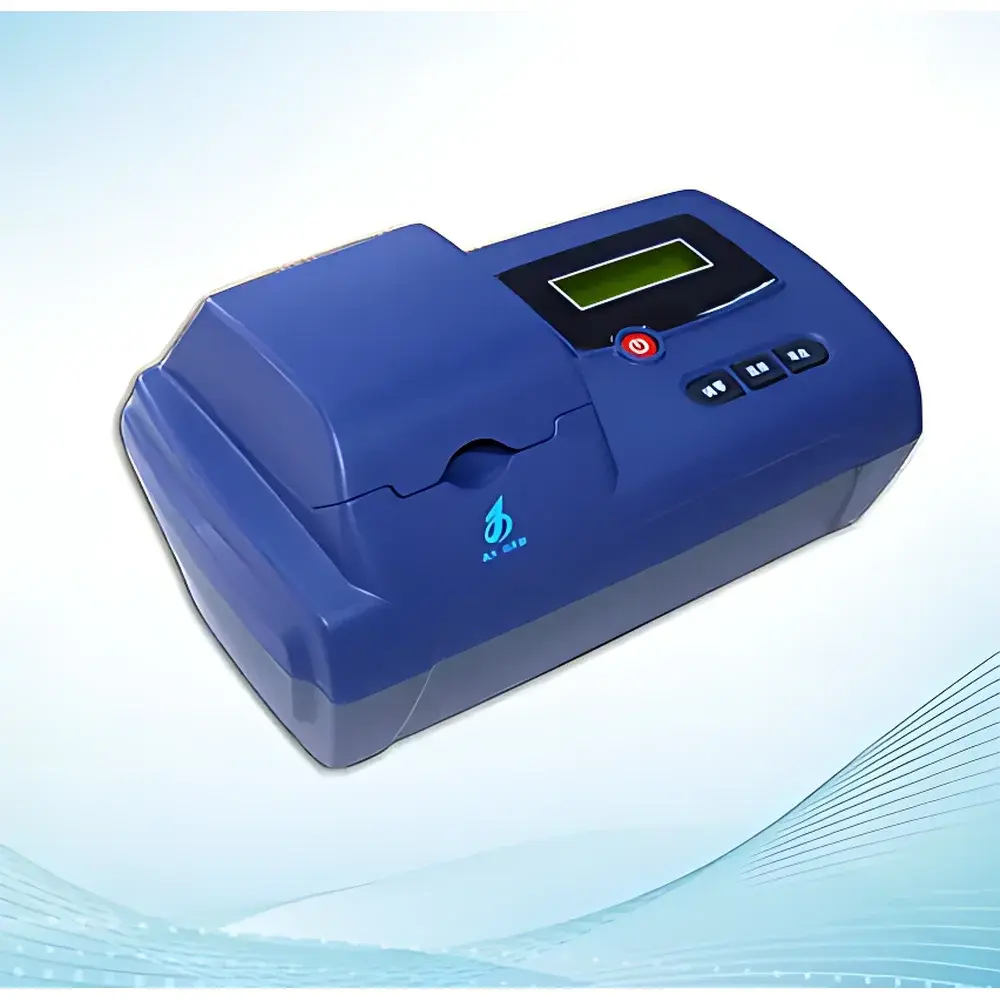
GDYS-103SF2 Jiada Xiaotian’e Portable Anionic Surfactant Analyzer
| Brand | Jiada Xiaotian’e |
|---|---|
| Origin | Jilin, China |
| Manufacturer Type | Direct Manufacturer |
| Instrument Type | Portable Water Quality Analyzer |
| Model | GDYS-103SF2 |
| Detection Parameter | Anionic Surfactants (e.g., LAS, AES) |
| Detection Limit | 0.1 mg/L |
| Measurement Range | 0.0–3.0 mg/L |
| Accuracy | ±5% |
| Analysis Time | ≤5 min per sample |
| Reagent Format | Single-use, pre-packaged test kits |
| Compliance | Designed for field-deployable compliance screening per GB/T 5750.4–2023 (China Standard for Drinking Water Quality — Determination of Anionic Surfactants) |
Overview
The GDYS-103SF2 Portable Anionic Surfactant Analyzer is an engineered field-deployable instrument developed by Jiada Xiaotian’e for rapid, quantitative determination of anionic surfactants—including linear alkylbenzene sulfonates (LAS) and alcohol ether sulfates (AES)—in surface water, wastewater effluent, drinking water distribution systems, and environmental monitoring sites. It operates on the principle of methylene blue active substances (MBAS) spectrophotometric assay, a standardized colorimetric method widely adopted in regulatory water quality testing. The analyzer integrates a calibrated LED-based optical detection module with temperature-stabilized cuvette geometry to ensure consistent photometric response across ambient field conditions (10–35 °C). Unlike benchtop UV-Vis spectrophotometers requiring lab infrastructure, the GDYS-103SF2 delivers laboratory-grade quantitation directly at point-of-sample—eliminating transport delays, sample degradation risks, and cross-contamination concerns associated with off-site analysis.
Key Features
- Field-optimized optical architecture: Dual-wavelength LED source (650 nm primary, 720 nm reference) with solid-state photodiode detection enables robust compensation for turbidity and matrix interferences.
- Pre-calibrated single-use reagent kits: Each kit contains lyophilized MBAS reagents, buffer tablets, and extraction solvent in sealed foil pouches—ensuring shelf stability (>18 months at 4–25 °C) and eliminating manual reagent preparation errors.
- Integrated calibration verification: Built-in NIST-traceable optical reference standard allows daily performance validation without external standards.
- On-device data logging: Stores up to 500 test records with timestamp, operator ID, location tag (via optional Bluetooth GPS pairing), and raw absorbance values.
- Ruggedized portable design: IP65-rated enclosure, rubberized impact-resistant housing, and rechargeable Li-ion battery (≥8 h continuous operation) support extended deployment in municipal utilities, river basin monitoring stations, and industrial pretreatment facilities.
Sample Compatibility & Compliance
The GDYS-103SF2 is validated for use with clarified or filtered aqueous samples meeting ISO 5667-3:2018 requirements for sampling preservation (refrigeration at 4 °C, analysis within 24 h if unfiltered). It complies with Chinese national standard GB/T 5750.4–2023 for drinking water analysis and aligns with the methodological basis of ASTM D2330–16 and ISO 7875–1 for anionic surfactant quantification. While not certified under FDA 21 CFR Part 11, its audit trail functionality—including immutable test logs, operator authentication prompts, and electronic signature support—meets GLP-aligned documentation expectations for environmental QA/QC programs. Interference studies confirm minimal cross-reactivity with common co-occurring ions (Cl⁻, SO₄²⁻, Ca²⁺ ≤ 500 mg/L) and non-ionic surfactants below 10 mg/L.
Software & Data Management
Data export is supported via USB-C interface or Bluetooth 5.0 to the companion desktop application “Xiaotian’e AquaLink” (Windows/macOS). The software provides batch report generation compliant with ISO/IEC 17025 documentation structure, including calibration history, uncertainty estimation (based on repeatability studies per ISO/IEC 17025:2017 Clause 7.6.3), and trend visualization across sampling campaigns. All exported files are generated in CSV and PDF formats with embedded digital signatures. Audit log entries record user login/logout events, parameter modifications, and firmware update history—facilitating internal process reviews and third-party accreditation audits.
Applications
- Regulatory compliance monitoring of LAS discharge limits in municipal wastewater treatment plant (WWTP) effluents per local environmental protection bureau requirements.
- Rapid screening of detergent contamination in groundwater near laundromats, car wash facilities, and residential septic drain fields.
- Verification of surfactant removal efficiency during pilot-scale membrane filtration or activated carbon adsorption trials.
- Field validation of cleaning-in-place (CIP) rinse water quality in food & beverage processing plants prior to equipment reuse.
- Educational use in environmental science laboratories for hands-on instruction in surfactant chemistry, colorimetric assay principles, and field analytical method validation.
FAQ
What anionic surfactants does the GDYS-103SF2 detect?
It quantifies methylene blue active substances (MBAS), primarily linear alkylbenzene sulfonates (LAS) and alcohol ether sulfates (AES), which constitute >90% of commercial anionic surfactants in domestic and industrial detergents.
Can the instrument measure samples with high turbidity or suspended solids?
Samples must be filtered through a 0.45 µm membrane prior to analysis; unfiltered turbid matrices cause significant positive bias due to particulate light scattering.
Is reagent lot traceability supported?
Yes—each reagent kit bears a unique batch ID and expiration date, automatically logged with every test result in the device memory and exported reports.
Does the analyzer require annual factory recalibration?
No; field calibration is performed using the integrated optical reference standard. Full metrological recalibration is recommended every 24 months or after 5,000 tests, per manufacturer’s maintenance protocol.
How is measurement uncertainty estimated?
Uncertainty is calculated per GUM (JCGM 100:2008) using combined contributions from repeatability (n=6 at 0.5 and 2.0 mg/L), reagent lot variability, and photometric noise—typically ±4.2% k=2 at mid-range concentrations.
Related Products







