
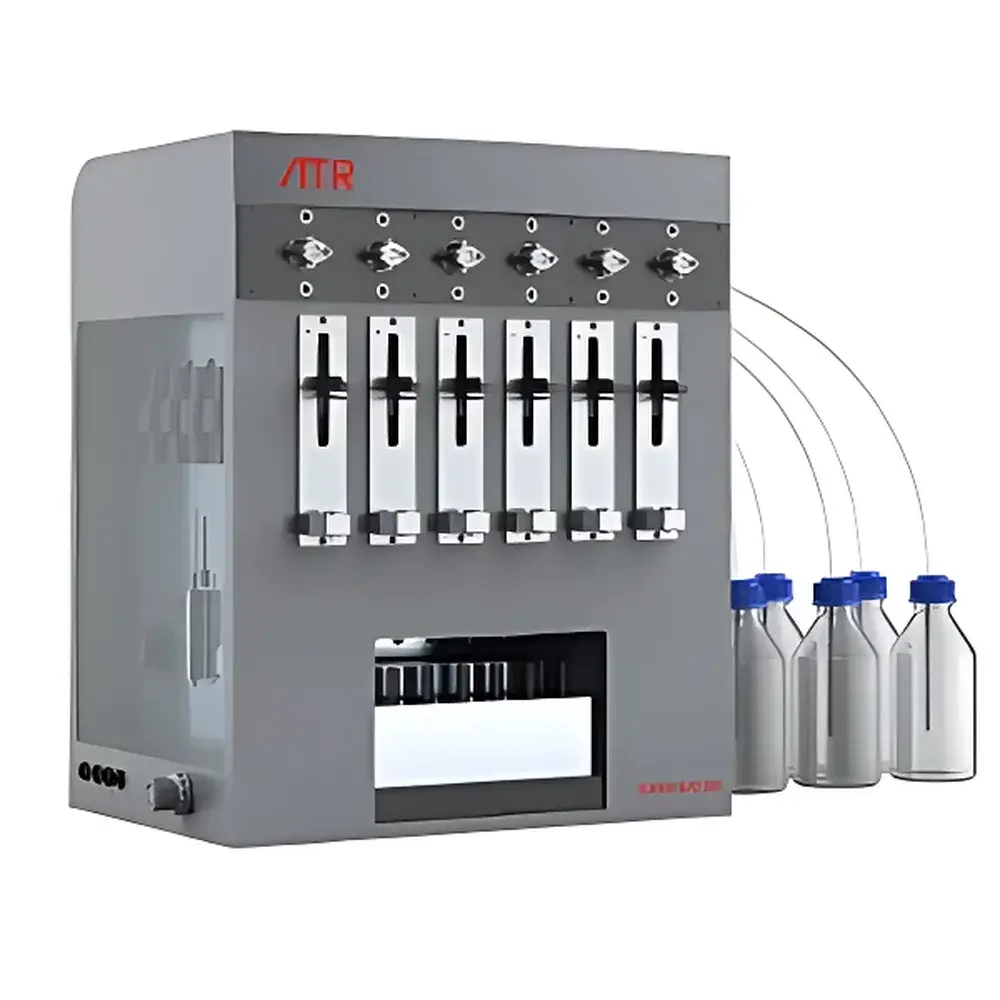
ATR Super SPE300 Large-Volume Fully Automated Solid Phase Extraction System
| Brand | ATR |
|---|---|
| Origin | USA |
| Model | Super SPE300 |
| Automation Level | Fully Automated |
| Number of Channels | 6 |
| Cartridge/Membrane Compatibility | Universal (Columns & Disks) |
| Flow Rate Control | 0.1–60 mL/min |
| Solvent Selection Ports | 8 |
| Sample Capacity | Up to 6 large-volume samples simultaneously |
| Sample Loading Volume | 10–20,000 mL |
| Wetted Materials | PTFE |
Overview
The ATR Super SPE300 Large-Volume Fully Automated Solid Phase Extraction System is an engineered solution for high-throughput, method-compliant sample preparation in environmental, food safety, and regulatory laboratories. Designed around positive-pressure liquid delivery via precision metering pumps, the system eliminates flow resistance issues commonly associated with particulate-laden aqueous matrices—ensuring consistent, clog-resistant operation across diverse sample types including drinking water, surface water, groundwater, wastewater, beverage extracts, and homogenized solid/semi-solid food digests. Its core architecture supports EPA Method 508.1, 525.3, 549.2, and 1694-compliant workflows, while also aligning with Chinese national standards (e.g., GB/T 5750.8–2023, GB 5009 series) for trace organic analysis. Unlike vacuum-driven SPE platforms, the Super SPE300 maintains precise, programmable flow control throughout conditioning, loading, washing, and elution—critical for reproducible analyte recovery and matrix removal in large-volume (up to 20 L) applications.
Key Features
- 6 independent parallel channels with synchronized or asynchronous operation—each equipped with dedicated high-accuracy metering pumps (±1.0% volumetric accuracy) for sample and solvent delivery
- Universal SPE interface accommodating standard cartridges (1–20 mL) and disk formats (25 mm and 47 mm diameter), without mechanical reconfiguration
- Eight solvent selection ports enabling fully automated multi-step elution protocols—including sequential polarity gradients and solvent exchange without column transfer
- Positive-pressure sample loading (0.1–60 mL/min) ensures uniform bed penetration and minimizes channeling, especially in turbid or suspended-solids-rich samples
- Dedicated waste routing: three isolated drainage paths for aqueous effluent, general organic solvents, and halogenated organics—supporting lab chemical hygiene and regulatory compliance (e.g., OSHA 29 CFR 1910.120, EPA 40 CFR Part 261)
- 12-inch industrial-grade touchscreen HMI with dual-language (English/Chinese) GUI, audit-trail-enabled method logging, and password-protected user roles
- Integrated leak detection and real-time pressure monitoring with automatic shutdown and alarm notification
Sample Compatibility & Compliance
The Super SPE300 processes liquid samples ranging from 10 mL to 20 L per channel, making it suitable for low-concentration analyte enrichment (e.g., ng/L-level pharmaceuticals, pesticides, PFAS, or endocrine disruptors). It accommodates both aqueous and organic-soluble extracts derived from Soxhlet, QuEChERS, or accelerated solvent extraction (ASE) workflows. All fluidic pathways contacting solvents or samples are constructed exclusively from chemically inert PTFE—ensuring compatibility with aggressive solvents (e.g., DCM, acetone, hexane, methanol) and eliminating metal leaching or adsorptive losses. Preloaded EPA- and GB-validated methods are stored onboard and editable per GLP/GMP requirements. The system meets essential design criteria for ISO/IEC 17025-accredited laboratories, including instrument qualification (IQ/OQ/PQ), electronic signature support (21 CFR Part 11 ready), and full method traceability.
Software & Data Management
Control software provides intuitive method building with drag-and-drop step sequencing for cartridge conditioning, sample loading, wash cycles, elution, and nitrogen drying. Each run generates a timestamped digital log containing pump parameters, pressure profiles, solvent usage, and operator ID—exportable as CSV or PDF for internal review or regulatory submission. Optional data integration modules support LIMS connectivity via ASTM E1384-compliant HL7 or direct SQL database push. Audit trails record all parameter modifications, user logins, and system alerts, satisfying FDA 21 CFR Part 11 requirements when paired with validated electronic signatures. Firmware updates are delivered via secure HTTPS with SHA-256 integrity verification.
Applications
- Environmental monitoring: EPA-compliant extraction of PAHs, PCBs, organochlorine pesticides, and emerging contaminants (e.g., PFOS, TCEP) from 1–20 L water samples
- Food safety testing: Clean-up of QuEChERS extracts prior to LC-MS/MS analysis of mycotoxins, veterinary drug residues, or plasticizers
- Pharmaceutical environmental risk assessment (ERA): Concentration and purification of active pharmaceutical ingredients (APIs) from wastewater influent/effluent
- Drinking water compliance: Preparation of samples for GC-ECD or LC-MS quantitation per US EPA Method 525.3 and EU Directive 2020/2184
- Research-scale method development: Rapid optimization of sorbent chemistry, solvent strength, and flow dynamics using reproducible, programmable conditions
FAQ
What regulatory methods are pre-programmed into the Super SPE300?
EPA Methods 508.1, 525.3, 549.2, and 1694 are included as default templates, along with GB/T 5750.8–2023 and GB 5009.272–2016 for domestic Chinese compliance.
Can the system handle membrane-based (disk) extraction without hardware modification?
Yes—the universal manifold accepts both cylindrical cartridges and flat-bed disks (25 mm and 47 mm) without tooling or adapter changes.
Is the system compatible with third-party SPE columns and membranes?
All standard SPE consumables meeting ANSI/SLAS footprint specifications are supported; no proprietary column locking mechanism is used.
What safety features prevent solvent exposure during operation?
Closed-loop solvent handling, vapor-tight sealing at all fluidic junctions, and automated solvent purge cycles minimize operator exposure and ambient VOC accumulation.
Does the optional auto-concentrator module require manual intervention between SPE and concentration steps?
No—fully integrated workflow allows direct transfer of eluate into the concentrator vial; no intermediate vial handling or sample transfer is needed.



