
AOE Tech JF8147 Single-Mode Pump Laser Source
| Brand | AOE Tech |
|---|---|
| Origin | Shanghai, China |
| Manufacturer Type | Authorized Distributor |
| Product Origin | Domestic (China) |
| Model | JF8147 |
| Light Source Type | Semiconductor Diode Pump Laser |
| Illumination Mode | Internal (Fiber-Coupled) |
| Output Power Range | 100–700 mW (adjustable) |
| Center Wavelength Options | 808 nm, 976 nm, 980 nm, 1053 nm, 1064 nm, 1420–1470 nm |
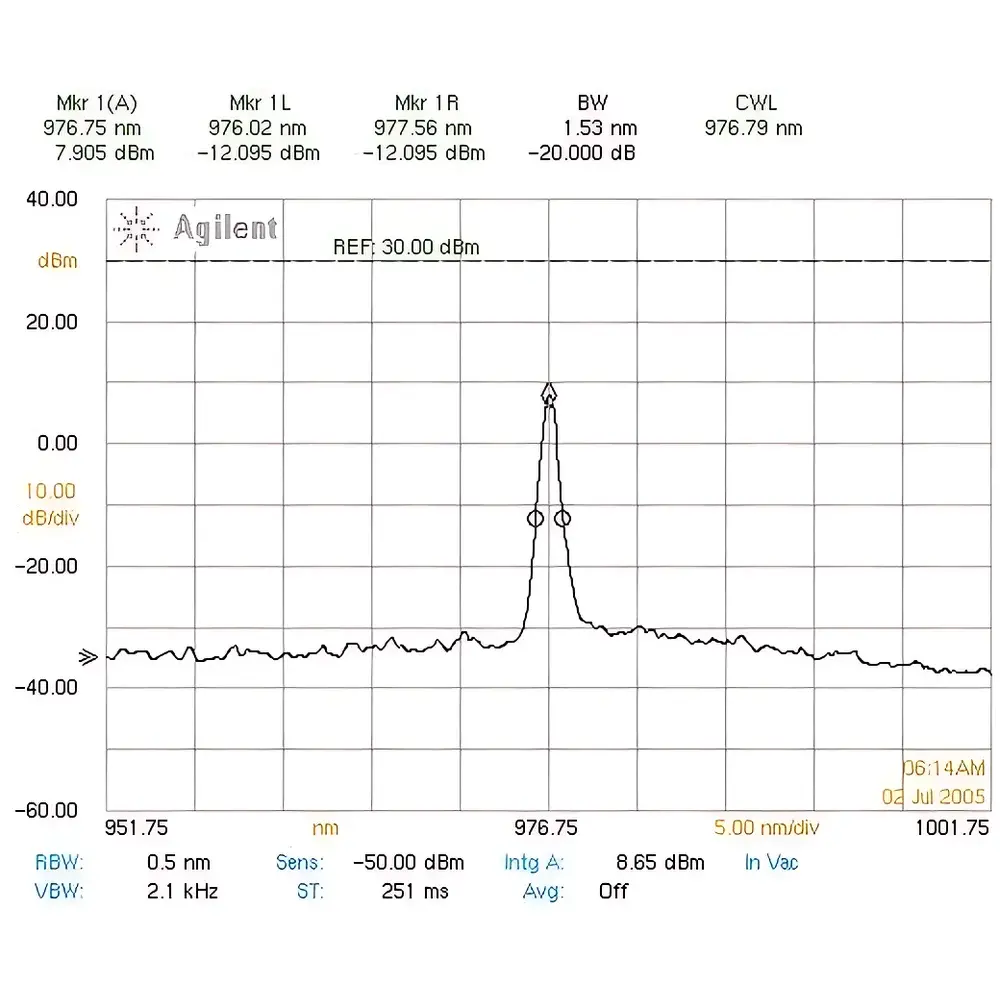
| Spectral Width (FWHM) | ≤12 nm |
| Power Stability (15 min) | ±0.05 dB |
| Power Stability (8 h) | ±0.2 dB |
| TEC Temperature Stability | ±0.1 °C (typ.), ±0.2 °C (max.) |
| TEC Operating Range | 20–30 °C |
| Input Voltage | 170–260 VAC (benchtop) |
| Power Consumption | ≤10 W |
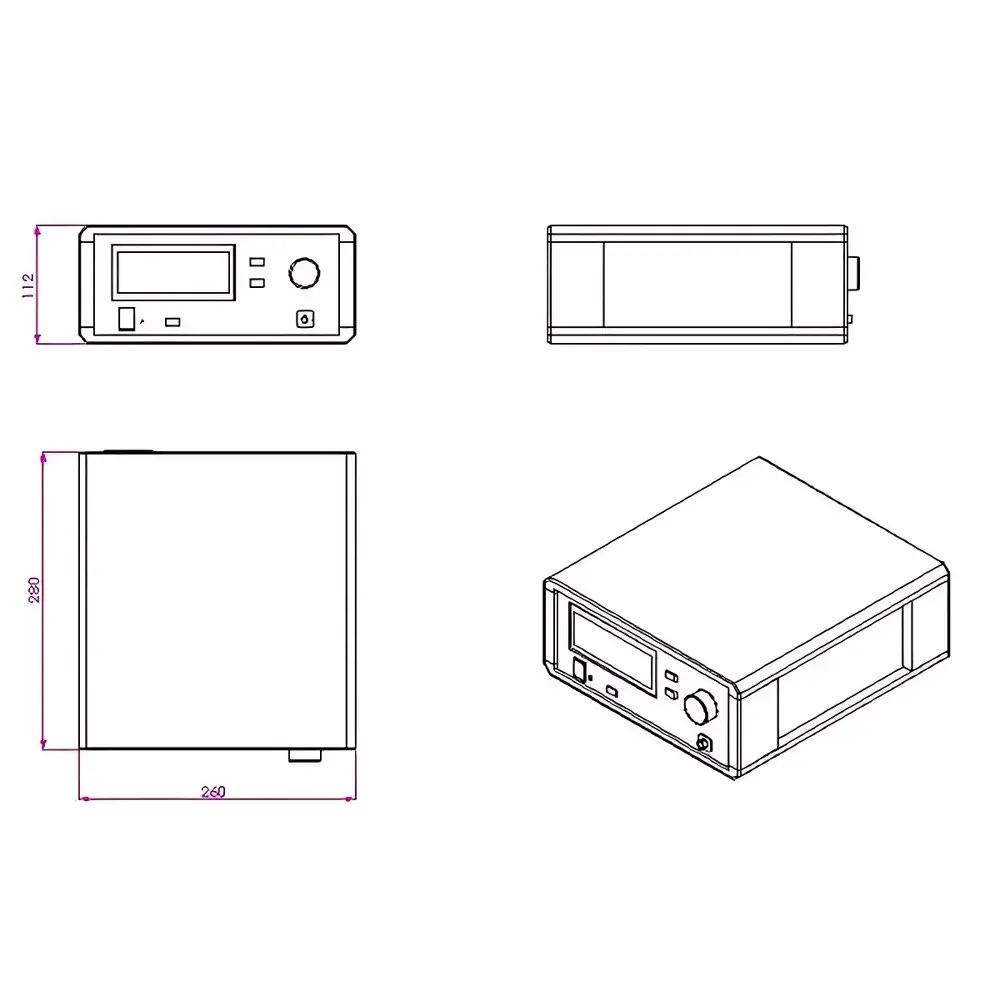
| Dimensions (Benchtop) | 280 × 260 × 112 mm |
| Display | Integrated LCD |
| Control Interface | Local keypad + RS232 / USB / analog modulation input |
| Safety Compliance | IEC 60825-1:2014 Class 3B Laser Product |
| Cooling | Active TEC + heatsink |
| Fiber Output | SMF-28, FC/APC or FC/PC connector optional |
Overview
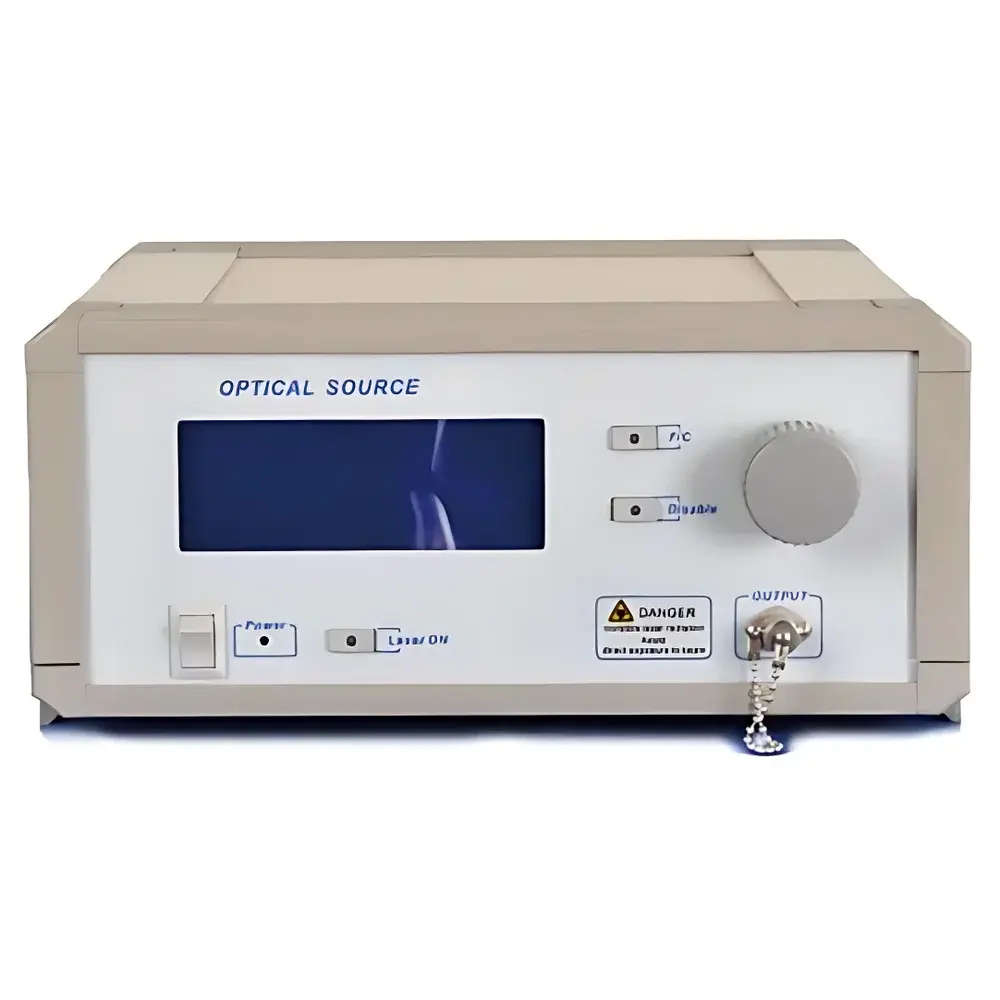
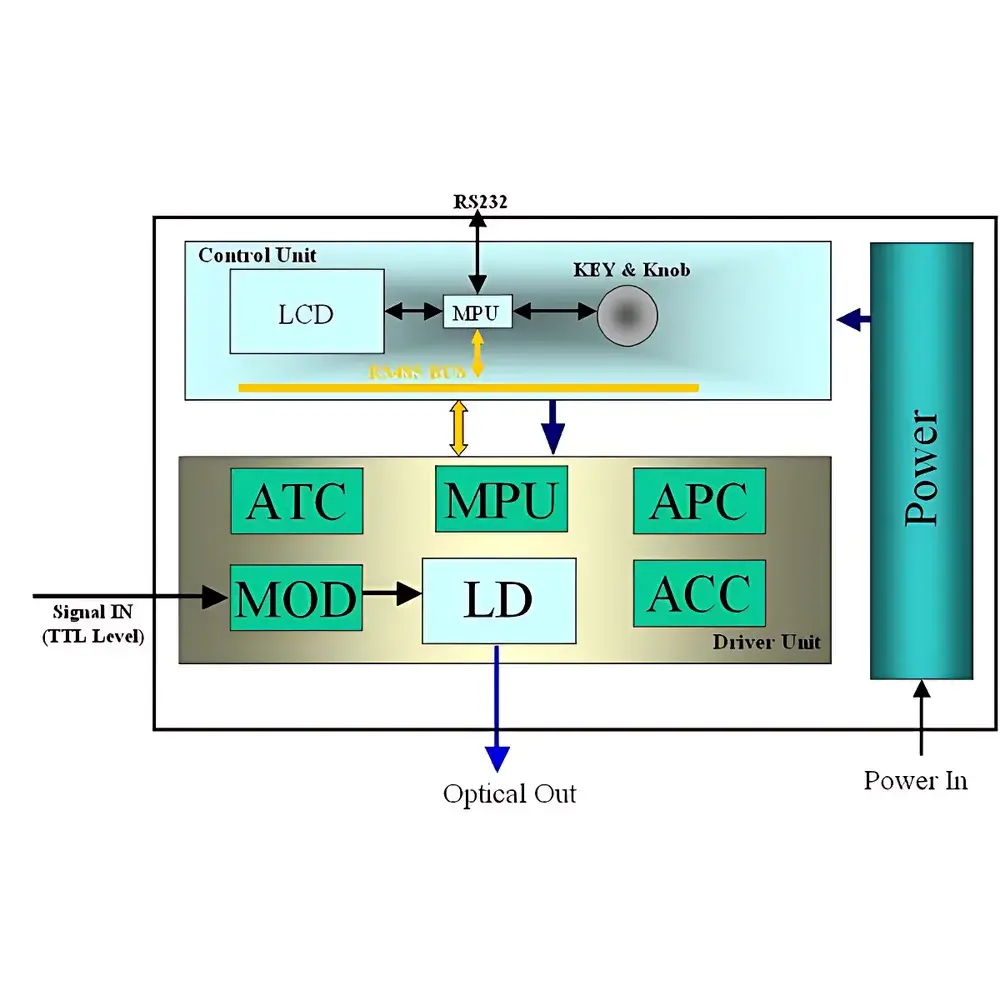
The AOE Tech JF8147 Single-Mode Pump Laser Source is a precision-engineered semiconductor diode laser system designed for demanding optical pumping applications in fiber amplifier and laser development laboratories, R&D facilities, and production test environments. Based on multi-quantum-well (MQW) active layers and integrated fiber Bragg grating (FBG) wavelength stabilization, the JF8147 delivers narrow-linewidth, spectrally stable output with minimal mode-hopping across its operational temperature and power range. Its core architecture employs a dual-feedback control loop: automatic power control (APC) maintains constant optical output under varying load and thermal conditions, while automatic temperature control (ATC) regulates the laser diode junction temperature to within ±0.1 °C—ensuring long-term wavelength fidelity and minimizing drift-induced measurement uncertainty. The source operates in continuous-wave (CW) mode and is optimized for fiber-coupled delivery into single-mode fibers (e.g., SMF-28), enabling direct integration with erbium-doped fiber amplifiers (EDFAs), ytterbium-doped fiber lasers (YDFLs), Raman gain modules, and passive component characterization setups.
Key Features
- Adjustable output power from 100 mW to 700 mW via front-panel interface or remote command
- Multiple wavelength options spanning critical pump bands: 808 nm (Nd³⁺), 976 nm & 980 nm (Yb³⁺, Er³⁺), 1053 nm & 1064 nm (Nd:YAG/YLF), and 1420–1470 nm (Raman Stokes shift)
- Integrated FBG-stabilized laser diode ensuring spectral stability ≤12 nm FWHM and minimal wavelength drift (<±0.05 nm over 8 h)
- Dual-loop ATC/APC electronics with high-resolution thermistor feedback and low-noise current drivers
- Benchtop (280 × 260 × 112 mm) and OEM module configurations available for system integration
- LCD status display showing real-time output power, setpoint, TEC temperature, and fault codes
- Comprehensive protection circuitry including back-reflection suppression, over-current shutdown, and thermal foldback
- Standard communication interfaces: RS232, USB 2.0, and 0–5 V analog modulation input for external power control
Sample Compatibility & Compliance
The JF8147 is compatible with standard single-mode telecom fibers (SMF-28, HI1060, PM980) and supports FC/APC or FC/PC connectors to minimize back-reflection—critical for protecting the laser diode when interfacing with isolators, WDM couplers, or high-reflectivity cavities. It meets IEC 60825-1:2014 safety requirements for Class 3B laser products and includes interlock-ready terminals for integration into certified optical enclosures. While not pre-certified for FDA 21 CFR Part 11 or ISO/IEC 17025, the device’s deterministic APC/ATC behavior, audit-ready parameter logging (via serial protocol), and stable output traceability support GLP/GMP-aligned validation protocols used in photonics manufacturing and qualification testing. All units undergo 48-hour burn-in and spectral verification at factory before shipment.
Software & Data Management
The JF8147 supports ASCII-based command sets over RS232 and USB CDC virtual COM port, enabling seamless integration with LabVIEW, Python (pySerial), MATLAB, or custom C++ test automation frameworks. Firmware provides timestamped logging of power readings, TEC voltage/current, and internal sensor values at user-defined intervals (10 ms to 1 s resolution). Optional software SDK includes DLL libraries for Windows and Linux, along with example scripts demonstrating closed-loop power calibration and multi-source synchronization. No proprietary GUI is bundled; instead, emphasis is placed on interoperability with industry-standard test executive platforms such as Keysight PathWave or NI TestStand—facilitating compliance with traceable calibration workflows required in ISO/IEC 17025-accredited labs.
Applications
- Pumping of erbium-doped fiber amplifiers (EDFAs) at 980 nm and 1480 nm for C-band and L-band optical communications
- Ytterbium-doped fiber amplifier (YDFA) and laser (YDFL) excitation at 976 nm with high absorption cross-section matching
- Stimulated Raman scattering (SRS) gain generation in dispersion-shifted or nonlinear fibers using 1420–1470 nm pump wavelengths
- Characterization of isolators, circulators, FBGs, and WDM filters under realistic pump-level loading conditions
- Seed source testing for MOPA architectures and nonlinear frequency conversion experiments (e.g., SHG, SFG)
- Calibration reference for optical power meters and spectrometers in metrology labs
FAQ
What wavelength options are available for the JF8147 series?
Standard configurations include 808 nm, 976 nm, 980 nm, 1053 nm, 1064 nm, and tunable bands from 1420–1470 nm. Custom wavelengths between 780–1650 nm may be quoted upon request.
Is the output polarization-maintaining (PM)?
The standard version delivers unpolarized output through SMF-28. PM fiber variants (e.g., PANDA or bow-tie) with aligned slow-axis coupling are available as optional configurations.
Can the JF8147 operate in pulsed mode?
No—it is a CW-only source. For nanosecond or modulated operation, external electro-optic or acousto-optic modulators must be used downstream.
Does it support analog modulation?
Yes: a 0–5 V analog input enables direct current modulation up to 100 kHz bandwidth (small-signal, <±5% setpoint deviation).
What is the typical warm-up time to reach spectral stability?
Less than 15 minutes from cold start, with full specification compliance achieved after 30 minutes of continuous operation at nominal power and ambient temperature.





