
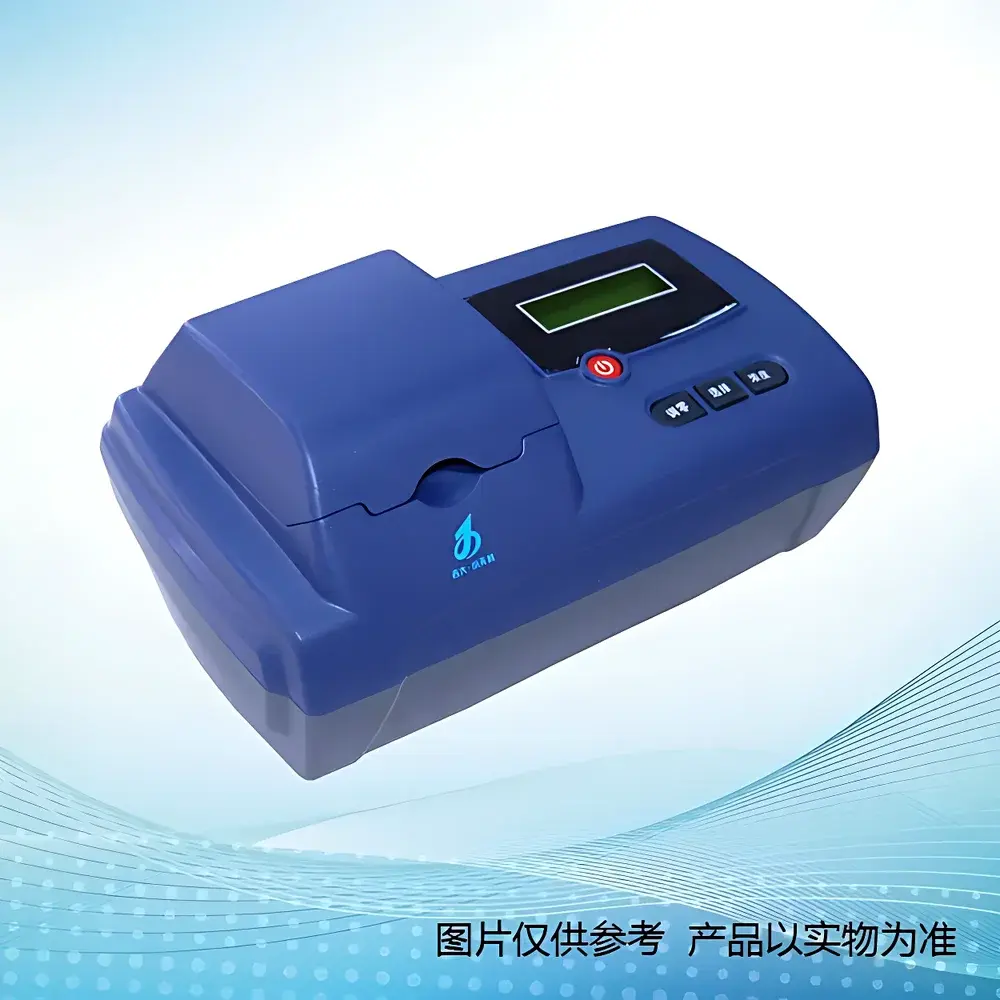
Jiada Xiaotianshe GDYS-101SQ3 Portable Chemical Oxygen Demand (COD) Analyzer
| Brand | Jiada Xiaotianshe |
|---|---|
| Origin | Jilin, China |
| Manufacturer Type | Direct Manufacturer |
| Instrument Type | Portable |
| Measurement Principle | Potassium Dichromate Digestion Method (On-site Compatible) |
| Wavelengths | 410 nm and 630 nm |
| Measurement Ranges | Range 1: 0–100 mg/L |
| Range 2 | 50–1000 mg/L |
| Range 3 | 500–3000 mg/L |
| Accuracy | ±5% |
| Detection Limit | 4 mg/L |
| Light Source | High-Brightness LED |
| Power Supply | DC 9 V |
| Dimensions | 200 × 105 × 95 mm |
| Weight | 0.4 kg |
Overview
The Jiada Xiaotianshe GDYS-101SQ3 Portable Chemical Oxygen Demand (COD) Analyzer is a field-deployable photometric instrument engineered for rapid, on-site quantification of chemical oxygen demand in aqueous samples. It operates on the standardized potassium dichromate digestion method—aligned with ISO 6060 and APHA Standard Methods 5220 D—where organic matter in water is oxidized under acidic, high-temperature conditions using potassium dichromate as the oxidant. The resulting colorimetric change, proportional to the concentration of reduced Cr3+, is measured at two discrete wavelengths (410 nm and 630 nm) to minimize interferences from turbidity, suspended solids, or sample matrix effects. Designed for operational simplicity and metrological robustness, the GDYS-101SQ3 delivers traceable COD data without requiring laboratory infrastructure, making it suitable for routine monitoring at wastewater discharge points, surface water sampling stations, and decentralized treatment facilities.
Key Features
- Triple-range measurement capability (0–100 mg/L, 50–1000 mg/L, 500–3000 mg/L) enables precise quantification across low-impact streams and highly polluted industrial effluents.
- Dual-wavelength photometry (410 nm and 630 nm) enhances analytical specificity by compensating for non-specific absorbance, improving reliability in colored or turbid samples.
- Integrated high-brightness LED light source ensures long-term spectral stability, minimal drift, and immunity to filament degradation—critical for field longevity and calibration retention.
- Compact form factor (200 × 105 × 95 mm) and lightweight design (0.4 kg) support extended handheld operation and integration into mobile environmental survey kits.
- DC 9 V power architecture allows compatibility with standard alkaline batteries or portable USB-to-DC adapters, eliminating dependency on mains electricity during remote deployments.
- Pre-programmed calibration curves and built-in reference checks align with QA/QC protocols required under national environmental monitoring guidelines (e.g., HJ/T 399–2007).
Sample Compatibility & Compliance
The GDYS-101SQ3 is validated for use with raw and treated wastewater, river and lake surface waters, and industrial process streams exhibiting moderate chloride interference (< 1000 mg/L Cl−). When used with recommended pretreatment (e.g., mercury sulfate masking for chloride-rich samples), it meets the performance criteria outlined in ISO 6060 for COD determination. While not certified to GLP or FDA 21 CFR Part 11, its measurement traceability, documented accuracy (±5%), and detection limit (4 mg/L) satisfy Tier-2 regulatory reporting requirements for municipal and provincial environmental protection agencies in China and comparable jurisdictions adopting APHA-aligned methodologies.
Software & Data Management
This analyzer operates via embedded firmware with no external software dependency. All measurements are displayed in real time on a backlit LCD screen, with manual entry of sample IDs and operator codes supported. Data logging is limited to on-device numeric storage of up to 200 test records—including date/time stamps, selected range, and result—accessible via scroll navigation. For audit readiness, users are advised to manually transcribe results into LIMS-compliant spreadsheets or paper-based chain-of-custody logs. Future firmware updates (if released) will be distributed via micro-USB interface, supporting version-controlled calibration file uploads aligned with internal QA procedures.
Applications
- Routine effluent monitoring at municipal wastewater treatment plants (WWTPs) prior to discharge compliance verification.
- Field screening of surface water bodies (rivers, reservoirs, irrigation canals) to identify point-source pollution events.
- Process control in food processing, textile dyeing, and pharmaceutical manufacturing where rapid COD feedback informs bioreactor loading adjustments.
- Educational laboratories conducting APHA-standardized water quality experiments under controlled pedagogical conditions.
- Emergency response teams assessing post-spill water contamination where lab turnaround time is prohibitive.
FAQ
Is the GDYS-101SQ3 compliant with international standards such as ISO 6060 or ASTM D1252?
Yes—the instrument implements the closed-reflux, potassium dichromate digestion protocol specified in ISO 6060 and ASTM D1252 Method B, provided users follow prescribed reagent ratios, digestion temperature (150 °C), and reaction time (2 hours).
Can it measure samples with high chloride concentrations?
Chloride interference is mitigated using mercury sulfate as a masking agent per standard protocol; samples exceeding 1000 mg/L Cl− require dilution or alternative methods such as the chlorine-resistant COD assay (ISO 15705).
Does the device support data export to Excel or LIMS platforms?
No native digital export is available; results must be manually recorded or captured via external documentation systems to maintain data integrity and audit trails.
What maintenance is required to ensure long-term accuracy?
Regular verification using certified COD standard solutions (e.g., potassium hydrogen phthalate at 100 mg/L and 500 mg/L) is recommended before each daily use cycle, along with periodic optical path cleaning using lint-free wipes and isopropyl alcohol.







