
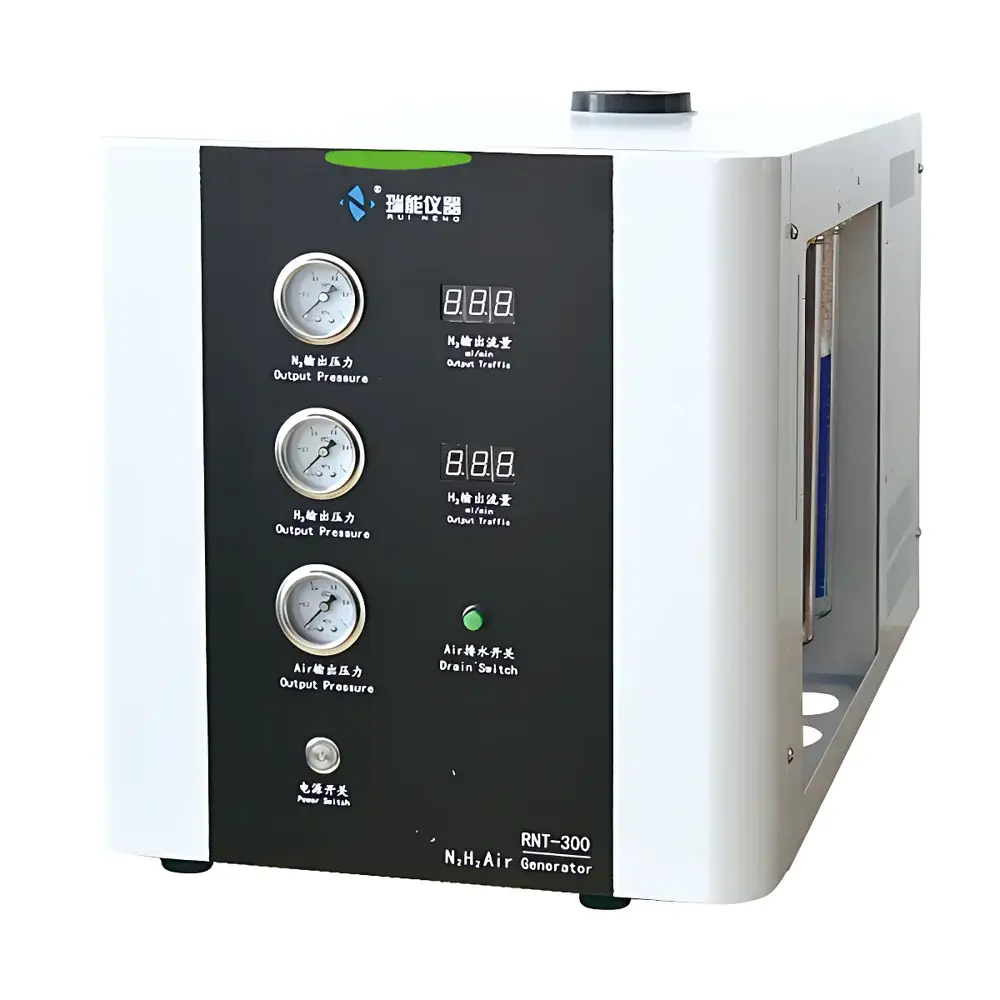
Ruinen RNT-300 Integrated Nitrogen-Hydrogen-Air Gas Generator
| Brand | Ruinen |
|---|---|
| Origin | Shandong, China |
| Manufacturer Type | OEM Manufacturer |
| Model | RNT-300 |
| Nitrogen Purity | ≥99.999% |
| Hydrogen Purity | ≥99.999% |
| Nitrogen Flow Rate | 0–300 mL/min |
| Hydrogen Flow Rate | 0–300 mL/min |
| Air Flow Rate | 0–3000 mL/min |
| Output Pressure | 0–0.4 MPa |
| Pressure Stability | <±0.2% FS |
| Nitrogen & Hydrogen Reservoir Volume | 3 L each |
| Feed Water Resistivity Requirement | ≥1 MΩ·cm |
| Air Compressor Noise Level | <35 dB(A) |
| Power Supply | 220 V ±10%, 50–60 Hz |
| Operating Temperature | 0–40 °C |
| Operating Humidity | <85% RH |
| Design | Integrated (All-in-One) Unit |
Overview
The Ruinen RNT-300 Integrated Nitrogen-Hydrogen-Air Gas Generator is an engineered solution for laboratories requiring reliable, on-demand supply of high-purity carrier, fuel, and combustion gases—primarily for gas chromatography (GC), GC-MS, flame ionization detection (FID), thermal conductivity detection (TCD), and other analytical instrumentation requiring stable, low-contamination gas streams. Unlike conventional cylinder-based systems, the RNT-300 employs membrane-based nitrogen separation from compressed air, PEM (proton exchange membrane) electrolysis for hydrogen generation, and a built-in oil-free diaphragm air compressor to deliver three independent gas streams in a single compact footprint. Its design eliminates reliance on high-pressure cylinders, reducing safety hazards, logistical overhead, and operational downtime associated with gas procurement and changeover.
Key Features
- Triple-gas integration: Simultaneous, independently regulated output of nitrogen (≤300 mL/min), hydrogen (≤300 mL/min), and zero-air (≤3000 mL/min) from a single unit.
- High-purity gas production: Nitrogen and hydrogen purity ≥99.999% (5.0 grade), verified by on-board electrochemical sensors and validated per ISO 8573-1:2010 Class 1 for particulate, water, and oil content in compressed gases.
- Stainless steel fluidic architecture: Electrolytically polished 316L stainless steel reservoirs and tubing; ultrasonically cleaned and passivated to minimize metallic leaching and ensure long-term compatibility with trace-level analytical applications.
- Low-noise, oil-free air compression: Integrated diaphragm compressor delivering <35 dB(A) operating noise—suitable for open-lab environments and adjacent instrument rooms without acoustic shielding.
- Continuous-duty pressure control: Precision low-voltage solenoid valves and PID-regulated pressure modules maintain output stability within ±0.2% full scale across variable flow conditions—critical for retention time reproducibility in GC methods.
- Intelligent safety architecture: Real-time monitoring of water resistivity (≥1 MΩ·cm required), electrolyte level, temperature, overpressure, and gas leak thresholds; automatic shutdown with event logging upon anomaly detection.
Sample Compatibility & Compliance
The RNT-300 is compatible with all major GC platforms—including Agilent, Thermo Fisher, Shimadzu, and PerkinElmer—supporting FID, TCD, NPD, and ECD detectors. It meets baseline requirements for USP <691>, ASTM D6299, and ISO/IEC 17025-accredited laboratories when operated within specified feed water quality and ambient conditions. While not certified to IEC 61010-1 or ATEX, its internal pressure containment, electrical isolation, and hydrogen venting pathways adhere to general laboratory risk mitigation practices for Class II, Division 2 environments. Documentation supports GLP/GMP audit readiness, including calibration logs, maintenance records, and system validation templates aligned with FDA 21 CFR Part 11 data integrity principles.
Software & Data Management
The RNT-300 operates as a standalone hardware platform with no proprietary software dependency. All operational parameters—including real-time flow rates, pressure setpoints, reservoir status, and fault codes—are displayed via a backlit LCD interface with tactile navigation buttons. Event history (last 100 entries) is stored non-volatile memory and exportable via USB port in CSV format for integration into LIMS or electronic lab notebooks (ELN). Optional RS-485 Modbus RTU interface enables remote status polling and basic control (start/stop, alarm reset) within SCADA or building management systems—facilitating unattended operation in 24/7 analytical workflows.
Applications
- Carrier gas supply for capillary GC columns requiring ultra-high-purity nitrogen (e.g., method validation per ICH Q2(R2)).
- Fuel gas source for FID and methanizer applications demanding consistent hydrogen stoichiometry and minimal moisture/oil carryover.
- Zero-air generation for oxidant supply in chemiluminescence NOx analyzers and ozone generators used in environmental air monitoring.
- Support gas for plasma cleaning, surface treatment, and inert atmosphere glove boxes where intermittent high-flow air is needed.
- Backup or primary gas source in QC/QA labs undergoing transition from cylinder dependency to centralized, sustainable gas infrastructure.
FAQ
What feed water quality is required for optimal hydrogen and nitrogen generation?
Deionized water with resistivity ≥1 MΩ·cm (equivalent to ASTM Type II water) is mandatory. Tap water, distilled water, or low-resistivity DI water will accelerate electrode degradation and compromise gas purity.
Can the RNT-300 operate continuously for 7×24 applications?
Yes—its solid-state electrolyzer, thermally managed compressor, and fail-safe valve architecture support uninterrupted operation under nominal load. Scheduled maintenance intervals are defined at 6-month or 2000-hour intervals, whichever occurs first.
Is external air drying or filtration necessary?
No. The integrated air compressor includes coalescing and activated carbon pre-filters, and the nitrogen generation module incorporates desiccant and carbon polishing stages compliant with ISO 8573-1 Class 1 specifications.
How is gas purity verified during routine use?
Purity is maintained via process control—not real-time inline analysis. Users should perform periodic verification using calibrated gas analyzers (e.g., trace oxygen/hydrocarbon analyzers) per their laboratory’s SOPs, typically every 6 months or after service.
Does the unit comply with electromagnetic compatibility (EMC) standards for laboratory environments?
The RNT-300 meets CISPR 11 Group 1, Class B emission limits and IEC 61326-1 immunity requirements for professional laboratory equipment, ensuring minimal interference with adjacent sensitive instruments such as mass spectrometers or NMR consoles.



