
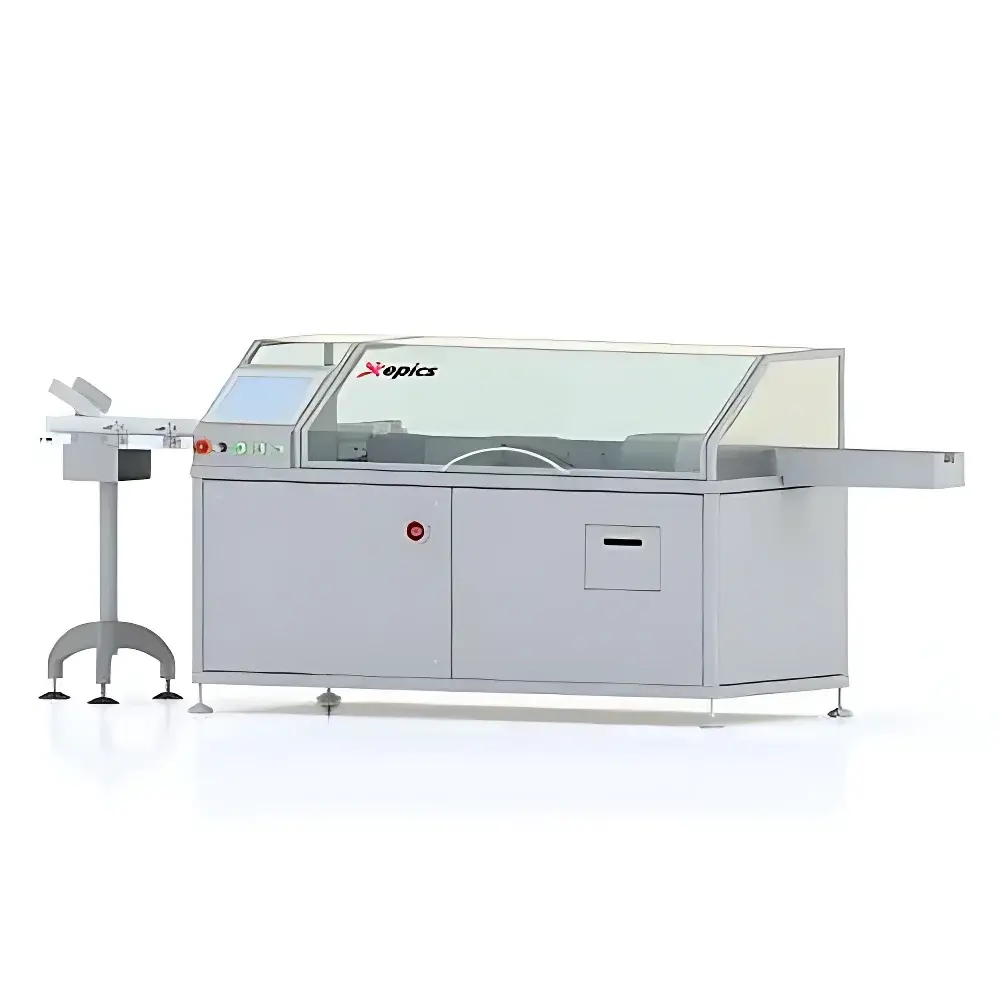
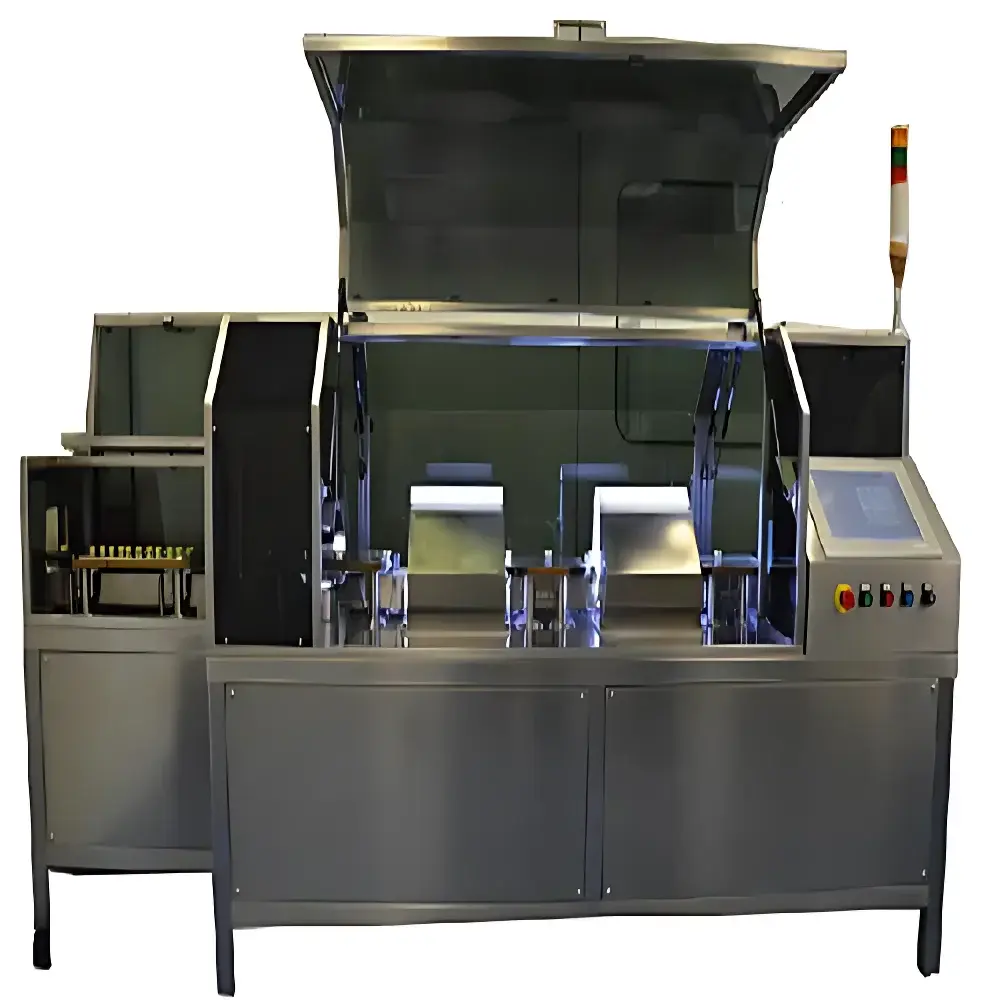
Xepics HVB High-Voltage Leak Detection (HVLD) Instrument for Non-Destructive Package Integrity Testing
| Brand | Xepics |
|---|---|
| Origin | Italy |
| Model | HVB |
| Voltage Range | Up to 30 kV |
| Liquid Conductivity Detection Limit | ≥1 µS/cm |
| Sample Throughput | 120 containers/min |
| Compatible Containers | Vials, Ampoules, Prefilled Syringes, IV Bags, Blow-Fill-Seal (BFS) & Form-Fill-Seal (FFS) containers |
| Dimensions (W×D×H) | 190 × 85 × 127 cm |
| Power Supply | 110–240 VAC, 50–60 Hz, 2 kW |
| Control System | Windows 10 PC with 8" Touchscreen Interface |
| Communication | Ethernet |
| Compliance | Designed to support USP <1207>, ISO 11607-2, ASTM F2338, and FDA 21 CFR Part 11 data integrity requirements |
Overview
The Xepics HVB High-Voltage Leak Detection (HVLD) Instrument is an offline, non-destructive, non-contact package integrity tester engineered for quantitative assessment of container closure integrity (CCI) in pharmaceutical liquid dosage forms. It operates on the principle of high-voltage induced current measurement across electrically insulating packaging materials—such as glass, plastic, and laminated polymers—filled with conductive or low-conductivity liquids (down to 1 µS/cm). When a voltage potential (up to 30 kV) is applied between two electrodes positioned around the container, intact seals maintain stable capacitance and minimal leakage current; micro-defects—including pinholes, micro-cracks, or incomplete crimping—disrupt the dielectric barrier, resulting in measurable increases in conductive current. This physics-based detection mechanism enables deterministic pass/fail classification without sample preparation, physical contact, or product compromise—making it fully compliant with the risk-based, quality-by-design (QbD) framework outlined in USP <1207> and ISO 11607-2.
Key Features
- True non-destructive testing: No sample modification, no media immersion, no vacuum or pressure cycling required
- Non-contact, non-invasive electrode configuration eliminates mechanical wear and cross-contamination risks
- High sensitivity to sub-micron defects in sealed liquid-filled containers—even those containing ultra-pure water (USP Purified Water, conductivity ~0.055 µS/cm at 25°C)
- Throughput-optimized design supports up to 120 containers per minute in batch or inline conveyor-fed configurations
- Universal container adaptability: accommodates vials (2–50 mL), ampoules, prefilled syringes, IV bags, and BFS/FFS plastic containers without tooling changes
- Robust industrial architecture with CE, UL, and EMC compliance; rated for continuous operation in GMP-controlled laboratory and manufacturing environments
- Integrated 8-inch touchscreen HMI with Windows 10 OS, real-time waveform visualization, and configurable alarm thresholds
Sample Compatibility & Compliance
The HVB is validated for use with aqueous-based parenterals, suspensions, emulsions, and biologics—including monoclonal antibodies and recombinant proteins—across a wide range of container formats. Its detection capability is independent of headspace gas composition and unaffected by residual oxygen or nitrogen purge conditions. As specified in USP <1207>, HVLD is classified as a *deterministic*, *probabilistic-capable* method suitable for both validation studies and routine QC release testing. The system supports full audit trail generation, electronic signatures, and secure user access control—enabling alignment with FDA 21 CFR Part 11 and EU Annex 11 requirements. All test parameters, raw current waveforms, timestamps, and operator IDs are stored in encrypted SQLite databases with configurable retention policies.
Software & Data Management
Xepics’ proprietary HVLD Control Suite provides comprehensive instrument management, method development, and data reporting capabilities. Users can define multi-step test protocols—including ramp-up voltage profiles, dwell times, and polarity reversal sequences—to optimize signal-to-noise ratio for challenging product-packaging combinations. The software supports automated report generation in PDF and CSV formats, with embedded metadata traceable to individual containers via barcode scanning integration. Batch-level statistical summaries (e.g., defect rate, mean current deviation, coefficient of variation) are exportable for SPC analysis and regulatory submission packages. All data files are digitally signed and time-stamped using NIST-traceable system clocks, satisfying GLP/GMP documentation standards for inspection readiness.
Applications
- Final container closure integrity verification for sterile injectables prior to market release
- Stability study monitoring of CCI over shelf life under accelerated and real-time storage conditions
- Root cause investigation of seal failures during process validation (e.g., stopper insertion, crimping, or BFS sealing parameter optimization)
- Comparative evaluation of alternative packaging components (e.g., elastomer formulations, aluminum cap designs)
- Supporting regulatory submissions requiring scientific justification of CCI test method suitability per ICH Q5C and Q9 principles
- Integration into PAT (Process Analytical Technology) frameworks for real-time release testing (RTRT) strategies
FAQ
Is HVLD suitable for lyophilized (freeze-dried) products?
No—HVLD requires a conductive liquid path between electrodes; it is not applicable to dry or powder-filled containers unless reconstituted with conductive solvent prior to testing.
Can the HVB detect leaks in metal-containing packaging?
No—HVLD relies on dielectric insulation; metallic layers or conductive inks disrupt field distribution and invalidate measurements.
What calibration and qualification protocols are recommended?
Xepics provides IQ/OQ documentation templates aligned with ASTM F2338-22; annual performance qualification (PQ) using certified leak standards (e.g., laser-drilled capillaries) is advised.
Does the system support 21 CFR Part 11-compliant electronic records?
Yes—role-based access control, audit trails, electronic signatures, and data encryption are enabled by default and validated per internal SOPs.
How is electrical safety ensured during operation?
The HVB incorporates dual-channel interlocked shielding, grounded Faraday cage enclosure, automatic voltage ramp-down on fault detection, and IEC 61010-1 Class I protection certification.



