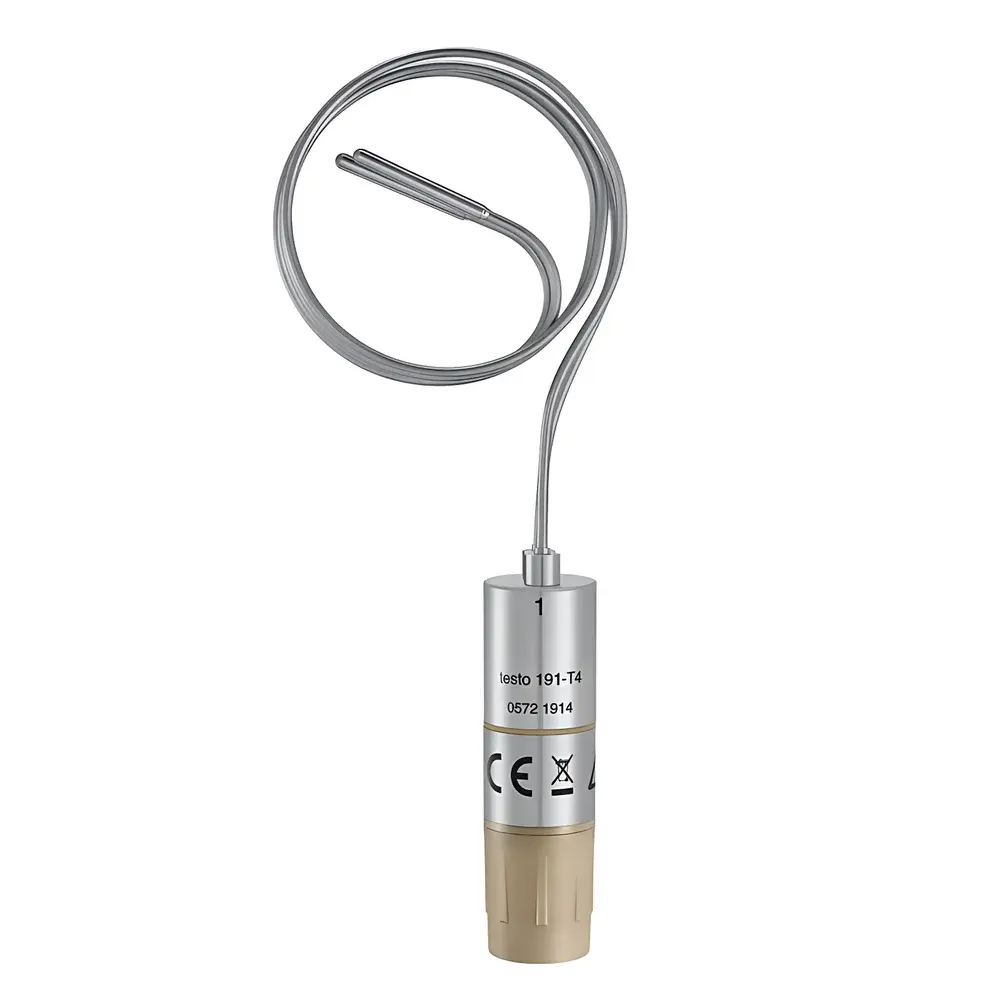
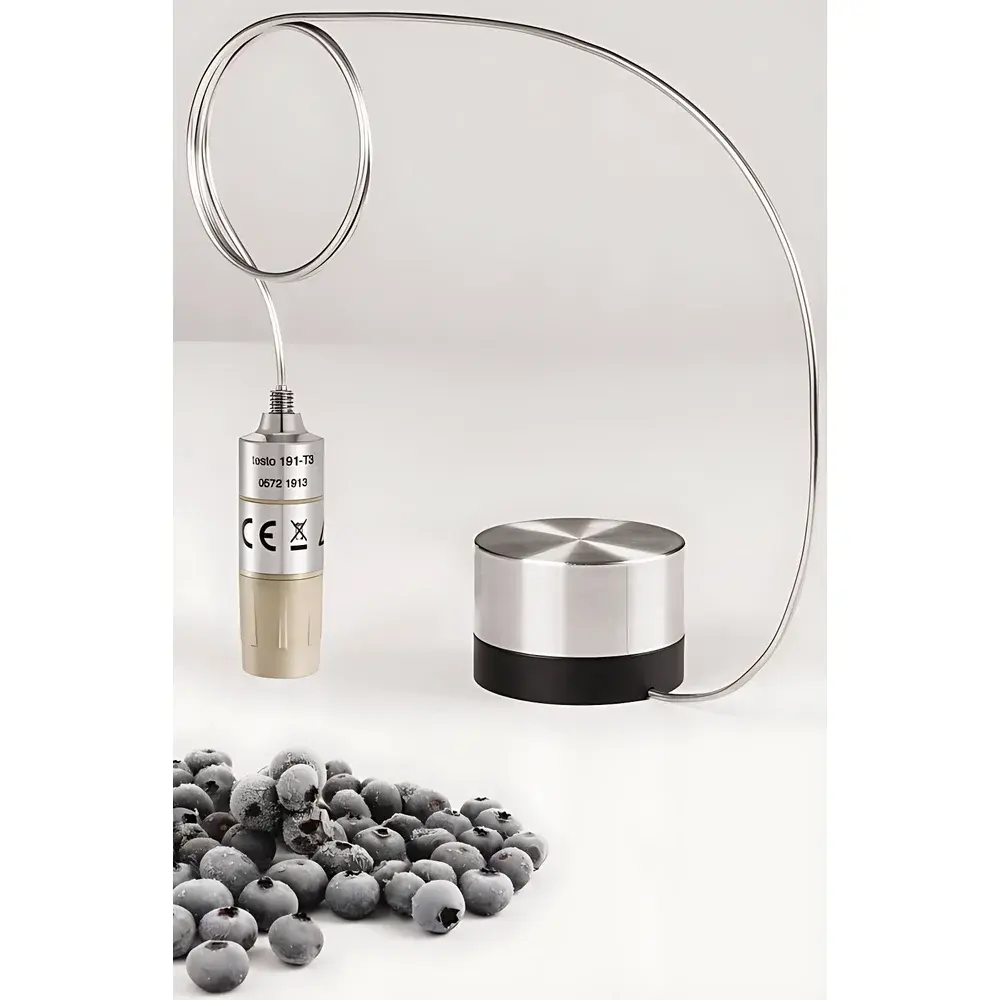
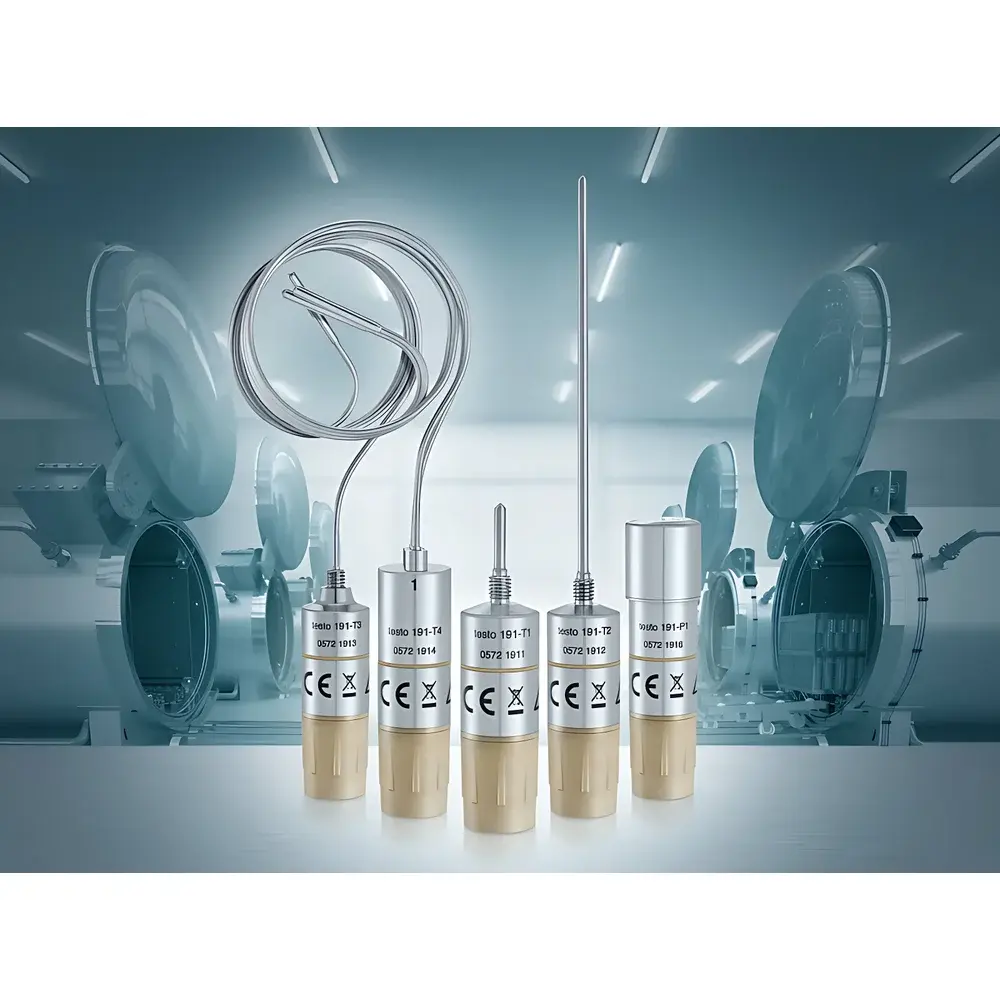
Testo 191-T4 HACCP Temperature Data Logger with Two Flexible Bendable Pt1000 Probes
| Brand | Testo |
|---|---|
| Origin | Germany |
| Model | 0572 1914 |
| Measurement Principle | Dual-channel Pt1000 resistance thermometry |
| Temperature Range | −50 °C to +140 °C |
| Accuracy | ±0.1 °C (−40 °C to +140 °C), ±0.2 °C (−50 °C to −40 °C) |
| Resolution | 0.01 °C |
| Storage Capacity | 30,000 readings per channel |
| Probe Length | 775 mm |
| Probe Diameter | 1.5 mm |
| Device Dimensions | Ø20 mm × 72 mm |
| IP Rating | IP68 |
| Battery | 1/2 AA lithium |
| Operating Life | 2,500 h (10 s sampling at +121 °C) |
| Enclosure Material | Stainless steel housing with PEEK-coated battery cap |
Overview
The Testo 191-T4 HACCP Temperature Data Logger is a dual-channel, high-integrity thermal monitoring instrument engineered for regulatory-compliant process validation and continuous temperature surveillance in critical food production environments. It operates on the fundamental principle of Pt1000 resistance thermometry—leveraging the predictable, linear change in platinum resistance with temperature to deliver traceable, NIST-traceable–compatible measurements across an extended range of −50 °C to +140 °C. Designed explicitly for Hazard Analysis and Critical Control Point (HACCP) compliance, the device meets the stringent metrological and operational requirements of pasteurization, sterilization (including steam-in-place and autoclave cycles), and lyophilization (freeze-drying) processes. Its compact cylindrical form factor (Ø20 mm × 72 mm), combined with two independently deployable, ultra-flexible 775 mm Pt1000 probes (1.5 mm diameter, PTFE-insulated sheath), enables precise spatial mapping of thermal gradients within confined geometries—such as chamber corners, product contact surfaces, or lyophilizer shelf interstices—without mechanical interference or thermal lag.
Key Features
- Dual independent Pt1000 measurement channels with full isolation and simultaneous logging—each storing up to 30,000 timestamped readings with 0.01 °C resolution
- High-accuracy calibration across the full operating range: ±0.1 °C from −40 °C to +140 °C; ±0.2 °C at cryogenic extremes (−50 °C to −40 °C)
- IP68-rated stainless steel enclosure with PEEK-coated, tool-free rotating battery cap—ensuring hermetic resealing after battery replacement and maintaining integrity under repeated thermal cycling
- Optimized thermal response: t90 ≤ 6 seconds in still air, validated per DIN EN 60751 for rapid process tracking during dynamic thermal events
- Modular battery configuration: supports both compact and extended-life 1/2 AA lithium cells—enabling adaptation to ambient or low-temperature storage conditions (e.g., −20 °C to +50 °C storage range)
- Robust mechanical design: probe tip diameter of only 3 mm permits insertion into narrow apertures; flexible shaft allows 360° bending without kinking or signal degradation
Sample Compatibility & Compliance
The Testo 191-T4 is validated for direct-contact surface and immersion-based temperature monitoring of food-grade liquids, packaging materials, equipment panels, and lyophilization trays. Its stainless steel body and chemically inert PTFE probe sheathing comply with FDA 21 CFR §177.2600 (indirect food additives) and EU Regulation (EC) No. 1935/2004. The device supports audit-ready documentation workflows aligned with ISO 22000, BRCGS Food Safety Issue 9, and IFS Food v7. All factory calibrations are performed against reference standards traceable to PTB (Physikalisch-Technische Bundesanstalt) and include individual calibration certificates. Data integrity conforms to FDA 21 CFR Part 11 requirements when used with testo 191 Professional software—including electronic signatures, audit trails, and immutable data export (CSV, PDF, XML). The logger’s sealed architecture eliminates risk of moisture ingress during steam sterilization cycles up to 135 °C, satisfying EN 285:2015 Annex C for sterilizer validation.
Software & Data Management
Data acquisition, configuration, and analysis are executed via testo 191 Professional software—a Windows-based application developed for regulated laboratory and production environments. The software enables batch programming of up to eight 191-series loggers simultaneously using the optional Multi-Station Docking Box (two sizes available), eliminating need for individual USB interfaces. Configuration parameters—including sampling interval (1 s to 24 h), start/stop triggers, alarm thresholds, and channel-specific offset corrections—are enforced with input validation and real-time warning prompts. Measurement data is exported with full metadata: UTC timestamps, probe IDs, device serial numbers, and environmental context tags. Reports generated meet GLP/GMP documentation standards, supporting automated pass/fail evaluation against predefined thermal profiles (e.g., F0 integration for sterilization validation). All software actions—including user login, parameter changes, and report generation—are logged in a tamper-evident audit trail compliant with ALCOA+ principles.
Applications
- Pasteurization cycle validation in dairy, juice, and ready-to-eat meal production lines
- Sterilization monitoring of autoclaves, SIP systems, and retorts—including load pattern analysis and cold-spot identification
- Lyophilization chamber mapping: shelf temperature uniformity, product interface temperature, and condenser performance verification
- Thermal profiling of refrigerated transport units, cold rooms, and blast freezers during qualification (IQ/OQ)
- Surface temperature verification of conveyor belts, sealing jaws, and metal detectors in HACCP-critical zones
- Validation of thermal hold times in sous-vide cooking and vacuum packaging processes
FAQ
What is the maximum allowable exposure temperature for the probe sheaths during steam sterilization?
The PTFE-insulated probes are rated for continuous operation up to +140 °C; short-term exposure to saturated steam at 134 °C for ≤ 30 minutes is permitted per EN 285:2015.
Can the device be recalibrated in-house, or must it be returned to an accredited lab?
Field recalibration requires traceable dry-block or liquid-bath references meeting ISO/IEC 17025; however, full recalibration with certificate issuance must be performed by a Testo-accredited service center or ISO 17025-certified third-party lab.
Is the battery replacement procedure compliant with GMP documentation requirements?
Yes—the rotation-based battery cap design ensures repeatable, tool-free access while preserving IP68 integrity; each replacement event is automatically timestamped and recorded in the audit trail when synchronized with testo 191 Professional software.
Does the logger support alarm-triggered data logging or external relay outputs?
No—it operates in fixed-interval or event-triggered (start/stop) modes only; alarm notification occurs post-readout via software evaluation, not real-time hardware signaling.
How is time synchronization managed across multiple loggers in a single validation run?
All devices are synchronized to UTC via the Multi-Station Docking Box during programming; internal quartz oscillators maintain drift < ±10 ppm over the full operating temperature range.