
Apkji AP-XD-A4 Advanced Xenon Arc Weathering Test Chamber
| Brand | Apkji |
|---|---|
| Origin | Guangdong, China |
| Manufacturer Type | Direct Manufacturer |
| Model | AP-XD-A4 |
| Internal Chamber Dimensions (W×H×D) | 450 × 1170 × 500 mm |
| External Dimensions (W×H×D) | 500 × 1280 × 1450 mm |
| Temperature Range | RT+10°C to 70°C |
| Humidity Range | 0–98% RH |
| Temperature Uniformity | ±2°C |
| Temperature Stability | ±0.5°C |
| Control Method | PID Auto-Tuning |
| Lamp Center-to-Center Distance | 70 mm |
| Sample-to-Lamp Distance | 50 mm |
| Standard Specimen Size | 75 × 150 mm or 75 × 300 mm |
| Water Tray Depth | 25 mm (Auto-Controlled) |
| Effective Irradiated Area | 900 × 210 mm |
| UV-A Spectrum | 315–400 nm |
| UV-B Spectrum | 280–315 nm |
| Exposure Time Range | 0–999 h (Adjustable |
| Black Panel Temperature Range | 40–65°C |
| Power Supply | 3-Phase AC 380 V / 50 Hz, 5 kW |
| Net Weight | ~110 kg |
| Lamp Type | 3000 W Long-Arc Xenon Lamp |
| Irradiance Control | Digital Setpoint with Closed-Loop Feedback (Optional Monitoring at 340 nm, 420 nm, 300–400 nm, or 300–800 nm) |
Overview
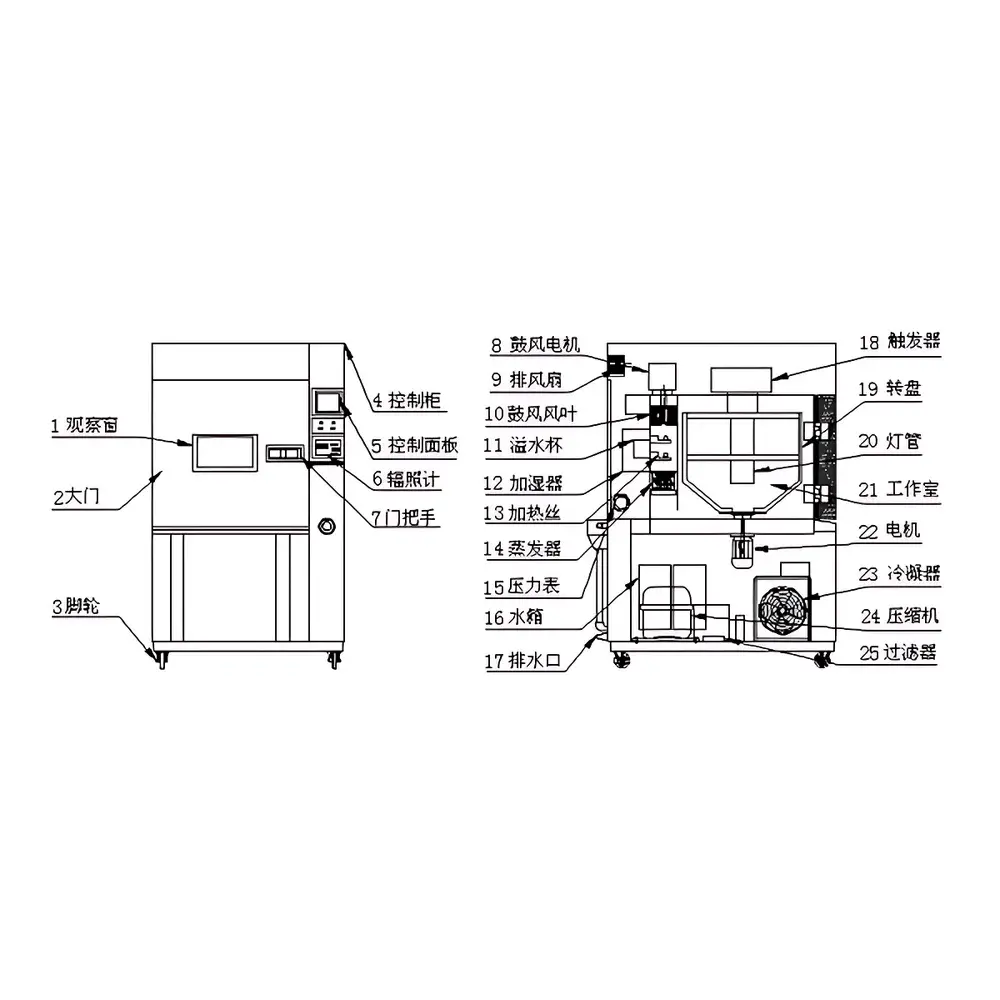
The Apkji AP-XD-A4 Advanced Xenon Arc Weathering Test Chamber is an engineered environmental simulation system designed to accelerate material degradation under controlled exposure to full-spectrum solar radiation, temperature, humidity, and moisture cycling. Utilizing a 3000 W long-arc xenon lamp with high-transmittance optical filtering (≥95% transmission), the chamber replicates critical components of natural sunlight—including UV-A (315–400 nm), UV-B (280–315 nm), visible, and near-infrared wavelengths—enabling quantitative assessment of photostability, colorfastness, gloss retention, cracking, chalking, and embrittlement. Its design adheres to fundamental principles of accelerated weathering science: spectral fidelity, irradiance stability, thermal management consistency, and realistic specimen conditioning (e.g., wet/dry cycles via spray and condensation). The system supports both static and dynamic exposure protocols, including simultaneous irradiation, black panel temperature control, programmable humidity modulation, and mechanical specimen rotation (orbital and self-rotation), ensuring representative stress distribution across test surfaces.
Key Features
- High-fidelity solar spectrum simulation using a stabilized 3000 W xenon arc lamp paired with precision quartz and borosilicate glass filters.
- Digital irradiance control with closed-loop feedback—user-selectable monitoring bands (340 nm, 420 nm, 300–400 nm, or 300–800 nm) for compliance with multiple international test standards.
- Integrated black panel temperature (BPT) and standard black standard thermometer (BST) sensors mounted at identical radial positions relative to specimens, enabling spatially correlated thermal measurement.
- Multi-stage climate control architecture: industrial-grade refrigeration system coupled with intelligent multi-level humidification for rapid, stable regulation of chamber temperature (±0.5°C) and relative humidity (0–98% RH).
- Modular exposure modes: independent programming of irradiation, dark cycles, water spray (rain simulation), condensation (dew formation), orbital rotation (360°), and specimen self-rotation—mimicking diurnal and seasonal climatic transitions.
- Wireless RF transmission of real-time sensor data (irradiance, BPT/BST, humidity, chamber temp) from test zone to controller—eliminating wiring constraints and enhancing measurement integrity.
- 10.1-inch high-resolution capacitive touchscreen interface with animated, numeric, and graphical display modes; intuitive navigation and multi-language support (English default).
- Individual specimen timer functionality—each sample holder maintains independent exposure tracking, enabling concurrent testing of heterogeneous materials under identical environmental conditions.
- Robust construction with corrosion-resistant stainless-steel interior, auto-drain water tray (25 mm depth), and fail-safe thermal overprotection circuits.
Sample Compatibility & Compliance
The AP-XD-A4 accommodates flat-panel specimens up to 75 × 300 mm, secured via standardized clamping fixtures compatible with textile swatches, painted panels, polymer sheets, coated wood substrates, and printed paper. Its operational envelope meets the physical and metrological requirements of key global standards including ISO 105-B02 (color fastness to artificial light), ISO 105-B04 (color fastness to daylight), AATCC TM16-2003 (lightfastness of textiles), GB/T 8427 and GB/T 8430 (Chinese textile weathering standards), GB/T 14576 (photostability of pigments), and GB/T 15102–2006 / GB/T 15104–2006 (decorative laminates and veneers). While not certified to IEC 60068-2-5 or ASTM G155 by default, its irradiance stability (<±2% over 100 h), temperature uniformity (±2°C), and humidity repeatability support GLP-aligned validation protocols and internal method qualification per ISO/IEC 17025 guidelines.
Software & Data Management
The embedded controller firmware provides non-volatile storage of up to 100 test programs with time-stamped logging of all critical parameters (irradiance, BPT, chamber temperature, RH, spray/condensation status) at user-defined intervals (1 s to 60 min resolution). All data are exportable in CSV format via USB port. Optional Ethernet connectivity enables remote monitoring and integration into centralized LIMS environments. Audit trails include operator ID, parameter changes, alarm events, and power interruption logs—supporting traceability requirements under ISO 9001 and FDA 21 CFR Part 11 when paired with appropriate user access controls and electronic signature modules (available as add-on).
Applications
This chamber is routinely deployed in R&D laboratories, quality assurance departments, and third-party testing facilities for evaluating the durability of organic materials exposed to outdoor service conditions. Typical use cases include: quantifying UV-induced fading in automotive interior trim; assessing gloss loss and microcracking in architectural coatings; validating weather resistance of PVC window profiles; screening dye stability in technical textiles subjected to combined light/sweat exposure; and benchmarking photodegradation kinetics of biodegradable polymers. Its ability to decouple and recombine stressors (e.g., UV + moisture without thermal cycling, or UV + heat without humidity) makes it suitable for mechanistic studies on degradation pathways.
FAQ
What spectral output does the xenon lamp provide?
The 3000 W long-arc xenon lamp delivers continuous spectrum from 290 nm to 2500 nm. With optional filter sets, users can isolate UV-A (315–400 nm), UV-B (280–315 nm), or broadband (300–800 nm) irradiation—matching target solar irradiance distributions defined in ISO, ASTM, and AATCC methods.
Can the chamber perform cyclic tests with alternating UV and condensation phases?
Yes. The controller supports fully programmable exposure sequences—including irradiation duration, dark period length, spray duration/frequency, and condensation hold time—with independent timers for each phase.
Is calibration traceable to national standards?
Irradiance sensors are factory-calibrated against NIST-traceable reference detectors. Users may perform field verification using supplied calibration tiles; full recalibration services are available through Apkji’s accredited service centers.
What maintenance is required for long-term reliability?
Recommended quarterly tasks include cleaning optical filters and lamp housing, verifying water tray level and drain function, inspecting spray nozzles for clogging, and validating temperature/humidity sensor drift using portable references. Lamp replacement is typically required every 1500–2000 hours of operation.
Does the system comply with GLP or GMP documentation requirements?
With optional software upgrade (Apkji DataTrace Pro), the system supports electronic signatures, role-based access control, audit trail generation, and 21 CFR Part 11–compliant data archiving—enabling use in regulated pharmaceutical, medical device, and aerospace material qualification workflows.



