
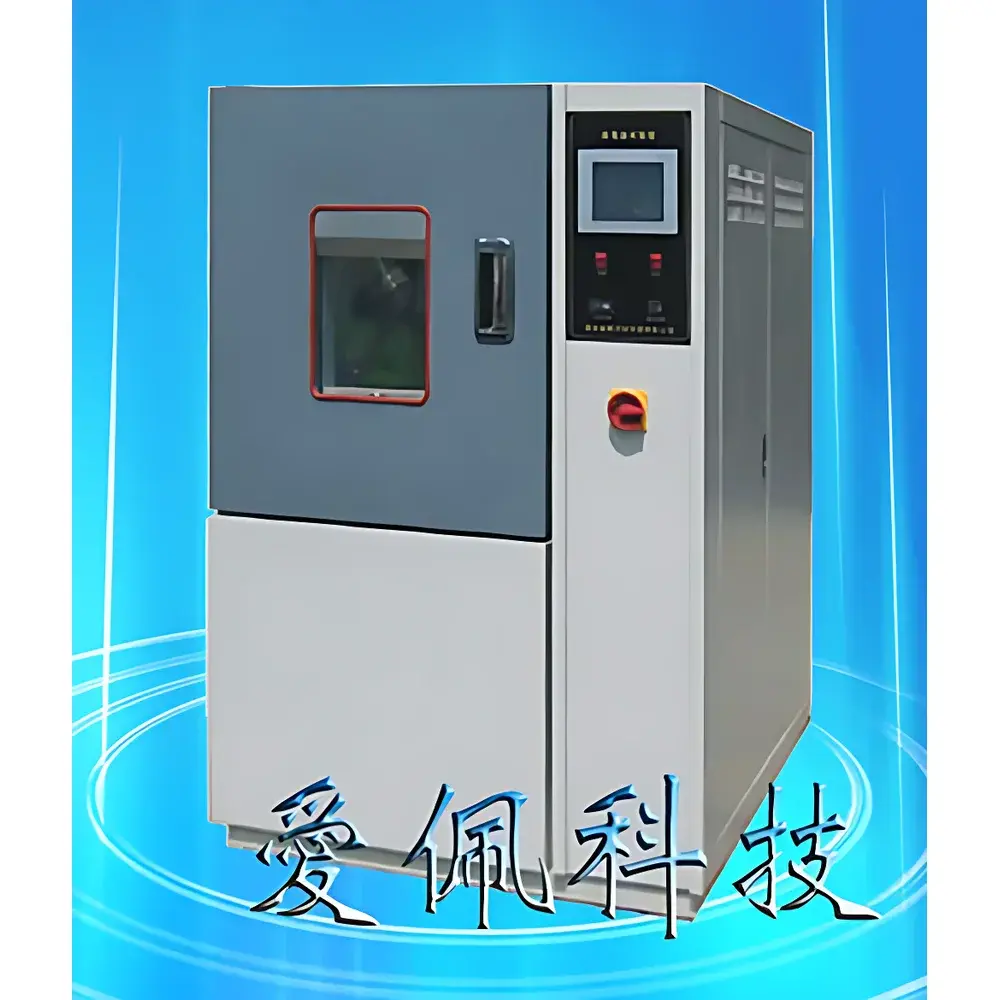
Apkem AP-HX Thermal Shock Test Chamber with Humidity Control
| Brand | Apkem |
|---|---|
| Origin | Guangdong, China |
| Manufacturer Type | OEM/ODM Producer |
| Country of Origin | China |
| Model | AP-HX |
| Price | Upon Request |
| Refrigeration System | Dual-stage cascade refrigeration (Low-temp stage: R23/R508B |
| High-temp stage | R404A/R507) |
| Compressor | Imported hermetic scroll compressor (Tecumseh France) |
| Temperature Range (Test Zone) | -40 °C to +150 °C (Standard A) |
| Optional | -55 °C / -65 °C to +150 °C |
| High-Temp Storage Zone | +60 °C to +200 °C |
| Low-Temp Storage Zone | -10 °C to -75 °C |
| Temp. Transition Time (Test Zone) | ≤10 s |
| Temperature Recovery Time (Test Zone) | ≤5 min |
| Temp. Uniformity | ±2.0 °C (measured at 1/10 distance from chamber walls) |
| Temp. Control Accuracy | ±0.5 °C |
| Compliance | GB/T 10589–1989, GB/T 10592–1989, GB/T 2423.1–1989 (Test Aa/Ab), GB/T 2423.4–1993 (Test Db), MIL-STD-810D Method 502.2 & 507.2 Proc. 3 |
| Interface | LAN + USB |
| Safety | Over-temperature, over-pressure, phase failure, refrigerant leak, and motor overload protection with auto-diagnostic display |
Overview
The Apkem AP-HX Thermal Shock Test Chamber with Humidity Control is an engineered environmental simulation system designed for accelerated reliability assessment under extreme thermal cycling conditions. It implements a three-zone mechanical architecture—comprising separate high-temperature storage, low-temperature storage, and test chambers—enabling rapid, repeatable transitions between extreme thermal states via pneumatic or servo-driven basket transfer mechanisms. Unlike conventional temperature-humidity chambers, the AP-HX executes true thermal shock per IEC 60068-2-14 and MIL-STD-810G Method 503.5, delivering defined dwell times, controlled ramp rates, and precise dwell-to-dwell transition fidelity. Its dual-stage cascade refrigeration system—featuring Tecumseh France hermetic compressors and environmentally compliant refrigerants (R23/R508B in low-stage; R404A/R507 in high-stage)—ensures stable operation down to –65 °C while meeting U.S. EPA SNAP program requirements through 2030 and beyond. The chamber’s structural integrity is reinforced by high-density polyurethane insulation (≥150 mm thick), stainless-steel interior cladding, and double-glazed observation windows with anti-fog heating.
Key Features
- Triple-chamber configuration enabling programmable thermal shock profiles with independent control of high-temp (up to +200 °C) and low-temp (down to –75 °C) storage zones
- High-speed transfer mechanism achieving ≤10-second basket movement between zones and ≤5-minute temperature stabilization in the test zone
- Intelligent controller with Ethernet (LAN) interface supporting remote program editing, real-time data logging, alarm history export, and firmware updates via web browser or dedicated PC software
- Multi-wing centrifugal circulation fan system with adjustable airflow velocity and directional vanes ensuring ±2.0 °C temperature uniformity across the effective test volume (per GB/T 2423.4–1993 Annex A)
- Comprehensive safety architecture including refrigerant pressure monitoring, compressor discharge temperature cutoff, phase-sequence protection, and fail-safe door interlocks with emergency power-off circuitry
- Modular design accommodating non-standard dimensions, extended temperature ranges, humidity integration (optional), and custom mounting fixtures for PCB trays, BGA substrates, or automotive harness assemblies
Sample Compatibility & Compliance
The AP-HX accommodates samples ranging from miniature semiconductor packages (e.g., QFN, WLCSP) to full-size automotive ECUs and aerospace avionics enclosures. Internal dimensions are configurable per ISO 16750-4 and AEC-Q200 requirements, with standard configurations validated for maximum payload volumes up to 500 L. All operational modes—including step-stress, ramp-and-soak, and random thermal profile execution—conform to GLP-aligned data integrity protocols. Calibration traceability follows ISO/IEC 17025 requirements, with optional NIST-traceable sensor validation reports available upon request. The system supports audit-ready documentation generation for FDA 21 CFR Part 11 compliance when paired with Apkem’s validated data management software suite.
Software & Data Management
Control firmware includes embedded audit trail functionality recording all user actions, parameter changes, and alarm events with timestamp, operator ID, and IP address metadata. Raw sensor data (temperature, humidity, pressure, cycle count) is logged at user-selectable intervals (100 ms to 60 s) and stored in CSV or binary format on internal SSD or network-attached storage. Exported datasets include embedded calibration coefficients and uncertainty budgets per ISO/IEC 17025 Clause 7.7. Optional add-ons include automated report generation (PDF/Excel), statistical process control (SPC) charting, and integration with LabVantage LIMS or Siemens Opcenter Quality.
Applications
- Evaluation of solder joint fatigue in automotive ADAS modules under repeated –40 °C ↔ +125 °C cycling (per ISO 16750-4 Section 4.1)
- Qualification testing of ceramic capacitors and MLCCs for aerospace applications per MIL-PRF-55681
- Accelerated aging of polymer-based medical device housings exposed to sterilization-grade thermal cycles
- Verification of hermetic seal integrity in MEMS sensors using thermal gradient-induced stress analysis
- Process validation of conformal coating adhesion on flex-rigid PCBs subjected to 1000+ shock cycles
- Material compatibility screening for battery pack thermal interface materials (TIMs) under dynamic load conditions
FAQ
What standards does the AP-HX comply with for thermal shock validation?
The system meets GB/T 2423.4–1993 (equivalent to IEC 60068-2-14), MIL-STD-810G Method 503.5, and ISO 16750-4 for automotive electronics. Full test reports include uncertainty quantification per ISO/IEC 17025 Annex A.
Can the AP-HX be integrated into an existing factory MES or SCADA system?
Yes—via Modbus TCP/IP or OPC UA protocol support. Apkem provides detailed register maps and sample Python/Node-RED integration scripts.
Is humidity control available as a retrofit option?
Humidity capability (10–98% RH, ±2% RH accuracy) can be added during initial build or retrofitted post-delivery with minimal downtime (typically <72 hours).
What maintenance schedule is recommended for the cascade refrigeration system?
Compressor oil analysis every 2,000 operating hours; refrigerant purity verification annually; heat exchanger cleaning semiannually. Preventive maintenance kits and OEM service contracts are available.
Does Apkem provide IQ/OQ/PQ documentation packages?
Yes—fully customizable qualification packages aligned with ASTM E2500, EU GMP Annex 15, and FDA guidance for computerized systems are included with enterprise-tier orders.



