
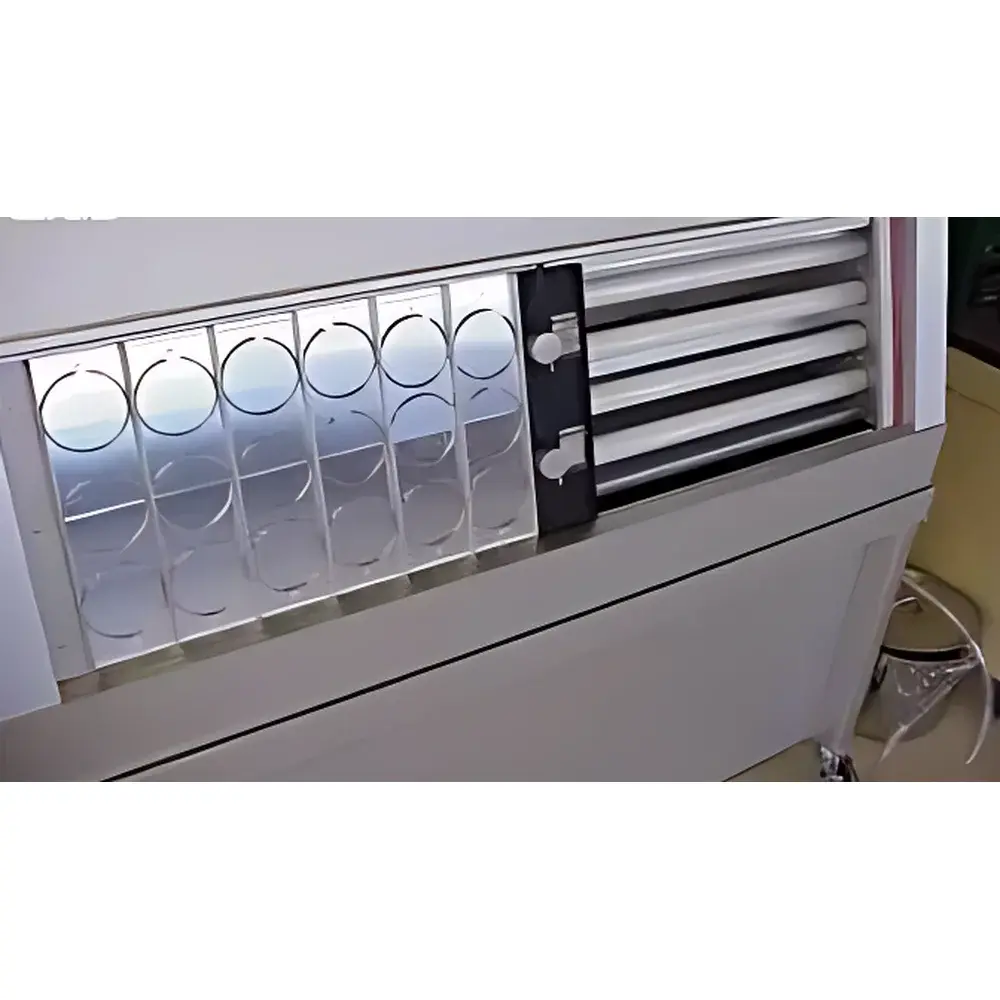
APKJ AP-UV-3 UV Aging Test Chamber
| Brand | APKJ |
|---|---|
| Model | AP-UV-3 |
| Chamber Internal Dimensions | 1170 × 500 × 450 mm (W×H×D) |
| External Dimensions | 1480 × 1300 × 550 mm (W×H×D) |
| Temperature Range | RT+20°C to 70°C |
| Humidity Range | ≥90% RH |
| Temperature Uniformity | ±1°C |
| Temperature Stability | ±0.5°C |
| UV Irradiance Range | Adjustable up to 1.0 W/m² |
| UV Spectrum Options | UVA-340 (315–400 nm) or UVB-313 (280–315 nm), 8 lamps total (4 per side) |
| Lamp Life | ≥1600 h |
| Black Panel Temperature Range | 50–70°C |
| Sample Holder Capacity | 24 standard frames (75 × 290 mm) |
| Sample-to-Lamp Distance | 50 ± 3 mm |
| Lamp Center Spacing | 70 mm |
| Water Tray Depth | 25 mm (auto-controlled) |
| Effective UV Exposure Area | 900 × 210 mm |
| Test Duration | 0–999 h (programmable) |
| Control System | TEMI880 color touchscreen controller (Korean) or RKC intelligent controller |
| Cooling/Condensation Mode | Automatic condensation cycle |
| Spray Function | Integrated automated water spray system |
| Construction Material | Interior & exterior SUS304 stainless steel |
| Compliance Standards | ASTM D822, D750, D1419, D2263, G23 |
| Optional Accessories | UV radiometer (UVA/UVB), RS232 bidirectional communication interface |
Overview
The APKJ AP-UV-3 UV Aging Test Chamber is a precision-engineered environmental test system designed to simulate the photochemical degradation effects of solar ultraviolet radiation under controlled thermal and hygrothermal conditions. It operates on the principle of accelerated UV exposure using fluorescent lamp technology—specifically UVA-340 or UVB-313 lamps—to replicate the most damaging segments of terrestrial sunlight (280–400 nm). Unlike xenon arc systems that emulate full-spectrum solar irradiance, this chamber focuses exclusively on UV-driven degradation mechanisms, making it ideal for evaluating polymer photostability, coating adhesion loss, pigment fading, and surface embrittlement. The chamber integrates programmable UV irradiance control, black-panel temperature monitoring, condensation cycles, and automated water spray to reproduce realistic outdoor weathering stressors—including diurnal UV exposure, nocturnal condensation, and intermittent rain simulation. Its design adheres to core principles of accelerated testing: reproducible spectral output, stable thermal-hygrometric control, and geometrically consistent sample irradiation geometry.
Key Features
- Eight high-stability UV fluorescent lamps (UVA-340 or UVB-313), arranged symmetrically across dual vertical arrays with precise 70 mm center-to-center spacing and fixed 50 ± 3 mm sample-to-lamp distance for uniform irradiance distribution.
- Black panel temperature control (50–70°C) with PID auto-tuning and SSR power regulation ensures accurate specimen surface thermal loading during irradiation cycles.
- Automated condensation cycle via heated water tray (25 mm depth, temperature-regulated) and controlled chamber humidity (≥90% RH) to simulate dew formation on exposed surfaces.
- Integrated spray system delivers calibrated water pulses during dark cycles, replicating natural rainfall-induced thermal shock and leaching effects.
- TEMI880 color touchscreen controller (standard) or RKC intelligent controller provides intuitive programming of multi-step test profiles—including independent control of UV intensity, irradiation duration, condensation time, and spray frequency.
- SUS304 stainless steel construction throughout interior and exterior surfaces ensures long-term corrosion resistance and compliance with ISO 4892-3 material compatibility requirements.
- Comprehensive safety architecture including漏电断路器 (RCD)-based overcurrent protection, real-time overtemperature cutoff, low-water level detection, and automatic fault logging.
Sample Compatibility & Compliance
The AP-UV-3 accommodates up to 24 standard specimens (75 × 290 mm) mounted on an aluminum frame holder, optimized for flat, rigid materials such as plastics, paints, textiles, automotive trim, roofing membranes, and packaging films. Its irradiance profile and thermal management meet the geometric and metrological requirements of ASTM D822 (Standard Practice for Conducting Accelerated Weathering Tests of Paintings and Related Coatings Using Fluorescent UV-Condensation Devices), ASTM G23 (Practice for Operating Light-Exposure Apparatus [Fluorescent UV-Condensation Type] for Exposure of Nonmetallic Materials), and ISO 4892-3 (Plastics — Methods of exposure to laboratory light sources — Part 3: Fluorescent UV lamps). It supports full traceability in GLP environments through optional RS232 bidirectional communication and audit-ready event logging. All operational parameters—including irradiance setpoint, black panel temperature, cycle timing, and alarm history—are timestamped and exportable for regulatory review per FDA 21 CFR Part 11 requirements when paired with validated software.
Software & Data Management
While the base configuration utilizes embedded firmware on the TEMI880 or RKC controller, the system supports integration into centralized laboratory data management platforms via its optional RS232 interface. Test profiles are stored internally with versioning capability; each run generates a machine-readable log file containing start/stop timestamps, cumulative UV dose (J/m²), black panel temperature history, and deviation alerts. Optional UV radiometers (UVA/UVB-selective) enable real-time irradiance validation against NIST-traceable calibration standards. For quality assurance workflows, the controller supports password-protected parameter locking, user-defined test templates, and configurable alarm thresholds—all critical for maintaining consistency across multi-site validation studies and supplier qualification programs.
Applications
This chamber is routinely deployed in R&D laboratories and QC departments for predictive lifetime assessment of UV-sensitive materials. Typical use cases include: evaluating UV stabilizer efficacy in polyolefins and PVC formulations; quantifying gloss retention and chalking resistance in architectural coatings; validating colorfastness of textile dyes per AATCC TM16; assessing delamination onset in laminated safety glass interlayers; screening photoinitiator performance in UV-curable inks; and verifying weathering resistance of aerospace sealants per MIL-STD-810G Method 505.5. Its narrow-band UV output enables targeted investigation of wavelength-dependent degradation pathways—e.g., comparing UVA-induced chain scission versus UVB-triggered oxidative crosslinking—without spectral interference from visible or IR components.
FAQ
What UV lamp types are supported, and how do they differ in application?
The AP-UV-3 accepts either UVA-340 or UVB-313 fluorescent lamps. UVA-340 closely matches terrestrial sunlight down to 315 nm and is recommended for general-purpose polymer and coating testing. UVB-313 emits shorter, more aggressive wavelengths (down to 280 nm) and is used for highly accelerated testing or materials known to degrade primarily under short-wave UV.
Is calibration of UV irradiance required, and how often?
Yes. Per ASTM G154 Section 7.3, irradiance sensors must be calibrated annually against a NIST-traceable reference standard. Optional integrated UVA/UVB radiometers facilitate in-situ verification prior to each test series.
Can the chamber operate unattended for extended durations?
Yes. With its robust stainless steel construction, redundant safety interlocks, and non-volatile memory for program retention, the AP-UV-3 supports fully autonomous operation for up to 999 hours without manual intervention.
Does the system comply with FDA 21 CFR Part 11 for electronic records?
The base controller does not provide Part 11-compliant audit trails; however, when interfaced with validated third-party LIMS or ELN software via RS232, full electronic signature, change control, and archival functionality can be implemented per organizational SOPs.
What maintenance is required to sustain measurement accuracy?
Lamp replacement every 1600 hours (or per irradiance decay >10%), quarterly cleaning of lamp reflectors and quartz sleeves, biannual verification of black panel sensor calibration, and annual full-system calibration by APKJ-certified service engineers.



