
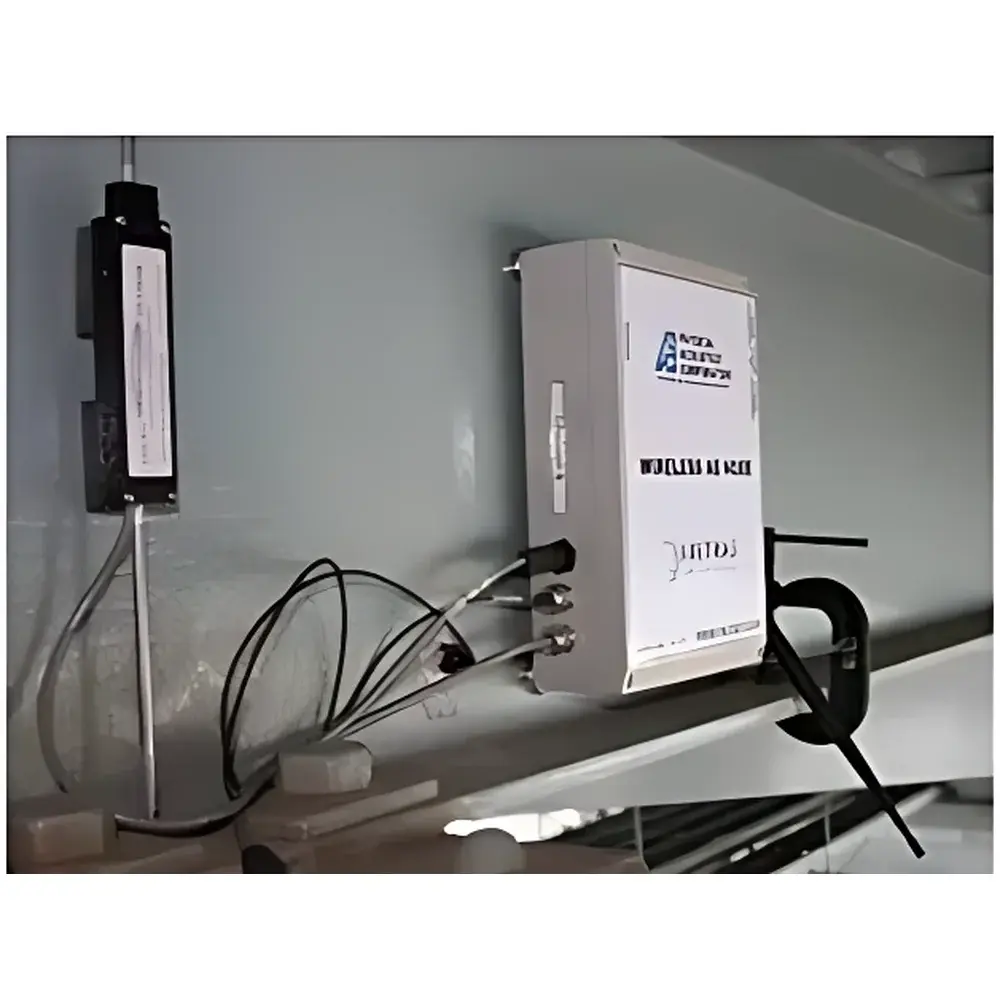
Physical Acoustics Sensor Highway II/III All-Weather Structural Health Monitoring System
| Origin | USA |
|---|---|
| Manufacturer Type | Authorized Distributor |
| Import Status | Imported |
| Model | Sensor Highway II / III |
| Instrument Category | Acoustic Emission (AE) & Multi-Parameter Structural Health Monitoring System |
| Operating Temperature Range | -35°C to +70°C |
| Power Supply | 10–28 VDC or 95–250 VAC |
| Power Consumption | 15 W (typical) |
| Dimensions | 40 cm × 50 cm × 20 cm |
| AE Channels | Up to 16 (expandable via four 4-channel micro-AE cards) |
| AE Frequency Bandwidth | 1 kHz – 1 MHz |
| Vibration Bandwidth | 1 Hz – 20 kHz |
| A/D Resolution | 18-bit |
| Sampling Rate | 20 MS/s (AE), 10 kS/s (16 low-speed external parameter channels) |
| IP Rating | IP67-rated enclosure (for outdoor deployment) |
| Communication Interfaces | Gigabit Ethernet, RS-232, RS-422, USB, CompactFlash |
Overview
The Physical Acoustics Sensor Highway II/III is an engineered all-weather structural health monitoring (SHM) platform designed for long-term, unattended operation in demanding field environments. Based on acoustic emission (AE) sensing and synchronized multi-parameter data acquisition, the system detects transient elastic wave events generated by active damage mechanisms—including crack initiation and propagation, fiber breakage, delamination, corrosion-induced pitting, and fluid leakage—within metallic, composite, and concrete structures. Unlike periodic inspection tools, Sensor Highway II/III delivers continuous, time-synchronized waveform and parametric data streams from distributed sensor networks, enabling condition-based assessment, progressive damage tracking, and predictive maintenance planning. Its ruggedized architecture supports deployment across civil infrastructure (bridges, tunnels, dams), energy assets (transformers, pipelines, wind turbine towers), geotechnical sites (landslides, mine shafts), and industrial facilities—operating reliably under extreme ambient conditions from -35°C to +70°C without thermal derating or environmental shielding.
Key Features
- Ruggedized IP67-rated enclosure with reinforced shock, rain, dust, and UV resistance—certified for permanent outdoor installation without climate-controlled housing.
- Modular AE acquisition architecture: scalable up to 16 high-fidelity AE channels using four independent 4-channel micro-AE cards, each supporting real-time hit detection, waveform capture, and feature extraction.
- Integrated 16-channel low-speed analog input subsystem for simultaneous acquisition of non-AE parameters—including strain (via Wheatstone bridge), temperature (RTD/thermocouple), pressure, acceleration (IEPE), tilt, humidity, and meteorological variables.
- High-resolution signal conditioning: 18-bit A/D conversion at 20 MS/s per AE channel, with programmable gain, threshold, and filter settings (high-pass, low-pass, band-pass) to suppress electromagnetic interference and mechanical noise.
- Low-power design: nominal 15 W consumption enables battery or solar-powered operation for remote or off-grid deployments; compatible with PK-series low-noise AE sensors.
- Flexible power options: accepts wide-range DC (10–28 V) or AC (95–250 V) input; includes built-in surge protection and undervoltage lockout.
Sample Compatibility & Compliance
The Sensor Highway II/III is compatible with industry-standard AE sensors (e.g., PAC R15a, PICO, and WD series), triaxial accelerometers, foil strain gauges, LVDTs, thermistors, and industrial-grade weather stations. It supports sensor calibration traceable to NIST standards and integrates seamlessly into existing SCADA or IIoT frameworks. The system complies with IEC 60255-27 (electromagnetic immunity), EN 61000-6-2/6-4 (EMC), and UL 61010-1 (safety). Data integrity and auditability meet GLP/GMP requirements through timestamped metadata, hardware-level event logging, and optional FDA 21 CFR Part 11-compliant software modules (available via AEwin v7.5+). All firmware and configuration files are digitally signed to prevent unauthorized modification.
Software & Data Management
AEwin software serves as the unified interface for system configuration, real-time visualization, automated analysis, and report generation. Its modular architecture supports both local workstation use and remote web-based access via secure HTTPS/TLS. Key capabilities include: synchronized multi-channel waveform viewing with adjustable time-base and amplitude scaling; parametric trend analysis (amplitude, energy, counts, duration, rise time); customizable alarm logic (threshold-based, rate-of-change, pattern-matching); spectral analysis (FFT, STFT, wavelet decomposition); and export to CSV, HDF5, or MATLAB-compatible formats. Data archival follows ISO/IEC 17025-compliant practices, with automatic backup to network-attached storage (NAS) or cloud repositories. Remote firmware updates and diagnostic telemetry are supported over encrypted SSH or TLS connections.
Applications
- Continuous crack growth monitoring in steel and post-tensioned concrete bridges—including cable break detection in suspension and cable-stayed structures.
- Online partial discharge (PD) mapping in high-voltage power transformers and GIS systems, correlating AE activity with electrical test data.
- Early-stage landslide deformation tracking via distributed AE and inclinometer arrays embedded in slope stabilization systems.
- Real-time leak localization in pressurized hydrocarbon pipelines and nuclear coolant loops using triangulated AE source location algorithms.
- Integrity verification of tunnel linings during excavation and service life, detecting spalling, delamination, and joint displacement.
- Safety-critical monitoring of mining conveyors, hoists, and roof support systems under dynamic loading and corrosive atmospheres.
FAQ
Can Sensor Highway II/III operate autonomously for extended periods without human intervention?
Yes—the system is engineered for unattended operation up to 10 years when paired with appropriate power management (e.g., solar-charged lithium iron phosphate batteries) and redundant data transmission paths (dual Ethernet + cellular fallback).
Does the system support integration with third-party SCADA or cloud platforms?
Yes—it provides OPC UA, Modbus TCP, and MQTT interfaces for bidirectional communication with enterprise asset management (EAM) and digital twin platforms.
Is AE source location accuracy validated against ASTM E1316 standards?
Yes—location algorithms comply with ASTM E1316 Section 3.1.3 (Acoustic Emission Standard Terminology) and support time-difference-of-arrival (TDOA) solutions with sub-meter resolution in homogeneous media.
How is data security ensured during remote access and firmware updates?
All network communications use TLS 1.2+ encryption; firmware images are cryptographically signed and verified before installation; role-based access control (RBAC) enforces granular user permissions.
What is the maximum recommended sensor spacing for reliable AE detection in concrete structures?
For typical reinforced concrete bridges, optimal AE sensor spacing ranges from 0.5 m to 2.0 m depending on expected source energy and attenuation characteristics—validated per guidelines in ACI 437R and fib Bulletin 80.



