
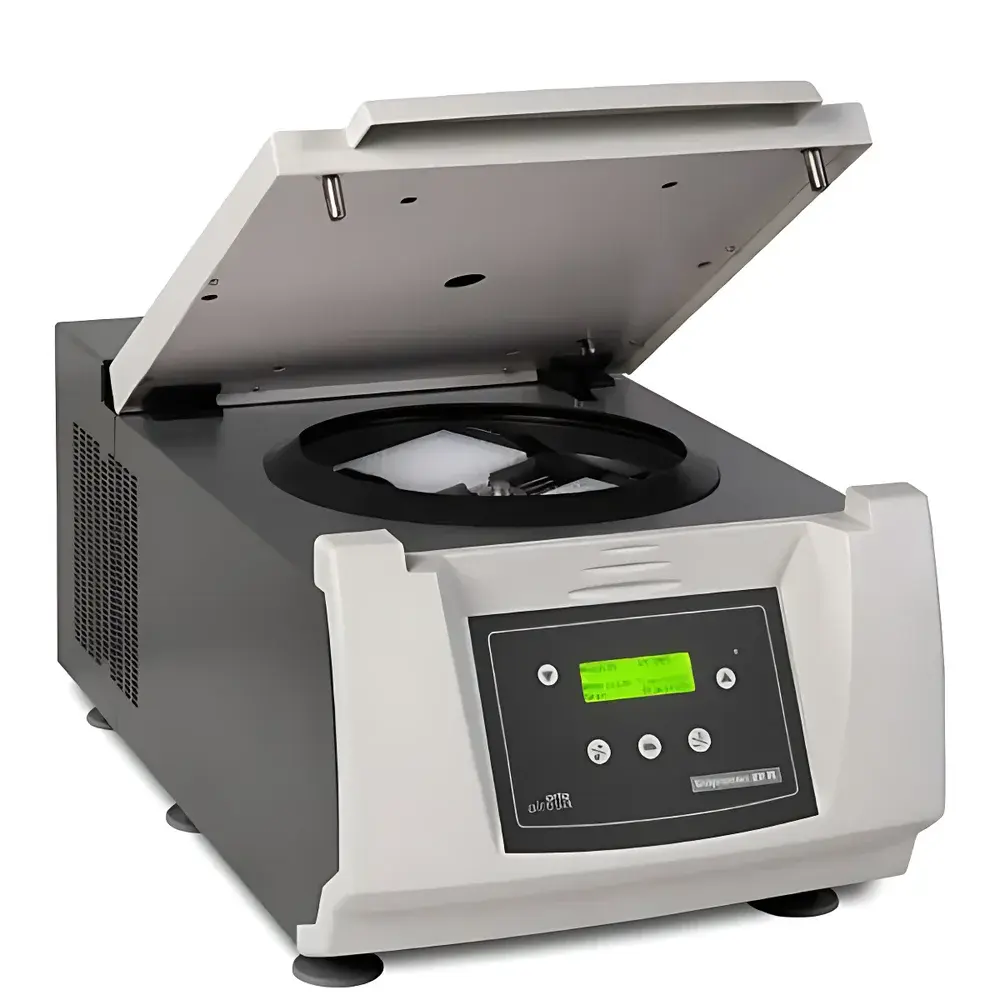
Analysis Bioprocen 22 R Refrigerated Microcentrifuge
| Brand | Analysis |
|---|---|
| Origin | Spain |
| Manufacturer Type | Manufacturer |
| Product Category | Imported |
| Model | Bioprocen 22 R |
| Instrument Type | Benchtop Centrifuge |
| Speed Range | High-Speed (10,000–30,000 rpm) |
| Function | Refrigerated Centrifuge |
| Configuration | Fixed-Angle Rotor Centrifuge |
| Max Capacity | 6 × 50 mL |
| Max Speed | 18,100 rpm |
| Max RCF | 31,865 × g |
| Dimensions (W×D×H) | 410 × 690 × 320 mm |
Overview
The Analysis Bioprocen 22 R is a high-performance benchtop refrigerated microcentrifuge engineered for precision separation of biological samples under controlled thermal conditions. It operates on the principle of centrifugal force generation via high-speed rotation of fixed-angle rotors, enabling rapid sedimentation of macromolecules, cellular organelles, and particulates based on density, size, and shape differences. Designed for demanding applications in molecular biology, clinical diagnostics, and biopharmaceutical QC laboratories, the Bioprocen 22 R delivers reproducible RCF values up to 31,865 × g at 18,100 rpm—optimized for both microvolume tubes (1.5–5 mL) and larger conical tubes (up to 50 mL). Its integrated refrigeration system maintains chamber temperature stability across the full operational speed range, ensuring sample integrity during prolonged or high-intensity runs.
Key Features
- Microprocessor-controlled brushless induction motor ensures maintenance-free operation, extended service life, and precise speed regulation with ±10 rpm accuracy.
- Intuitive 5.7-inch LCD display shows real-time RPM, RCF, elapsed/remaining time, set temperature, and programmable acceleration/deceleration profiles (PCBS).
- Progressive Control Braking System (PCBS) offers 175 selectable ramp profiles to minimize post-run resuspension and preserve pellet integrity—critical for RNA, DNA, and protein purification workflows.
- 16 user-programmable protocols with automatic rotor recognition and memory retention of last-used parameters—including speed, time, temperature, and brake profile.
- Acoustic and visual alarm system provides immediate feedback for lid status, imbalance detection, temperature deviation, rotor mismatch, and emergency stop events.
- Electric dual-lock lid mechanism with auto-engagement, emergency manual release, drop protection, and calibration port—compliant with EN 61010-2-020 mechanical safety requirements.
- Noise emission <60 dB(A) at maximum speed, enabling quiet operation in shared laboratory environments.
Sample Compatibility & Compliance
The Bioprocen 22 R accommodates diverse sample formats including 1.5–5 mL microtubes, 15–50 mL conical tubes, and standard 96-well microplates via optional adapters. All rotors and tube adapters are autoclavable (121°C, 20 min), supporting GLP-compliant decontamination protocols. The stainless-steel centrifuge chamber facilitates rapid cleaning and corrosion resistance. Regulatory compliance includes CE marking per EU Directives 2011/65/EU (RoHS), 2012/19/EU (WEEE), 2014/30/EU (EMC), 2014/35/EU (LVD), and 98/79/EC (IVDR). Electrical safety conforms to EN 61010-1 and EN 61010-2-101; electromagnetic compatibility meets EN 61326-1 and EN 61326-2-6. Refrigerant R-449A complies with Regulation (EU) No 517/2014 and (EC) No 1005/2009 for low-GWP alternatives.
Software & Data Management
While the Bioprocen 22 R operates as a standalone instrument, its firmware architecture supports audit-ready operation in regulated environments. All parameter changes—including speed, time, temperature, and brake settings—are logged internally with timestamping. The device retains run history for the most recent 100 cycles, accessible via front-panel navigation. For integration into LIMS or electronic lab notebook (ELN) systems, optional RS-232 or USB-to-serial interfaces enable export of protocol metadata and event logs. Firmware updates maintain alignment with evolving ISO/IEC 17025 documentation requirements and support traceability for FDA 21 CFR Part 11–aligned validation packages when deployed in GMP/QSR settings.
Applications
- High-yield pelleting of bacterial and mammalian cells prior to lysis.
- Clarification of lysates and supernatants in nucleic acid and protein extraction workflows.
- Separation of extracellular vesicles (exosomes) and lipoprotein fractions from plasma or serum.
- Concentration of dilute antibody or enzyme solutions without denaturation.
- Routine quality control of vaccine formulations, cell therapy products, and sterile filtration validation samples.
- Pre-analytical processing in clinical microbiology and hematology labs requiring strict temperature control (e.g., cold-chain-sensitive biomarkers).
FAQ
What is the minimum and maximum operating temperature range?
The chamber temperature is adjustable from –20°C to +40°C in 1°C increments, with active cooling maintained at full speed (18,100 rpm) to ensure stable 4°C operation.
Does the centrifuge support rotor pre-cooling?
Yes—pre-cooling mode allows chamber equilibration to the set temperature before rotor insertion, with optional rotor-spinning during cooldown to accelerate thermal stabilization.
How is rotor imbalance detected and managed?
Integrated vibration sensors continuously monitor rotational symmetry; if imbalance exceeds ISO 21501-4 thresholds, the unit automatically decelerates and halts with audible/visual alert.
Is the Bioprocen 22 R compatible with ISO 13485 or GMP environments?
Its design supports IQ/OQ/PQ validation, electronic log retention, and autoclavable components—enabling deployment in medical device manufacturing and pharmaceutical QC labs adhering to ISO 13485:2016 and EU Annex 11.
What safety certifications apply to the refrigeration system?
The R-449A refrigerant and sealed compressor assembly comply with EU F-Gas Regulation (EU) 517/2014 and IEC 60335-2-40 for hermetic refrigeration safety.



