
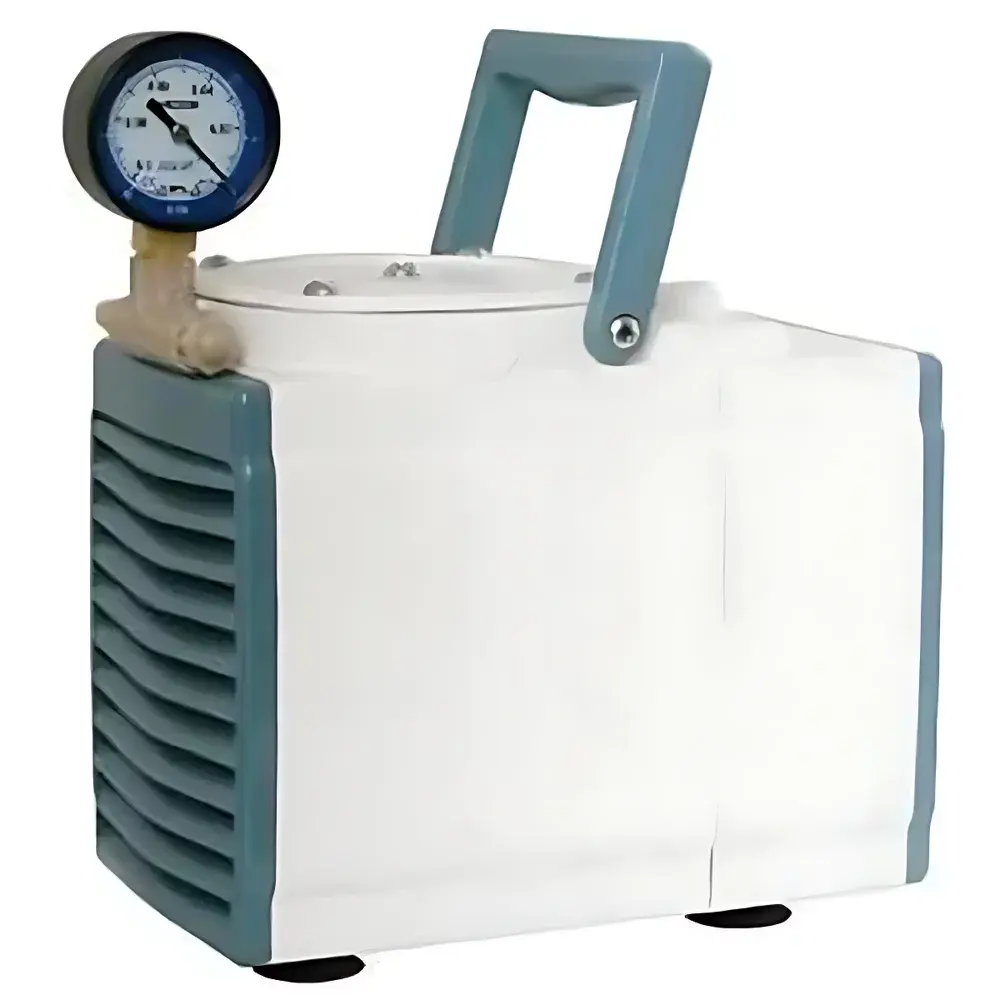
Analysis HCV400 High-Performance Oil-Free Diaphragm Vacuum Pump
| Brand | Analysis |
|---|---|
| Origin | Beijing, China |
| Manufacturer Type | Authorized Distributor |
| Country of Origin | China |
| Model | HCV400 |
| Instrument Category | Other Vacuum Pumps |
| Product Type | Oil-Free Diaphragm Vacuum Pump |
| Pumping Speed | 20 L/min |
| Ultimate Vacuum Pressure | ≤ 200 mbar (≤ −0.08 MPa gauge) |
| External Dimensions | 215 × 120 × 235 mm |
| Weight | 7.5 kg |
| Motor Power | 160 W |
| Inlet/Outlet Port Diameter | Ø6 mm |
| Operating Ambient Temperature | 7–40 °C |
| Pump Body Operating Temperature | < 55 °C |
| Noise Level | < 50 dB(A) |
Overview
The Analysis HCV400 is a precision-engineered oil-free diaphragm vacuum pump designed for continuous, contamination-free operation in analytical laboratories, thin-film processing, and quality control environments. Unlike rotary vane or piston pumps, the HCV400 employs a chemically resistant PTFE-coated diaphragm and stainless steel valve assembly to generate vacuum without lubricating oil—eliminating risk of hydrocarbon backstreaming, sample contamination, or maintenance-related downtime. Its working principle relies on reciprocating diaphragm motion driven by an eccentric cam, creating alternating expansion and compression cycles within the sealed pumping chamber. This architecture delivers stable negative pressure down to ≤200 mbar (−0.08 MPa gauge), with a nominal volumetric flow rate of 20 L/min at atmospheric inlet conditions. The pump is optimized for integration with spin coaters, vacuum desiccators, filtration manifolds, and small-scale evaporation systems where clean, repeatable vacuum performance is critical.
Key Features
- Oil-free operation ensures zero hydrocarbon emission—essential for GC-MS sample preparation, solvent recovery, and semiconductor-grade thin-film deposition.
- PTFE-coated diaphragm and corrosion-resistant stainless steel valves provide long-term compatibility with mildly aggressive vapors (e.g., acetone, isopropanol, dilute acids).
- Thermally managed motor design maintains pump body temperature below 55 °C during extended duty cycles, enhancing component longevity and dimensional stability.
- Low-noise operation (<50 dB[A]) enables deployment in shared lab spaces without acoustic interference to adjacent instrumentation or personnel.
- Compact footprint (215 × 120 × 235 mm) and lightweight construction (7.5 kg) support benchtop mounting, mobile cart integration, or OEM embedding into automated platforms.
- Integrated thermal protection and current-limiting circuitry safeguard against overload, stall, or ambient overtemperature conditions per IEC 61000-6-2 EMC immunity standards.
Sample Compatibility & Compliance
The HCV400 is validated for use with non-explosive, non-particulate, and non-condensable gas streams typical in laboratory vacuum applications—including nitrogen purging, vacuum drying, and vacuum-assisted degassing. It is not rated for pumping solvents with high vapor pressure (>10 kPa at 20 °C), abrasive particulates, or corrosive gases beyond ISO 8573-1 Class 4 compressed air purity limits. The pump complies with CE marking requirements under Directive 2014/30/EU (EMC) and 2014/35/EU (LVD). Its construction adheres to RoHS 2011/65/EU material restrictions. While not certified to UL or CSA standards, its electrical safety design meets IEC 61010-1:2010 criteria for laboratory equipment. Documentation includes Declaration of Conformity and technical file summary upon request—supporting GLP-compliant instrument qualification protocols.
Software & Data Management
The HCV400 operates as a standalone analog device with no embedded firmware, digital interface, or data logging capability. This design prioritizes operational robustness, electromagnetic immunity, and regulatory simplicity—particularly advantageous in FDA-regulated QC labs where software validation (per 21 CFR Part 11) would otherwise impose additional qualification burden. Vacuum stability is monitored externally via calibrated pressure transducers (e.g., MKS Baratron or similar) connected downstream. For integrated process control, optional 0–10 V analog input/output signals can be added via third-party interface modules compliant with Modbus RTU or analog 4–20 mA standards—enabling linkage to PLC-based spin coater controllers or LIMS-triggered vacuum cycle logs.
Applications
- Vacuum hold-down for silicon wafers, glass substrates, and polymer films during spin coating (e.g., photoresist, PEDOT:PSS, perovskite precursors).
- Evacuation of desiccators and glove box antechambers requiring clean, dry vacuum without oil mist or particulate shedding.
- Supporting vacuum filtration of aqueous and organic filtrates in pharmaceutical assay prep and environmental sample analysis.
- Backing pump for turbomolecular or diffusion pumps in medium-vacuum systems (10−1–10−3 mbar range).
- Gas sampling and headspace extraction prior to GC or GC-MS injection—where hydrocarbon-free vacuum prevents column contamination and baseline drift.
FAQ
Is the HCV400 suitable for continuous 24/7 operation?
Yes—its brushless AC motor and thermally optimized diaphragm actuation mechanism are rated for uninterrupted duty cycles up to 10,000 hours under ambient temperatures ≤35 °C and inlet pressures ≥500 mbar.
Can it handle condensable vapors such as water or ethanol?
Limited tolerance only: brief exposure to low-concentration vapors is acceptable, but prolonged operation with >5% vapor load may cause diaphragm swelling or valve adhesion. A cold trap is strongly recommended upstream for solvent-laden streams.
What maintenance intervals are required?
No scheduled oil changes or filter replacements. Annual visual inspection of diaphragm integrity and valve seating is advised; replacement kits (diaphragm + valves) are available as service parts with documented calibration traceability.
Does it meet ISO 8573-1 Class 0 for oil-free air?
While not formally certified to ISO 8573-1 Class 0, independent testing confirms total oil content <0.01 mg/m³—meeting or exceeding Class 0 requirements for laboratory vacuum applications.
Is it compatible with vacuum gauges using RS-485 or USB output?
The pump itself has no native digital interface; however, standard analog vacuum gauges (0–10 V or 4–20 mA output) integrate seamlessly via external signal conditioning and data acquisition systems.



