
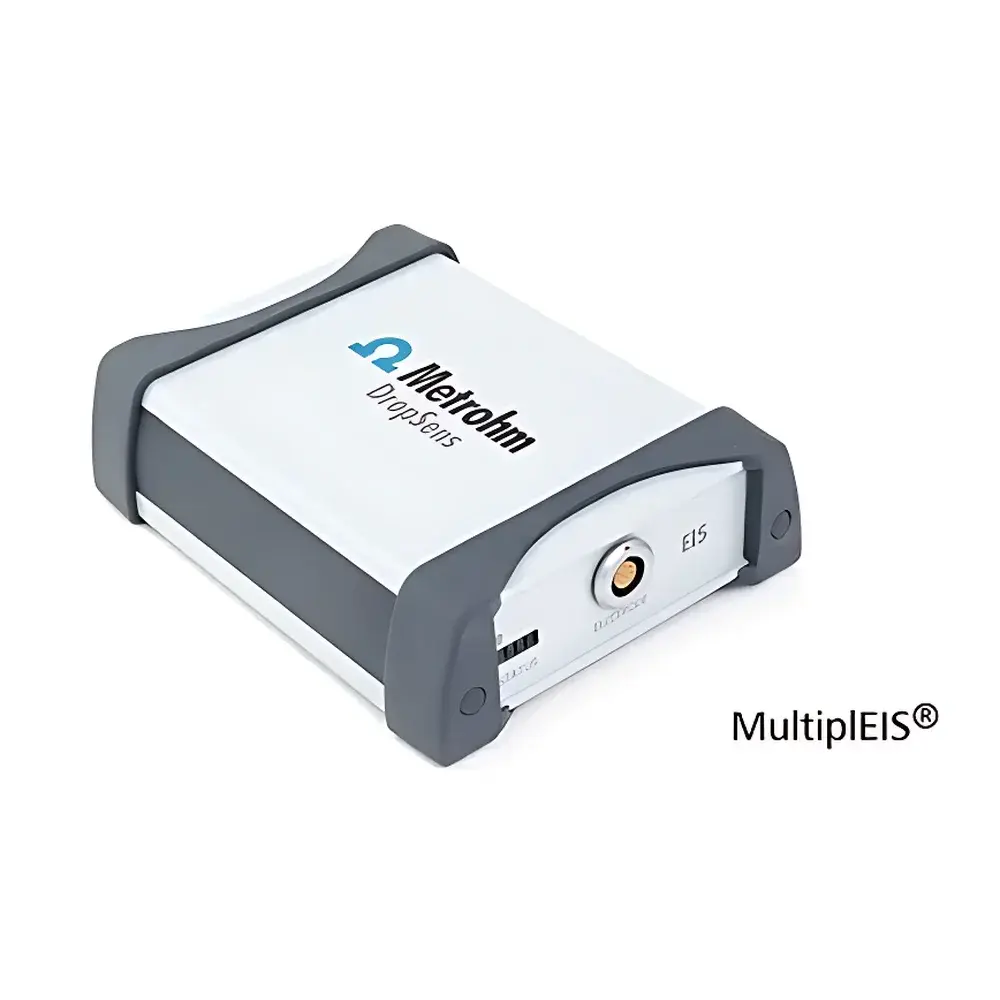
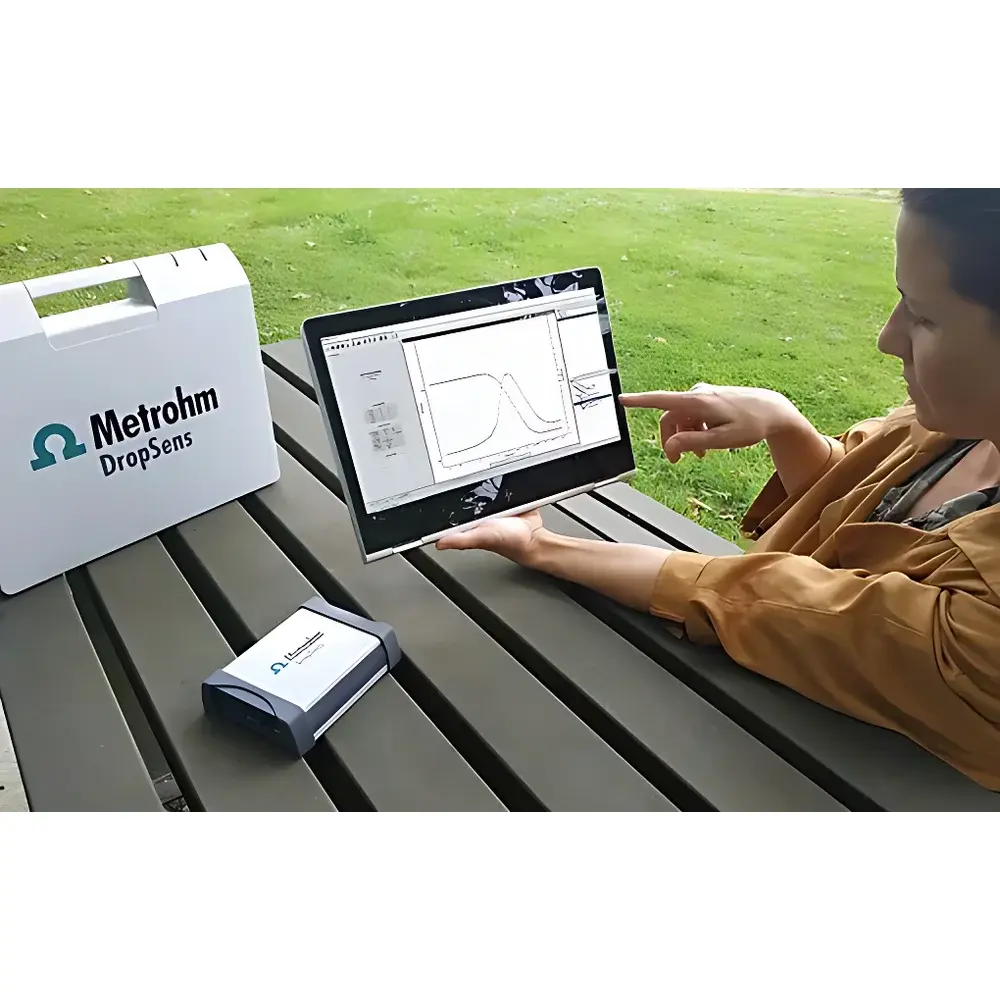
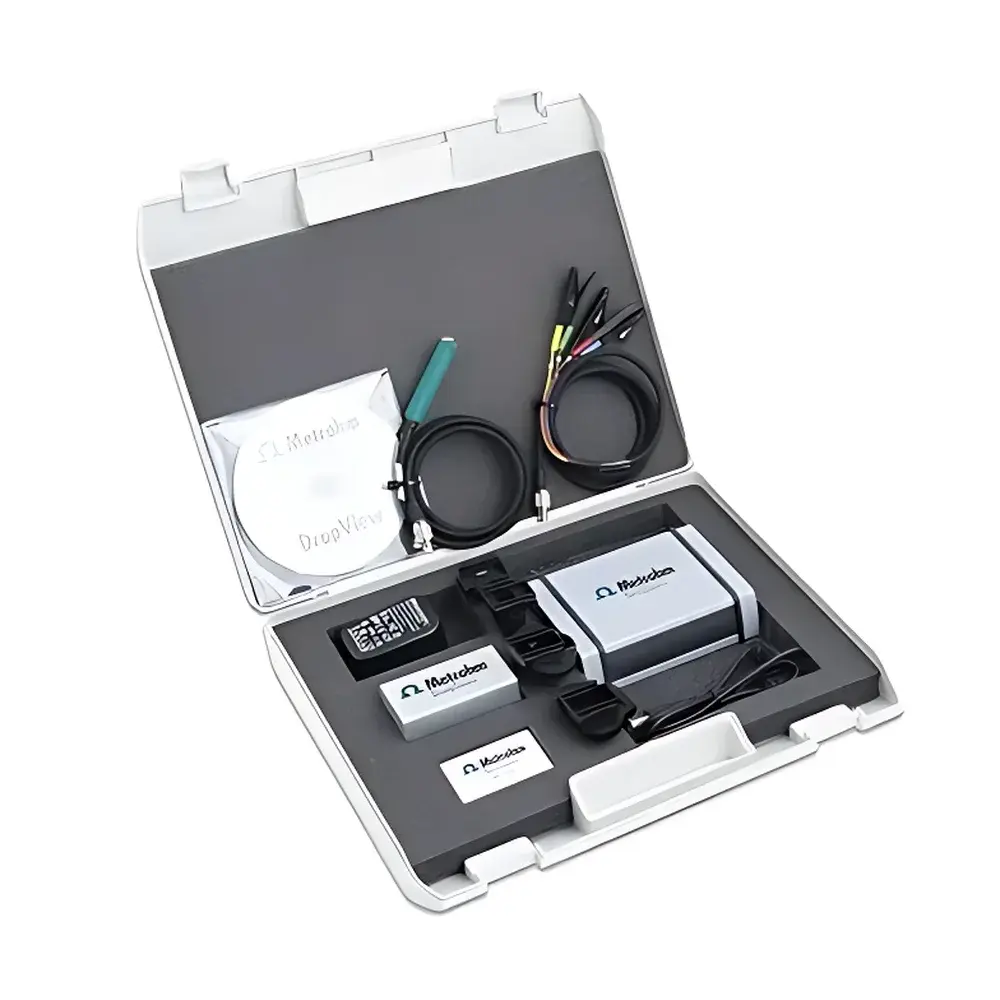
Metrohm DropSens μ-Stat-i 400(s) Portable Potentiostat/Galvanostat/EIS Analyzer
| Brand | Metrohm DropSens |
|---|---|
| Origin | Netherlands |
| Manufacturer | Yes |
| Import Status | Imported |
| Model | μ-Stat-i 400(s) |
| Instrument Type | Portable Electrochemical Workstation |
| Channel Count | Single-Channel |
| Current Range | ±1 nA to ±10 mA |
| Current Accuracy | ≤ 0.5 % of full scale (at 100 nA–10 mA) |
| Potential Accuracy | ±0.2 % |
| Potentiostatic Range | ±4 V |
| EIS Frequency Range | 1 mHz to 1 MHz |
Overview
The Metrohm DropSens μ-Stat-i 400(s) is a compact, battery-powered, wireless potentiostat/galvanostat with integrated electrochemical impedance spectroscopy (EIS) capability. Engineered for precision and field-deployable robustness, it operates on the fundamental principles of controlled-potential and controlled-current electrochemistry, enabling quantitative analysis of interfacial charge-transfer kinetics, double-layer capacitance, diffusion-controlled processes, and bulk solution resistance. Its architecture supports standard three-electrode configurations (working, reference, counter) and is optimized for low-noise current measurement down to the sub-nanoampere range—critical for biosensor characterization and corrosion monitoring under near-open-circuit conditions. Unlike benchtop systems requiring AC power and shielding, the μ-Stat-i 400(s) delivers laboratory-grade reproducibility in non-laboratory environments, including industrial sites, environmental monitoring stations, and educational field labs.
Key Features
- True portable operation: Integrated rechargeable Li-ion battery supports >8 hours of continuous EIS or voltammetric scanning without external power.
- Wireless connectivity via Bluetooth 5.0 and USB-C interface—enables real-time data streaming to Windows, macOS, and Android platforms without driver installation.
- MultiplEIS® technology: Simultaneous multi-frequency excitation and phase-sensitive detection across the full 1 mHz–1 MHz bandwidth, minimizing measurement time while preserving spectral fidelity.
- Single-channel architecture with programmable analog front-end: Supports potentiodynamic, potentiostatic, galvanostatic, and hybrid modes—including cyclic voltammetry (CV), linear sweep voltammetry (LSV), chronoamperometry (CA), chronopotentiometry (CP), and open-circuit potential (OCP) tracking.
- Ruggedized aluminum housing (IP54-rated) with anti-static coating—designed for mechanical durability and electromagnetic interference (EMI) resilience in uncontrolled ambient settings.
- Onboard memory (16 GB) with timestamped, encrypted storage—ensures audit-ready raw data retention independent of host device availability.
Sample Compatibility & Compliance
The μ-Stat-i 400(s) is compatible with standard screen-printed electrodes (SPEs), disk microelectrodes, carbon paste, gold, platinum, and modified electrode substrates used in biosensing, corrosion coupon testing, and microbial fuel cell (MFC) anode/cathode evaluation. It meets functional requirements for ASTM G59 (potentiostatic polarization for corrosion rate determination), ISO 17475 (electrochemical noise analysis), and USP supporting electrochemical validation of pharmaceutical sensor coatings. While not certified as GMP-compliant hardware per se, its firmware implements secure user authentication, electronic signature support, and 21 CFR Part 11–compliant audit trail logging when operated with DropView 2.0 software in validated environments.
Software & Data Management
DropView 2.0 (Windows/macOS) provides full instrument control, real-time visualization, and post-acquisition modeling—including equivalent circuit fitting (ECF) using Randles, Voigt, and custom topologies with Levenberg–Marquardt optimization. All datasets are saved in HDF5 format with embedded metadata (timestamp, electrode ID, environmental temperature, calibration history). The software supports batch processing for corrosion rate calculation via Tafel extrapolation or polarization resistance (Rp) methods per ASTM G102. Export options include CSV, MATLAB .mat, and standardized MIRIBEL-compliant JSON for interoperability with LIMS and ELN platforms. Firmware updates are delivered over-the-air (OTA) with SHA-256 integrity verification.
Applications
- Corrosion science: In-situ monitoring of passive film stability on stainless steel, aluminum alloys, and coated pipelines using low-frequency EIS and potentiodynamic scans.
- Biosensor development: Label-free detection of DNA hybridization, antigen–antibody binding, and enzymatic activity via impedance change quantification at functionalized SPEs.
- Energy materials: Characterization of redox-active polymers, solid electrolytes, and catalyst layers in dye-sensitized solar cells (DSSCs) and proton-exchange membrane fuel cells (PEMFCs).
- Environmental electroanalysis: Field-deployable detection of heavy metals (e.g., Pb²⁺, Cd²⁺) via anodic stripping voltammetry (ASV) on bismuth-film electrodes.
- Academic teaching: Hands-on electrochemistry pedagogy with intuitive workflow templates covering Faraday’s law verification, diffusion coefficient estimation, and Butler–Volmer parameter extraction.
FAQ
What distinguishes the μ-Stat-i 400 from the μ-Stat-i 400s?
The μ-Stat-i 400 supports dual working electrode (DWE) configurations for techniques such as scanning electrochemical microscopy (SECM) and generator-collector experiments; the 400s is optimized for single-electrode EIS and classical voltammetry.
Is external shielding required for low-noise measurements?
No—the instrument incorporates active guarding, differential current sensing, and digital lock-in amplification to suppress 50/60 Hz interference without Faraday cages.
Can the device perform impedance measurements below 1 mHz?
No—its specified lower limit is 1 mHz, consistent with ISO 12783-2 for long-term corrosion monitoring protocols.
Does DropView support automated method sequencing?
Yes—users can define multi-step protocols (e.g., OCP stabilization → CV scan → EIS acquisition) with conditional triggers and error handling.
How is calibration traceability maintained?
Each unit ships with NIST-traceable calibration certificates for voltage and current channels, and DropView includes built-in self-test routines compliant with IEC 61000-4-30 Class A accuracy verification.





