
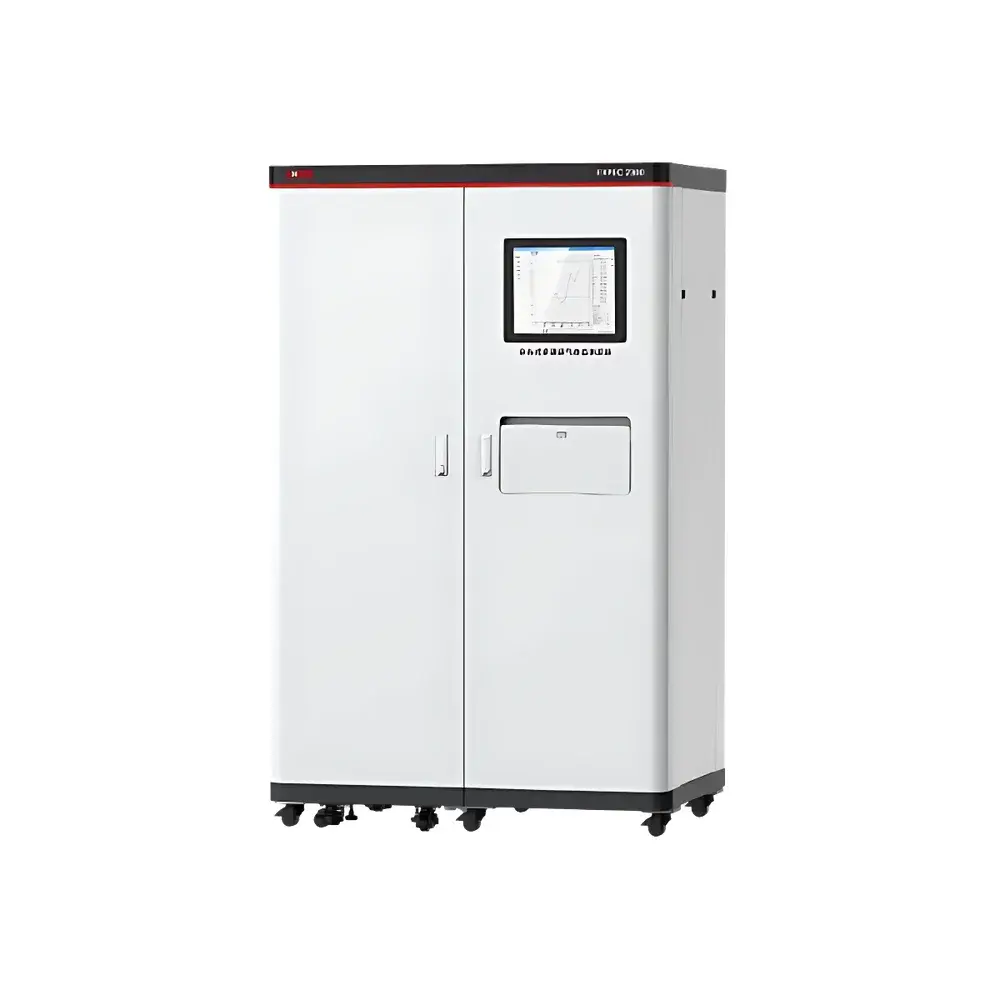
EXPEC 2300 Distributed Pollutant Automatic Monitoring and Source-Tracking System
| Brand | EXPEC (Hangzhou Superspectra Technology Co., Ltd.) |
|---|---|
| Origin | Zhejiang, China |
| Model | EXPEC 2300 |
| Configuration | Modular multi-point sampling system integrated with PTR-TOFMS |
| Maximum monitoring points | 124 |
| Single-point analysis cycle | <30 s |
| Coverage area | >7.07 km² |
| Compatibility | NH₃, H₂S, organic sulfur compounds, organic amines, VOCs, and other odorants |
| Data output | Real-time concentration profiles, plume dispersion modeling inputs, source attribution scores |
Overview
The EXPEC 2300 Distributed Pollutant Automatic Monitoring and Source-Tracking System is an engineered environmental intelligence platform designed for continuous, spatially resolved detection and quantitative attribution of airborne toxic and odorous compounds in industrial parks and manufacturing zones. At its core, the system integrates a field-deployable multi-channel sequential sampling unit with a high-sensitivity Proton-Transfer-Reaction Time-of-Flight Mass Spectrometer (PTR-TOFMS). This architecture enables real-time, compound-specific molecular detection without pre-concentration or chromatographic separation—leveraging soft ionization to preserve structural integrity and yield unambiguous mass spectral fingerprints for targeted analytes including ammonia (NH₃), hydrogen sulfide (H₂S), low-molecular-weight organic sulfides (e.g., methanethiol, dimethyl sulfide), aliphatic and aromatic amines, and volatile organic compounds (VOCs) associated with malodorous emissions. Unlike fixed-station monitors or passive diffusion samplers, the EXPEC 2300 implements dynamic spatial sampling across up to 124 georeferenced locations via programmable pneumatic valving and inertized stainless-steel tubing networks. Each sampling point completes full-spectrum acquisition in under 30 seconds, supporting sub-minute temporal resolution for tracking transient emission events and diurnal variability. The resulting high-density spatiotemporal dataset serves as foundational input for atmospheric dispersion modeling and inverse modeling algorithms used in quantitative source apportionment.
Key Features
- Modular multi-point sampling architecture with scalable channel expansion up to 124 independent inlet ports
- Automated sequential sampling with configurable dwell time, rotation order, and adaptive duty cycling based on real-time concentration thresholds
- Chemical ionization selectivity via H₃O⁺ reagent ions ensures minimal fragmentation and high sensitivity for polar, semi-volatile, and reactive odorants
- Zero-cross contamination design: dedicated sample lines, heated transfer paths (up to 180 °C), and automated purge cycles between channels prevent carryover and cross-talk
- Onboard calibration gas management with dual-standard delivery (zero air + certified multi-component span gas) enabling daily drift correction traceable to NIST-certified references
- Embedded edge computing module for real-time spectral deconvolution, background subtraction, and quantification using internal standard normalization
Sample Compatibility & Compliance
The EXPEC 2300 is validated for ambient air, stack effluent ducts (with appropriate dilution and conditioning), and boundary fence-line sampling per EPA Method TO-15 and ISO 16000-6 protocols. Its PTR-TOFMS detector meets performance criteria for detection limits ≤50 pptv (for NH₃ and H₂S) and ≤200 pptv (for C₂–C₁₀ VOCs) at 1-second integration time. All hardware components comply with IEC 61326-1 (EMC) and IEC 61000-6-2/6-4. System software supports audit-trail logging, electronic signatures, and data integrity controls aligned with FDA 21 CFR Part 11 requirements when deployed in regulated industrial hygiene or environmental compliance contexts. Full documentation packages—including IQ/OQ protocols, uncertainty budgets per GUM (JCGM 100:2008), and ISO/IEC 17025-aligned validation reports—are available upon request.
Software & Data Management
The EXPEC Cloud Intelligence Platform provides web-based access to live monitoring dashboards, historical trend analysis, and GIS-integrated plume visualization. Raw mass spectra are archived in HDF5 format with metadata tagging (GPS coordinates, meteorological inputs, instrument status flags). The platform embeds three proprietary algorithms: (1) Dynamic Source Weighting (DSW), which correlates concentration gradients with wind vector fields to assign probabilistic emission contributions per facility; (2) Temporal Anomaly Detection (TAD), applying seasonal-trend decomposition (STL) to identify statistically significant deviations from baseline behavior; and (3) Risk Index Scoring (RIS), synthesizing odor impact potential (based on odor activity values), toxicity thresholds (ACGIH TLVs®), and exposure duration into a tiered alert framework (Level 1–3). All analytical workflows are exportable as PDF reports compliant with ISO 14001 environmental management reporting standards.
Applications
- Real-time odor nuisance investigation and regulatory response in chemical parks, wastewater treatment plants, and livestock facilities
- Continuous compliance monitoring against local odor ordinances (e.g., Shanghai Municipal Standard DB31/T 1025–2017) and national emission standards (GB 14554–93)
- Pre-commissioning verification and post-remediation validation of abatement systems (e.g., biofilters, activated carbon units, thermal oxidizers)
- Supporting environmental impact assessments (EIA) and cumulative risk modeling for new infrastructure projects adjacent to sensitive receptors
- Integration with digital twin frameworks for predictive emission forecasting under varying operational and meteorological conditions
FAQ
What types of compounds can the EXPEC 2300 quantify without derivatization or pre-concentration?
It directly detects protonated molecules [M+H]⁺ of NH₃, H₂S, methyl mercaptan, dimethyl sulfide, trimethylamine, indole, skatole, short-chain aldehydes, ketones, and monoterpenes—with no sample preparation required.
How does the system ensure data continuity during network outages or power interruptions?
Local edge storage retains ≥72 hours of raw spectral data and processed concentration time series; automatic synchronization resumes upon connection restoration without data loss.
Can third-party meteorological data be ingested into the source attribution model?
Yes—the platform accepts standardized MET files (CSV/NetCDF) from on-site weather stations or mesoscale models (e.g., WRF outputs) to refine dispersion simulations and improve localization accuracy.
Is remote calibration verification supported?
Fully supported: remote initiation of zero/span checks, automated report generation, and comparison against historical calibration curves with statistical control charting (X-bar/R charts).
What cybersecurity measures are implemented in the cloud platform?
Role-based access control (RBAC), TLS 1.3 encryption for data in transit, AES-256 encryption for data at rest, annual penetration testing, and SOC 2 Type II attestation for infrastructure providers.







