
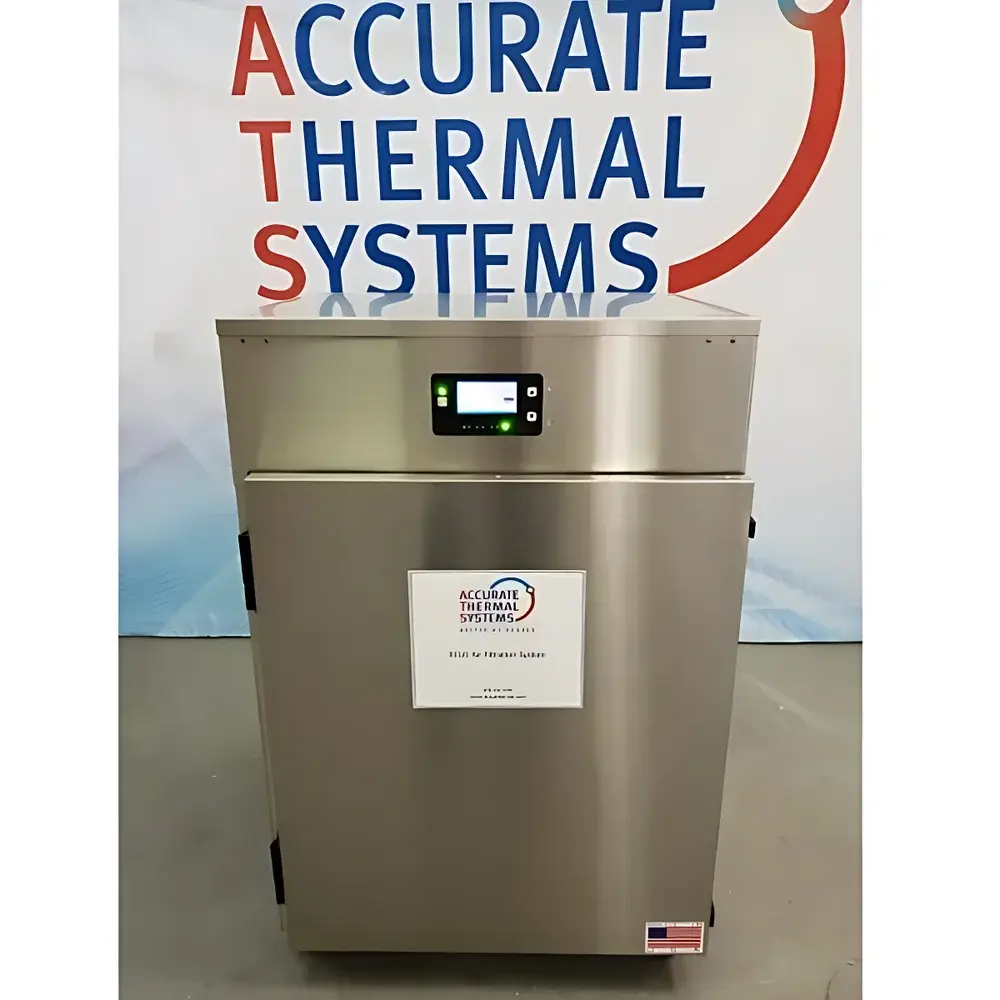
Accurate Thermal Systems ECU2 HEPA Air Filtration Unit
| Brand | Accurate Thermal Systems |
|---|---|
| Origin | USA |
| Manufacturer Type | Authorized Distributor |
| Product Origin | Imported |
| Model | ECU2 |
| Instrument Type | Filter-Based Air Purification System |
| Dimensions (W×D×H) | 24 in × 35 in × 52 in |
| Fan Capacity | 750 CFM |
| Noise Level | 60 dBA |
| Power Supply | 220 V AC, 3-Phase, 50/60 Hz, 1100 W per Phase |
| Remote Control Interface | 24 V DC Start/Stop |
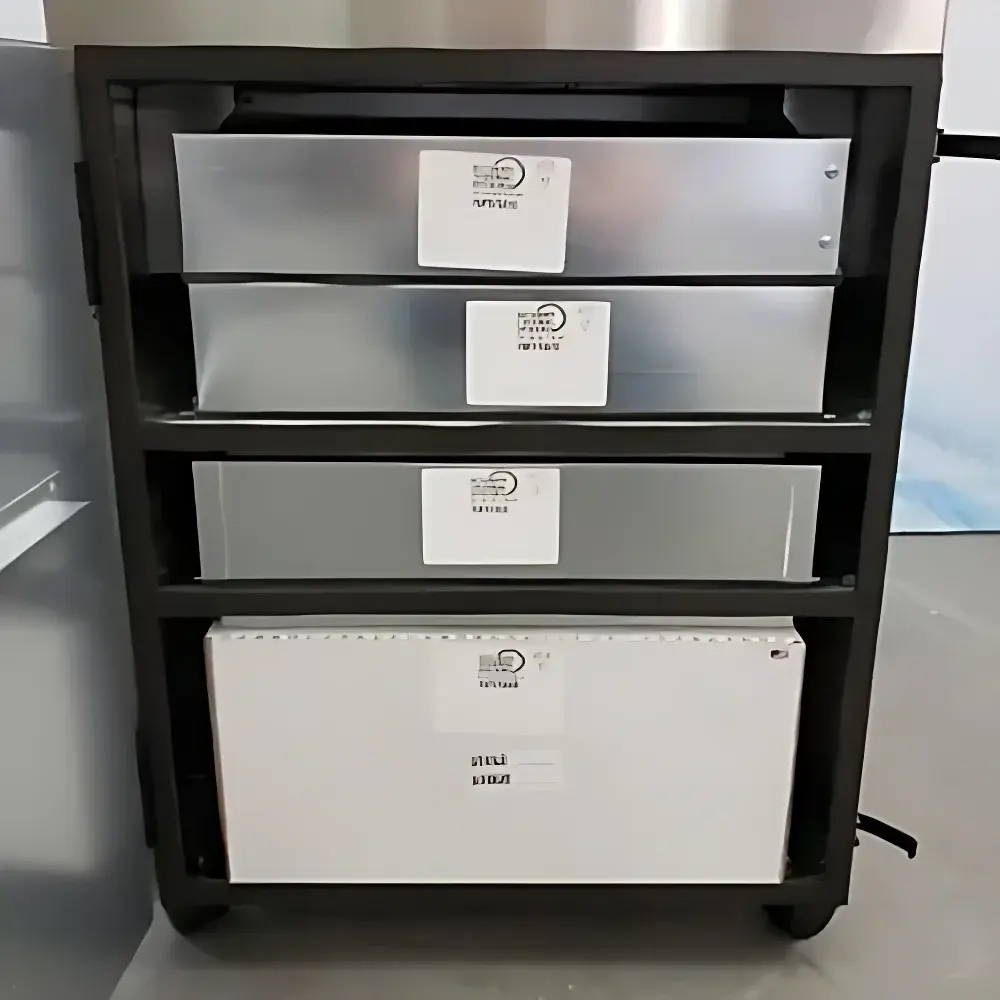
| Filter Configuration | Pre-filter (99% @ 1 µm), HEPA Filter (99.97% @ 0.3 µm), Dual Activated Carbon Modules (40 lbs each) |
| VOC Sensor Calibration | Ethanol at 600 ppm |
| Weight (Net) | 490 lbs |
| Weight (Shipping) | 590 lbs |
| Mobility | Industrial Swivel Casters (2 with Lock) |
Overview
The Accurate Thermal Systems ECU2 HEPA Air Filtration Unit is an industrial-grade, source-capture air purification system engineered for precision particulate and gaseous contaminant control in laboratory and light-manufacturing environments. Designed around a robust, multi-stage filtration architecture, the ECU2 employs a combination of mechanical and adsorptive principles: coarse pre-filtration removes macro-particulates; high-efficiency particulate air (HEPA) filtration captures submicron aerosols via diffusion, interception, and impaction mechanisms; and dual high-capacity activated carbon modules provide broad-spectrum adsorption of volatile organic compounds (VOCs), odors, and reactive gases. Its integrated 750 CFM centrifugal blower—featuring a brushless direct-drive motor—delivers consistent airflow across variable resistance conditions, while the stainless steel cabinet with internal acoustic damping ensures stable operation at ≤60 dBA, even at maximum fan speed. The ECU2 is not a general ambient air cleaner; it is purpose-built for localized, near-source extraction during thermal processing operations such as extrusion, injection molding, laser sintering, and solvent-based coating—where real-time containment of fumes, pyrolysis byproducts, and organic vapors is critical to personnel safety, regulatory compliance, and process integrity.
Key Features
- Stainless steel enclosure with brushed finish and internal sound-dampening structure for low-noise operation (≤60 dBA)
- Integrated 750 CFM centrifugal blower with brushless DC motor and electronic 4-step speed control (adjustable airflow for optimized capture efficiency)
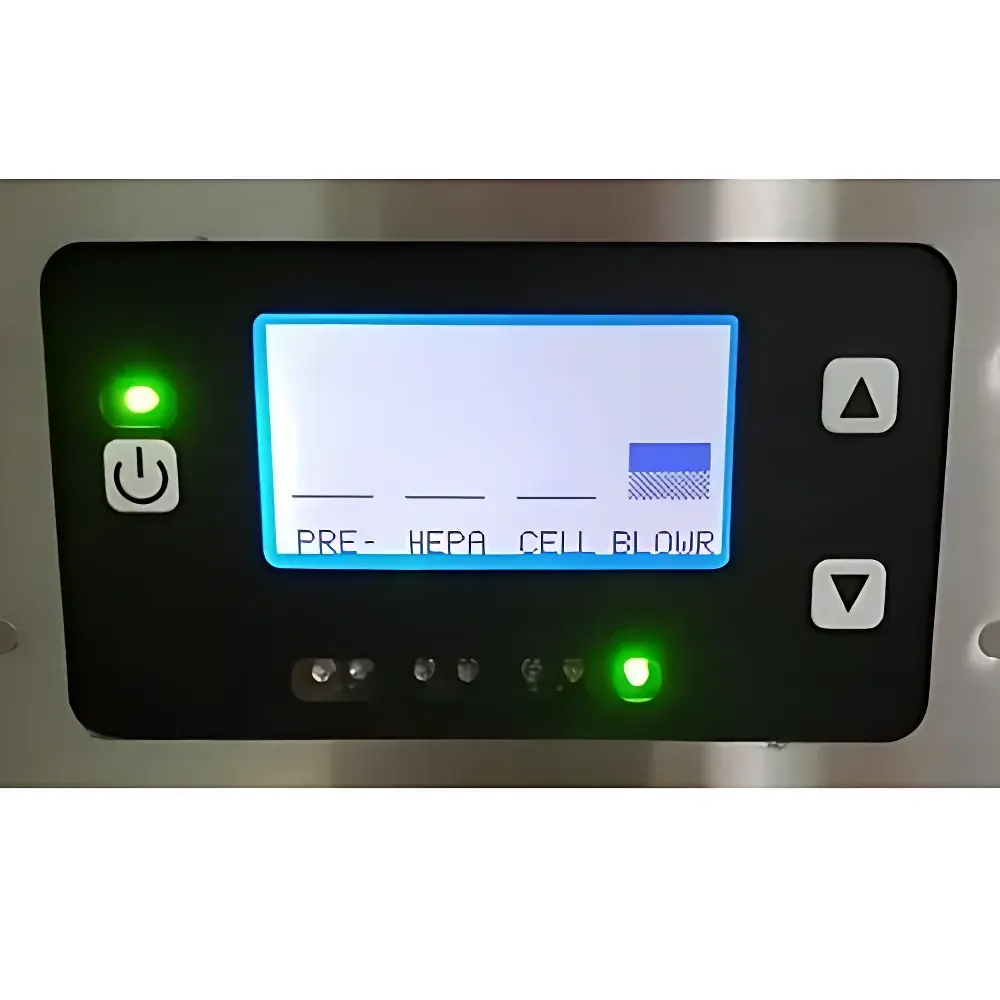
- Dual-stage digital monitoring: real-time status display for pre-filter, HEPA, and carbon modules, with LED alerts for scheduled or condition-based replacement
- Electrochemical VOC sensor calibrated to ethanol at 600 ppm, enabling dynamic assessment of carbon saturation and adsorption breakthrough
- Front-access service panel for tool-free filter replacement—designed for rapid maintenance without system disassembly
- 24 V DC remote start/stop interface compatible with PLC-controlled workflows or safety interlock systems
- Standard 6-inch inlet/outlet ports with included 8-ft, double-layer smooth-bore rubber ducting (6-in OD)
- Industrial-grade swivel casters (two with locking brakes) for repositioning across lab or production floor environments
Sample Compatibility & Compliance
The ECU2 is validated for continuous-duty operation in environments generating thermally generated aerosols (e.g., polymer fumes, metal oxide nanoparticles), combustion-derived particulates, and low-to-moderate concentration VOC streams (e.g., alcohols, ketones, esters, hydrocarbons). Its filtration configuration meets ISO 14644-1 Class 5 (ISO Class 5) airborne particle removal requirements for ≥0.3 µm particles when operated within specified airflow and static pressure limits. While not certified to UL 507 or IEC 60335-1 as a consumer appliance, the unit complies with OSHA 29 CFR 1910.1200 (Hazard Communication) and ANSI Z9.2–2018 (Fundamentals Governing Ventilation) for local exhaust ventilation design. The VOC sensor output and filter life logging support documentation required under EPA Method 204 and ISO 16000-23 for indoor air quality verification. All electrical components conform to NEMA 12 enclosure rating for dust-tight, drip-resistant operation in non-hazardous locations.
Software & Data Management
The ECU2 features an embedded microcontroller-driven graphical LCD interface—not cloud-connected or PC-dependent—designed for standalone operational transparency. The display provides real-time metrics including fan speed setting, cumulative runtime hours, differential pressure across each filter stage (derived from calibrated airflow resistance curves), and VOC concentration trend (ppm-equivalent ethanol signal). Filter replacement logs—including date, operator ID (manually entered), and reason code (e.g., “scheduled,” “carbon breakthrough,” “pre-filter clogged”)—are stored in non-volatile memory for GLP-compliant audit trails. Data export is not supported; however, the 24 V DC remote interface allows integration into facility-wide Building Management Systems (BMS) or SCADA platforms for centralized status monitoring and event-triggered shutdown protocols. No software licensing, firmware updates, or third-party drivers are required.
Applications
- Source capture of thermal decomposition fumes during polymer extrusion, injection molding, and hot-wire cutting
- Controlled removal of metal oxide nanoparticles generated in sputtering, thermal evaporation, or arc melting processes
- VOC abatement in solvent-based cleaning stations, dip-coating baths, and UV-curable resin post-processing
- Supplemental local exhaust for fume hoods handling low-volatility organics where ducted exhaust capacity is constrained
- Protection of sensitive instrumentation (e.g., SEM, XRD, mass spectrometers) from ambient airborne contaminants in shared lab spaces
- Compliance support for ISO 14644 cleanroom buffer zones requiring supplemental particle scrubbing
FAQ
What is the recommended maintenance interval for the pre-filter and HEPA filter?
Pre-filters should be inspected weekly and replaced every 2–4 weeks depending on particulate load; HEPA filters are rated for 12–18 months of continuous use under typical lab conditions but must be replaced immediately if differential pressure exceeds 0.8 in. w.g. or if VOC breakthrough is detected.
Can the ECU2 be ducted to an external exhaust system?
Yes—the unit includes a 6-inch outlet port and is rated for static pressure up to 1.2 in. w.g.; it may be connected to rigid or flexible ductwork terminating outdoors, provided backpressure remains within specification.
Is the VOC sensor field-calibratable?
No—the electrochemical sensor is factory-calibrated to ethanol at 600 ppm and is not user-adjustable; recalibration requires return to an ATS-authorized service center.
Does the ECU2 meet FDA 21 CFR Part 11 requirements?
No—it does not include electronic signature capability, audit trail encryption, or role-based access control; however, its manual log entries and timestamped filter records satisfy basic GMP documentation expectations for environmental control equipment.
What electrical infrastructure is required for installation?
A dedicated 220 V AC, 3-phase, 50/60 Hz circuit with minimum 15 A per phase and proper grounding per NEC Article 430 is mandatory; voltage imbalance must not exceed ±2% between phases.



