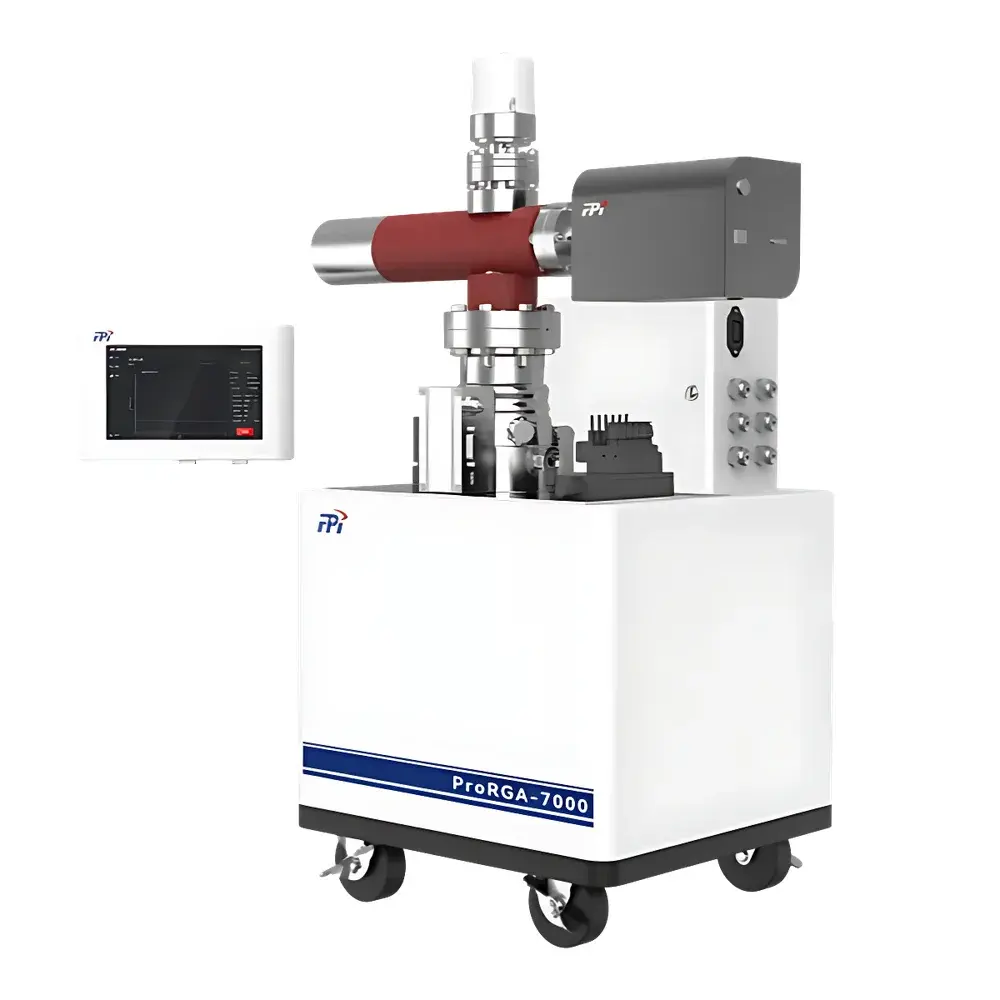
ProRGA-7000 Residual Gas Analyzer by FPI
| Brand | FPI |
|---|---|
| Origin | Zhejiang, China |
| Manufacturer Type | Original Equipment Manufacturer (OEM) |
| Country of Origin | China |
| Model | ProRGA-7000 |
| Pricing | Available upon Request |
Overview
The ProRGA-7000 Residual Gas Analyzer is a quadrupole mass spectrometer (QMS) engineered for real-time, in-situ monitoring of trace gas species in ultra-high vacuum (UHV) and high-vacuum (HV) environments. Operating on the principle of mass-selective ion filtering via radiofrequency (RF) and direct current (DC) voltage scanning across a hyperbolic quadrupole rod assembly, the instrument delivers quantitative and qualitative analysis of residual gases—including H2, He, CH4, H2O, CO, CO2, N2, O2, and hydrocarbon fragments—within the mass range of 1–100 u (atomic mass units). Designed specifically for integration into industrial vacuum process chambers, the ProRGA-7000 supports continuous leak detection, outgassing profiling, and process endpoint verification without requiring sample extraction or external gas handling systems.
Key Features
- Compact, bakeable stainless-steel ion source and analyzer head rated for operation down to 1×10⁻⁹ mbar base pressure
- Integrated filament auto-switching and dual-filament redundancy to ensure uninterrupted operation during extended vacuum cycles
- Onboard automatic mass calibration using reference peaks (e.g., N2+ at m/z 28, O2+ at m/z 32) with drift compensation over temperature and time
- Real-time spectral acquisition at up to 100 scans/second, with configurable dwell time per mass channel for optimized signal-to-noise ratio
- Embedded self-diagnostic firmware that monitors electron emission stability, detector gain, vacuum integrity, and RF power supply health
- RS-485 and Ethernet (TCP/IP) interfaces compliant with Modbus RTU and SECS/GEM protocols for seamless integration into SCADA and MES platforms
Sample Compatibility & Compliance
The ProRGA-7000 interfaces directly with vacuum flanges (CF-35 or ISO-KF40 standard) and is compatible with inert, reactive, and corrosive gas matrices typical in semiconductor etch chambers, lithium-ion battery dry rooms, and pharmaceutical lyophilization condensers. It meets electromagnetic compatibility requirements per IEC 61326-1 and safety standards under IEC 61010-1. While not certified for hazardous area use (e.g., ATEX or IECEx), its design supports installation in Class 100–Class 1000 cleanrooms and conforms to SEMI E10 guidelines for equipment reliability and measurement uncertainty reporting. Data logging and audit trails align with GLP and GMP documentation expectations where configured with optional secure user authentication and 21 CFR Part 11–compliant software modules.
Software & Data Management
FPI’s RGAControl Suite provides vendor-neutral spectral visualization, peak identification via NIST MS Search integration, and customizable alarm thresholds for partial pressure deviations. The software supports automated trend logging (pressure vs. time, species concentration vs. process step), batch export to CSV/ASCII, and API-driven data ingestion into LIMS or cloud-based analytics platforms (e.g., AWS IoT Core, Azure Time Series Insights). All raw spectra are timestamped with system clock synchronization (PTPv2 support optional), and firmware updates are delivered via signed binary packages to ensure integrity and traceability.
Applications
- Battery Manufacturing: Monitoring H2, CO, and HF evolution during electrode drying and cell formation to detect electrolyte decomposition and moisture ingress
- Semiconductor Fabrication: Identifying process gas residuals (e.g., Cl2, SiH4, NF3) and pump oil backstreaming in PVD/CVD chambers to optimize chamber conditioning and reduce particle generation
- Pharmaceutical Lyophilization: Tracking water vapor partial pressure and organic solvent traces (e.g., tert-butanol) in condenser sections to validate primary drying endpoints and prevent collapse
- Research Vacuum Systems: Characterizing outgassing profiles of novel materials (e.g., metal-organic frameworks, thin-film coatings) under thermal ramping or UV exposure
- Accelerator Facilities: Detecting helium leaks in superconducting magnet cryostats and identifying hydrocarbon contamination in beamline UHV segments
FAQ
What vacuum range is the ProRGA-7000 rated for?
The analyzer operates continuously from 1×10⁻⁹ mbar to 1×10⁻³ mbar; above 1×10⁻³ mbar, optional differential pumping stages are recommended.
Does it support quantitative analysis without external calibration standards?
Yes—relative sensitivity factors (RSFs) for common gases are factory-determined using calibrated leak standards; absolute quantification requires one-point calibration with a known partial pressure reference.
Can the ProRGA-7000 be integrated into a PLC-controlled vacuum system?
Yes—Modbus TCP and digital I/O signals (including ready/busy, fault, and scan-complete triggers) enable deterministic control loop integration.
Is the filament lifetime extended under intermittent use conditions?
Filament life exceeds 6,000 hours under typical duty cycles (≤30% duty factor); auto-shutdown during idle periods further reduces thermal stress.
How is data security handled during remote diagnostics?
All remote access sessions require TLS 1.2+ encrypted tunnels and multi-factor authentication; no telemetry or spectra are transmitted without explicit operator consent.
Related Products