
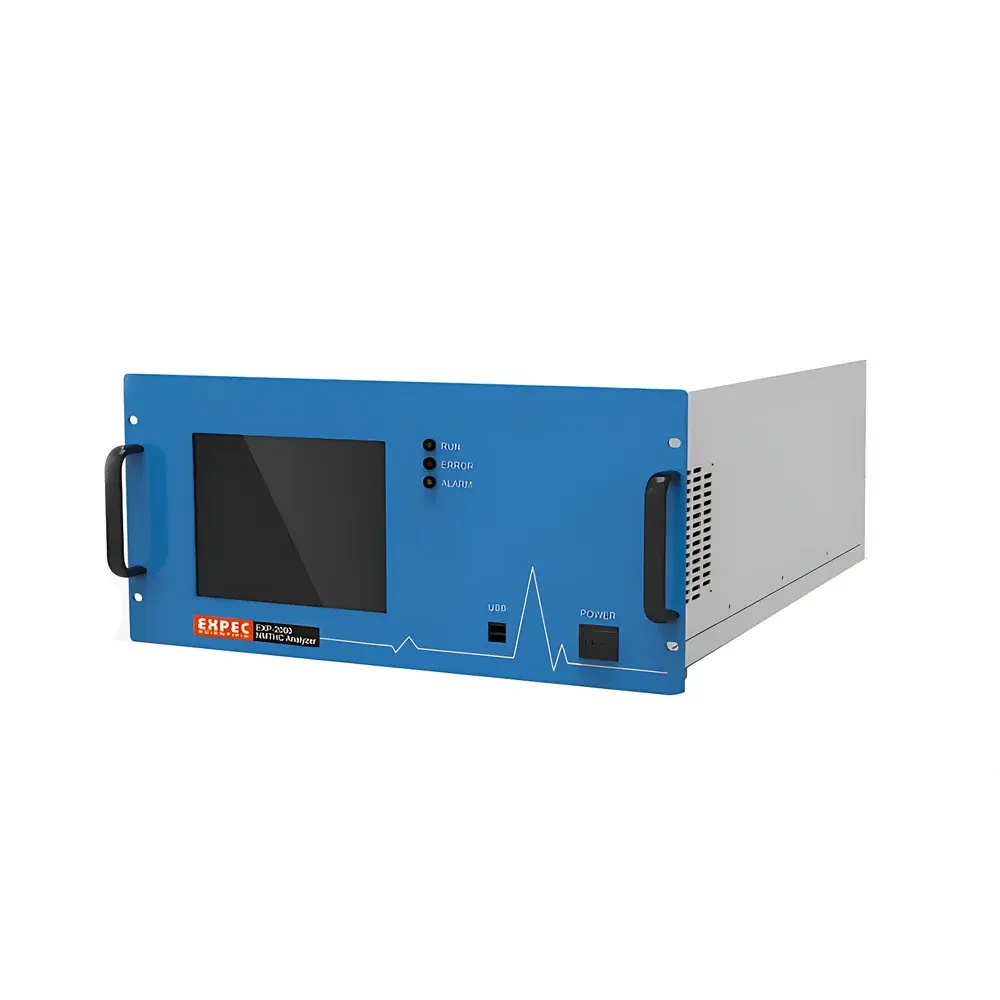
FPI Methane / Non-Methane Hydrocarbons (NMHC) Online Analyzer Model FPI-MN-2000
| Brand | FPI (Fortune Photonics Instrumentation) |
|---|---|
| Origin | Zhejiang, China |
| Manufacturer Type | OEM Manufacturer |
| Product Category | Ambient Air VOCs & Hydrocarbon Monitoring System |
| Measurement Principle | Dual-Channel GC-FID with Valve-Switched Cut-and-Backflush Separation |
| Detection Method | Flame Ionization Detection (FID) |
| Analyte Specificity | CH₄ and Total NMHC (C₂–C₁₂ hydrocarbons) |
| Carrier Gas | High-Purity Nitrogen or Helium |
| Hydrogen Fuel Gas | Ultra-High-Purity H₂ (99.999%) |
| Air for Combustion | Clean, Oil-Free Compressed Air |
| Flow Control | Electronic Pressure Control (EPC) and Electronic Flow Control (EFC) for Carrier, H₂, and Air |
| Safety Protocol | Auto-H₂-Shutoff upon Flame-Out Detection |
| Sample Introduction | Integrated Diaphragm Vacuum Pump with 1/8" PTFE-Lined Sampling Line |
| Quantitation Mode | External Standard Calibration with Certified Gas Mixtures |
| Data Output | RS485, Modbus TCP, 4–20 mA Analog Outputs |
| Environmental Operating Range | 5–40 °C, 20–90 % RH (non-condensing) |
| Power Supply | 220 VAC ±10 %, 50/60 Hz, 800 W Max |
| Enclosure Rating | IP54 Industrial Cabinet |
| Compliance | Meets CNEMC Guideline HJ 1012–2018, ASTM D6348–20, ISO 12010:2012 (for FID-based hydrocarbon analysis), GLP-Ready Data Logging |
Overview
The FPI Methane / Non-Methane Hydrocarbons (NMHC) Online Analyzer Model FPI-MN-2000 is a fully automated, laboratory-grade gas chromatography–flame ionization detection (GC-FID) system engineered for continuous, unattended measurement of methane (CH₄) and total non-methane hydrocarbons (NMHC) in ambient air and industrial boundary environments. It implements a validated valve-switched cut-and-backflush separation protocol to isolate methane in the first elution window, followed by rapid backflushing of higher-boiling C₂–C₁₂ hydrocarbons into the FID detector—enabling speciated quantification without cryogenic trapping or preconcentration. This architecture eliminates cross-sensitivity between CH₄ and NMHC, ensures sub-minute cycle times (< 120 s per analysis), and maintains long-term baseline stability under fluctuating ambient conditions. Designed for deployment in regulatory-grade air quality monitoring stations, petrochemical fence-line networks, and greenhouse gas (GHG) verification programs, the analyzer complies with methodological requirements defined in China’s HJ 1012–2018 and aligns with international technical benchmarks including ASTM D6348–20 (Standard Test Method for Determination of Gaseous Compounds by GC-FID) and ISO 12010:2012 (Stationary source emissions — Determination of total volatile organic compounds).
Key Features
- Dual-path GC-FID architecture with programmable six-port switching valve for precise cut-and-backflush chromatographic separation
- High-stability flame ionization detector with auto-ignition and real-time flame monitoring; hydrogen supply automatically terminates within 1.2 seconds upon flame-out detection
- Electronic Pressure Control (EPC) and Electronic Flow Control (EFC) modules for carrier gas (N₂/He), hydrogen, and combustion air—achieving ±0.05 psi pressure accuracy and ±0.5 mL/min flow repeatability
- Integrated sample conditioning: heated PTFE-lined sampling line (60 °C), particulate filter (2.5 µm), and moisture trap with desiccant cartridge (replaceable every 90 days at 25 °C/50 % RH)
- Ruggedized industrial enclosure (IP54) with internal temperature stabilization (±2 °C) and optional NEMA 4X outdoor housing kit
- Modular hardware design: GC column oven, detector chamber, and valve manifold are independently thermally insulated and PID-controlled
Sample Compatibility & Compliance
The FPI-MN-2000 accepts uncompressed ambient air, stack effluent (diluted ≤1:10), and duct-sampled process gases with particulate loading < 1 mg/m³ and dew point ≤ −20 °C. It is certified for operation in Class II, Division 2 hazardous locations when equipped with optional ATEX/IECEx-compliant purge system. All firmware and data handling routines support audit-trail functionality per GLP/GMP guidelines. Raw chromatograms, calibration logs, maintenance timestamps, and system diagnostics are time-stamped and stored locally (8 GB embedded SSD) with optional encrypted cloud sync via TLS 1.2. The instrument meets traceability requirements of CNEMC HJ 1012–2018 and supports validation protocols aligned with US EPA Method TO-15 and EU EN 13649–2.
Software & Data Management
FPI-Insight™ v4.2 software provides full remote configuration, real-time chromatogram visualization, automated calibration scheduling (daily/weekly), and QC flagging per ISO/IEC 17025 criteria. Data export formats include CSV, NetCDF, and XML compliant with AQMesh and AirNow-2.0 ingestion schemas. Role-based access control (RBAC) supports administrator, operator, and auditor profiles with password policy enforcement and session timeout. All method files, calibration curves, and raw signal integrations are digitally signed and version-controlled. Audit logs record every parameter change, manual intervention, or calibration event—including user ID, timestamp, and pre-/post-value deltas—fully satisfying FDA 21 CFR Part 11 electronic record requirements when deployed in regulated environmental compliance settings.
Applications
- Ambient air quality monitoring networks (AAQMN) for urban and regional NMHC trend analysis
- Fence-line monitoring at refineries, olefin plants, and synthetic resin manufacturing facilities
- Greenhouse gas inventory verification under national MRV (Monitoring, Reporting, Verification) frameworks
- Leak detection and repair (LDAR) program support with quantitative emission rate calculation
- Research applications in atmospheric chemistry, VOC speciation, and photochemical ozone formation potential (POFP) modeling
- Compliance reporting for local ecological bureaus and provincial environmental monitoring centers per China’s “Blue Sky Defense Campaign” KPIs
FAQ
What is the minimum detectable concentration for methane and NMHC?
The system achieves method detection limits (MDL) of 50 ppb for CH₄ and 80 ppb for total NMHC (as propane equivalent) under standard operating conditions (1 L/min sample flow, 60 °C column oven, 30 m DB-1 capillary column).
Does the analyzer require external calibration gas standards?
Yes—certified CH₄/NMHC/N₂ mixtures (e.g., Scott-Marrin or Linde-certified gases) are required for initial setup and periodic recalibration. The system supports multi-point linear and quadratic calibration curves with R² ≥ 0.9998.
Can it operate continuously without supervision?
Yes—the analyzer supports unattended 7×24 operation with self-diagnostics, automatic flame re-ignition, and low-gas alarms. Mean time between failures (MTBF) exceeds 8,000 hours per IEC 61508 SIL2 assessment.
Is the data output compatible with SCADA and central EMS platforms?
Yes—native Modbus TCP, OPC UA, and 4–20 mA analog outputs enable seamless integration with Siemens Desigo, Honeywell Experion, and Schneider EcoStruxure systems without middleware.
What maintenance intervals are recommended?
FID jet cleaning every 3 months; GC column bake-out monthly; desiccant replacement quarterly; full system performance verification semiannually per HJ 1012–2018 Annex B.
Related Products







