
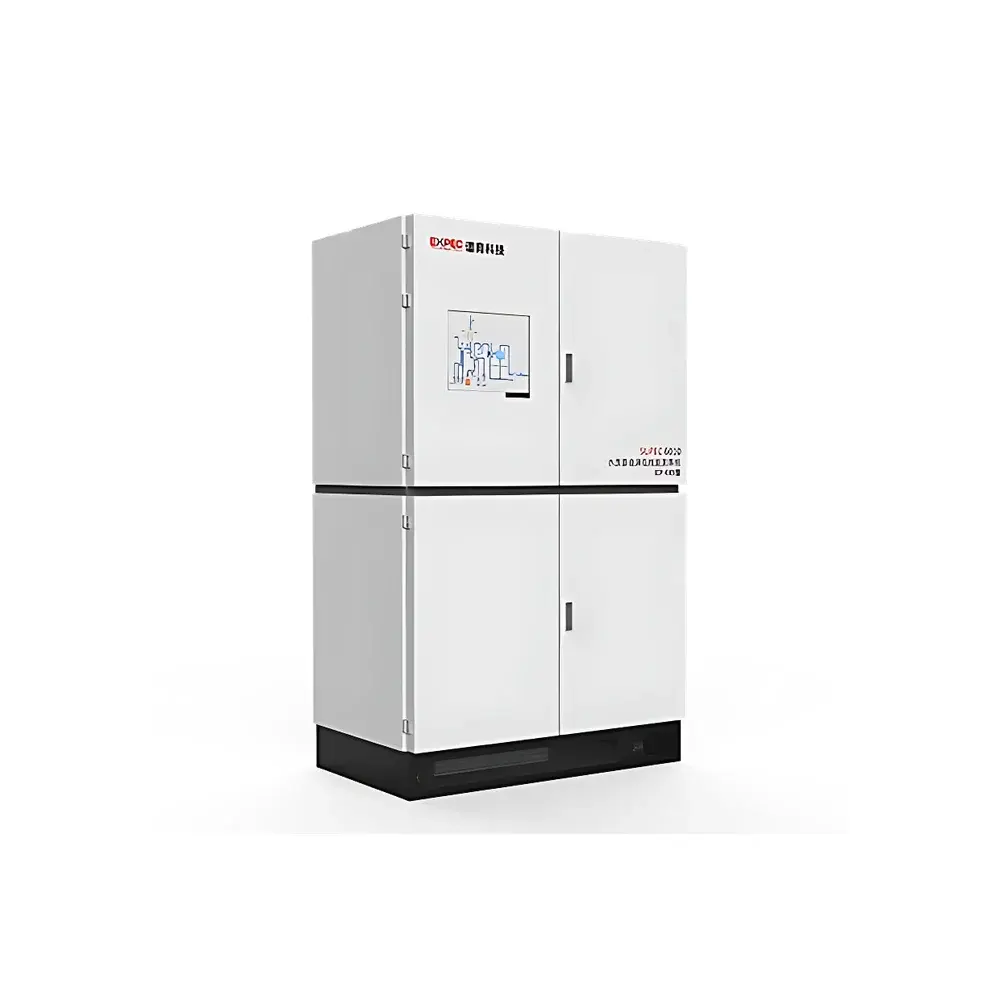
EXPEC SUPEC 6010 Online Heavy Metals Monitoring System (ICP-OES-Based)
| Brand | EXPEC |
|---|---|
| Origin | Zhejiang, China |
| Manufacturer Type | Authorized Distributor |
| Country of Origin | China |
| Model | SUPEC 6010 |
| Quotation | Upon Request |
| Instrument Type | Online Analyzer |
| Detection Principle | Inductively Coupled Plasma Optical Emission Spectrometry (ICP-OES) |
| Target Elements | Multi-Element (e.g., As, Cd, Cr, Cu, Ni, Pb, Zn, Hg, Mn, Fe, Al, etc.) |
| Compliance Standard | HJ 776–2015 “Determination of 32 Elements in Water by ICP-OES” |
| Automation Level | Fully Automated (Sampling, Filtration, Pre-treatment, Analysis, QC, Data Acquisition & Transmission) |
| Detection Range | Sub-ppb to ppm (full dynamic range) |
| Measurement Cycle | < 5 minutes per sample (multi-element simultaneous analysis) |
| Interference Resistance | Immune to color, turbidity, and matrix-induced spectral overlap under optimized plasma conditions |
| Waste Generation | Minimal reagent consumption |
Overview
The EXPEC SUPEC 6010 Online Heavy Metals Monitoring System is an industrial-grade, fully automated water quality analyzer engineered for continuous, unattended quantification of trace and major metallic elements in environmental and industrial aqueous matrices. It employs robust Inductively Coupled Plasma Optical Emission Spectrometry (ICP-OES) as its core detection principle—leveraging high-temperature argon plasma (>6,000 K) to atomize, excite, and emit element-specific wavelengths from dissolved metal species. Unlike electrode-based or colorimetric online sensors, the SUPEC 6010 delivers true multi-element capability without cross-sensitivity, enabling simultaneous determination of up to 32 regulated heavy metals—including As, Cd, Cr(VI)/Cr(III), Cu, Ni, Pb, Zn, Hg, Mn, Fe, Al, Co, V, and Se—in a single 5-minute analytical cycle. Designed for deployment at surface water intake points, municipal wastewater treatment plants, industrial effluent discharge channels, and watershed monitoring stations, the system operates under ambient or controlled sheltered environments with IP54-rated enclosures and integrated climate stabilization.
Key Features
- Fully integrated automation architecture: programmable peristaltic sampling, 5-µm inline filtration, acid digestion module (optional), internal standard addition, plasma ignition control, and auto-calibration sequence
- Compliance-certified methodology: validated against HJ 776–2015—the Chinese national standard equivalent to ISO 11885 and ASTM D1976 for multi-element water analysis—ensuring data acceptability in regulatory reporting and laboratory intercomparison studies
- High-fidelity optical detection: Czerny-Turner spectrometer with solid-state CCD detector, enabling simultaneous acquisition across 165–900 nm spectral range with 0.007 nm resolution (pixel-limited)
- Robust interference mitigation: real-time background correction, internal standard normalization (e.g., Y or Sc), and intelligent spectral deconvolution algorithms to resolve overlapping emission lines (e.g., As 193.7 nm / Al 193.7 nm)
- Low operational footprint: compact cabinet design (<1.2 m³ volume); reagent-free operation for filtration and dilution; <5 mL acid consumption per analysis; no consumable electrodes or membranes
- Remote operability: embedded Linux controller with dual Ethernet ports, Modbus TCP/RTU, and OPC UA support for SCADA integration; TLS 1.2 encrypted cloud telemetry optional
Sample Compatibility & Compliance
The SUPEC 6010 accepts raw water samples directly from open-channel flumes, pressurized pipes, or grab-sample interfaces with conductivity ≤2,000 µS/cm and total suspended solids (TSS) ≤100 mg/L (pre-filtered). It is validated for use with GB 3838 Class I–V surface water, municipal secondary effluent, electroplating rinse water, mining leachate, and landfill leachate—provided pH is maintained between 2.0–8.5 prior to introduction. All analytical workflows adhere to Good Laboratory Practice (GLP) and support audit-ready electronic records compliant with FDA 21 CFR Part 11 when paired with EXPEC’s optional secure data management server. Calibration verification standards follow NIST-traceable CRM protocols; daily drift correction uses certified multi-element check standards.
Software & Data Management
The system runs EXPEC AquaView™ v4.2 firmware—a deterministic real-time OS supporting synchronized data logging at 1 Hz temporal resolution. Raw spectral data, QC metrics (recovery %, RSD, blank signal), and calibrated concentration outputs are stored locally on industrial-grade SSD with 12-month retention. The web-based AquaView Portal provides role-based access (operator, supervisor, auditor), customizable alerting (SMS/email on exceedance, maintenance due, calibration failure), and export to CSV, PDF analytical reports, or direct SQL push to LIMS. Audit trails record all user actions, method changes, and instrument state transitions with cryptographic timestamping. Optional 21 CFR Part 11 compliance package includes electronic signatures, biometric login, and immutable log archiving.
Applications
- Real-time compliance monitoring at national surface water quality stations (e.g., Yangtze River Basin surveillance network)
- Early-warning detection of industrial accidental discharges in eco-industrial parks
- Process control feedback for chemical precipitation and ion exchange units in WWTPs
- Long-term trend analysis of bioavailable metal speciation in reservoir sediments via pore-water extraction coupling
- Emergency response screening during flood-related contamination events (e.g., post-mining tailings breach)
- Research-grade validation of passive sampler field data (e.g., DGT, Chelex columns) in hydrological studies
FAQ
Does the SUPEC 6010 require daily manual intervention?
No—once commissioned, it performs unattended operation for ≥30 days with scheduled reagent replenishment and filter replacement intervals. Preventive maintenance is guided by onboard diagnostics and predictive alerts.
Can it quantify hexavalent chromium (Cr(VI)) separately from total Cr?
Not natively; Cr speciation requires pre-column separation (e.g., ion chromatography) upstream of ICP-OES. The SUPEC 6010 reports total chromium unless coupled with EXPEC’s optional IC-ICP-OES hyphenated module.
Is remote firmware update supported over public internet?
Firmware updates are delivered via authenticated SFTP to local network gateways only; no direct WAN exposure. Over-the-air updates require air-gapped staging and SHA-256 signature verification.
What is the minimum detectable concentration for arsenic in drinking water matrix?
Under routine field operating conditions (3σ, n=7), the practical quantitation limit (PQL) for As is 0.12 µg/L, meeting WHO and EU Drinking Water Directive requirements.
How does the system handle high-chloride brine samples?
Chloride-induced polyatomic interferences (e.g., 40Ar35Cl on As 75 nm) are suppressed using helium collision/reaction cell mode (optional upgrade) or mathematical correction based on Cl 134.8 nm intensity tracking.
Related Products







