
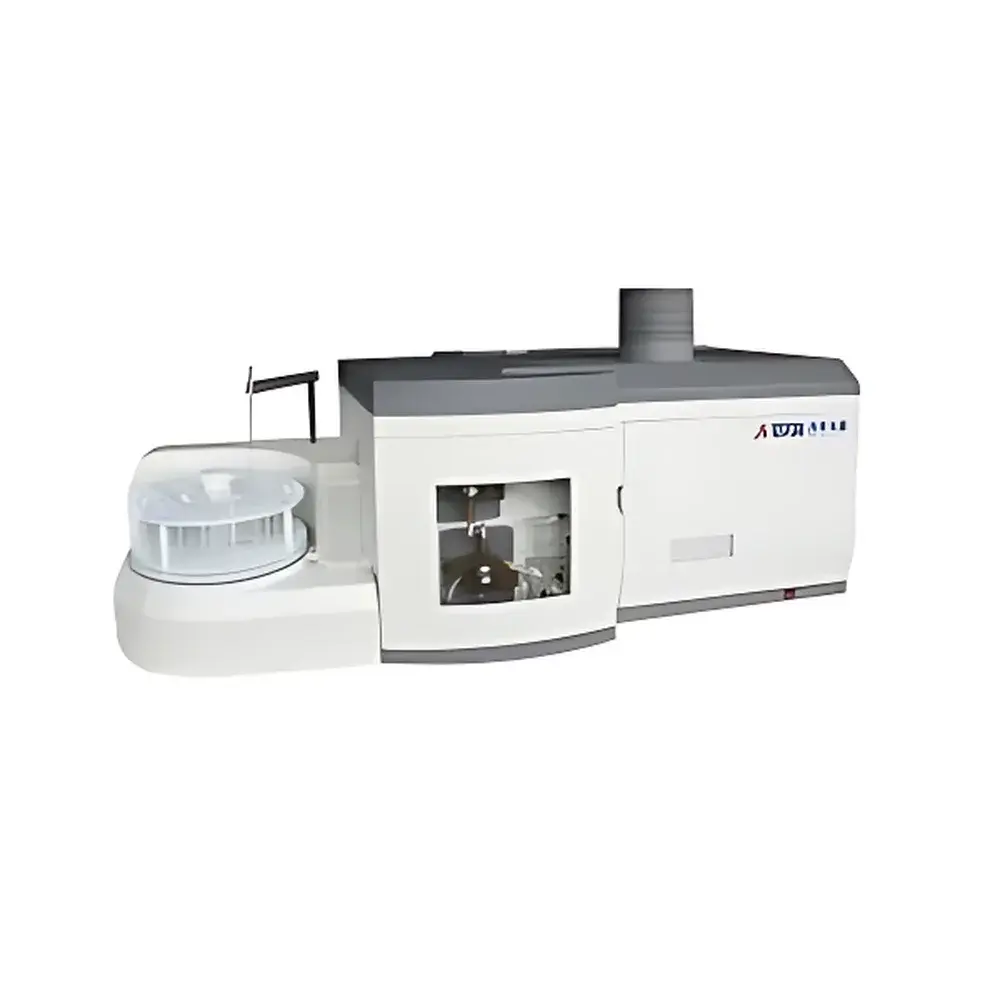
Titan Instruments AFS-8330 Fully Automated Six-Lamp Atomic Fluorescence Spectrometer
| Brand | Titan Instruments |
|---|---|
| Origin | Beijing, China |
| Model | AFS-8330 |
| Instrument Type | Multi-channel Atomic Fluorescence Spectrometer |
| Sample Introduction | Peristaltic Pump |
| Waste Disposal | Peristaltic Pump Extraction |
| Hydride Generation Mode | Vapor Generation / Hydride Generation |
| Pneumatic Control | Valve Island System |
| Detectable Elements | As, Se, Bi, Hg, Te, Sn, Ge, Pb, Zn, Cd, Au |
| RSD | < 0.8% |
| Linear Dynamic Range | > 3 orders of magnitude |
| Detection Limits | As, Bi, Sb < 0.01 µg/L |
| PMT Wavelength Range | 160–320 nm |
| Atomizer Temperature Control | Yes |
Overview
The Titan Instruments AFS-8330 is a fully automated, multi-channel atomic fluorescence spectrometer engineered for high-sensitivity, trace-level quantification of hydride-forming and cold-vapor elements in complex environmental, food, clinical, and industrial matrices. Based on the principle of atomic fluorescence spectroscopy (AFS), the instrument excites ground-state atoms—generated in situ via hydride vapor generation (HVG) or cold-vapor atomic fluorescence (CV-AFS)—using element-specific hollow cathode lamps (HCLs). The resulting fluorescence emission at characteristic wavelengths is collected by a low-noise photomultiplier tube (PMT) operating in the deep UV to near-UV range (160–320 nm), enabling exceptional signal-to-noise ratios and sub-ppt detection capability. Designed for routine compliance testing and research-grade analysis, the AFS-8330 integrates robust pneumatic architecture, thermal stabilization, and optical isolation to ensure measurement reproducibility across extended operational cycles.
Key Features
- Six-position automatic lamp turret with computer-controlled lamp selection and alignment, eliminating manual lamp changes and minimizing optical drift during multi-element sequences.
- Dual-channel simultaneous detection architecture, supporting concurrent measurement of two elements (e.g., As and Hg) without spectral interference—enhancing throughput while preserving method integrity.
- Integrated 160-position polar-coordinate autosampler with programmable rinse, dilution, and standard addition capabilities, compatible with vial sizes from 10–50 mL.
- Intermittent-flow hydride generation system with sealed gas–liquid separation, minimizing reagent carryover and memory effects—critical for high-precision analysis of As, Sb, Bi, Se, and Te.
- Shielded quartz atomizer with precise temperature regulation and low-power argon–hydrogen flame ignition, ensuring stable atomization efficiency and reduced background noise.
- Valve island–based pneumatic control system providing real-time pressure monitoring, leak detection, and fail-safe shutdown protocols per ISO 17025–aligned safety requirements.
- Onboard hazardous vapor trap for post-detection mercury and arsenic capture, compliant with OSHA PEL and EU Directive 2017/164 guidelines for laboratory exhaust management.
- Self-diagnostic firmware with automated startup calibration, gas flow validation, lamp warm-up verification, and error logging—all traceable for GLP/GMP audit trails.
Sample Compatibility & Compliance
The AFS-8330 supports liquid samples following standardized digestion protocols (e.g., microwave-assisted HNO₃/H₂O₂ or aqua regia treatment), as well as direct analysis of aqueous standards, filtered environmental waters, acid-extracted soils, and biological digests. Its validated performance meets or exceeds requirements specified in major regulatory methods including: ASTM D6722-22 (mercury in water), USP / (elemental impurities in pharmaceuticals), EPA Method 1631E (ultra-trace mercury in water), and multiple Chinese National Standards (GB 5009.11–2014, GB 5009.17–2014, HJ 694–2014, HJ 702–2014). All hardware and software components are designed to support 21 CFR Part 11–compliant data integrity frameworks—including electronic signatures, audit trail activation, and immutable raw data storage.
Software & Data Management
The instrument is operated via Titan’s proprietary AFSControl Suite—a bilingual (English/Chinese), Windows-based platform certified for IEC 62304 Class B medical device software lifecycle compliance. The interface provides full method development tools, including multi-point calibration curve fitting (linear, quadratic, weighted), spike recovery calculation, QC flagging (e.g., %RSD, bracketing standard deviation), and customizable report templates aligned with ISO/IEC 17025 reporting clauses. Raw spectral data, instrument parameter logs, and user activity timestamps are stored in encrypted SQLite databases with SHA-256 hashing. Export options include CSV, PDF, and XML formats compatible with LIMS integration via RS-232/RS-485 serial gateways or optional Ethernet TCP/IP module.
Applications
The AFS-8330 delivers reliable performance across regulated and academic laboratories engaged in: monitoring total and inorganic arsenic in rice and infant formula per Codex Alimentarius STAN 193–1995; speciation-ready analysis of As(III)/As(V), methylmercury, and inorganic mercury when coupled with optional HPLC–AFS hyphenation modules; ultra-trace mercury determination in seawater and atmospheric particulate matter (PM₂.₅); rapid screening of heavy metals in fertilizers, feedstuffs, and cosmetics under GB/T 22105–2008 and GB/T 29650–2013; and method validation studies requiring linear dynamic range >10⁴ and long-term RSD stability <1.0% over 24-hour continuous operation.
FAQ
Does the AFS-8330 support elemental speciation analysis?
Yes—when equipped with the optional HPLC–AFS interface kit and dedicated speciation software module, it enables quantitative separation and detection of As(III), As(V), MMA, DMA, and inorganic/organic Hg species.
What is the typical maintenance interval for the peristaltic pump tubing?
Under standard operating conditions (8 hrs/day, aqueous samples), Tygon® LFL tubing should be replaced every 300–500 hours of cumulative pump runtime; wear indicators are logged automatically in the service history tab.
Can the system be integrated into an existing laboratory network for remote monitoring?
Yes—the RS-485 port supports Modbus RTU protocol for SCADA integration, and optional Ethernet adapter enables secure HTTPS-based remote diagnostics and real-time status polling via browser interface.
Is the instrument compliant with FDA 21 CFR Part 11 requirements?
Out-of-the-box configuration includes electronic signature enforcement, audit trail generation (with user ID, timestamp, action type, and before/after values), and role-based access control—fully configurable to meet Part 11 Subpart B implementation criteria.
What sample preparation steps are required prior to analysis?
Most solid and semi-solid matrices require acid digestion (microwave or hot-block) followed by reduction with KBH₄/KI–HCl; aqueous samples may be analyzed directly after filtration (0.45 µm) and pH adjustment. Detailed SOPs—including reagent purity grades and blank correction protocols—are embedded in the software’s Expert Assistant module.




