
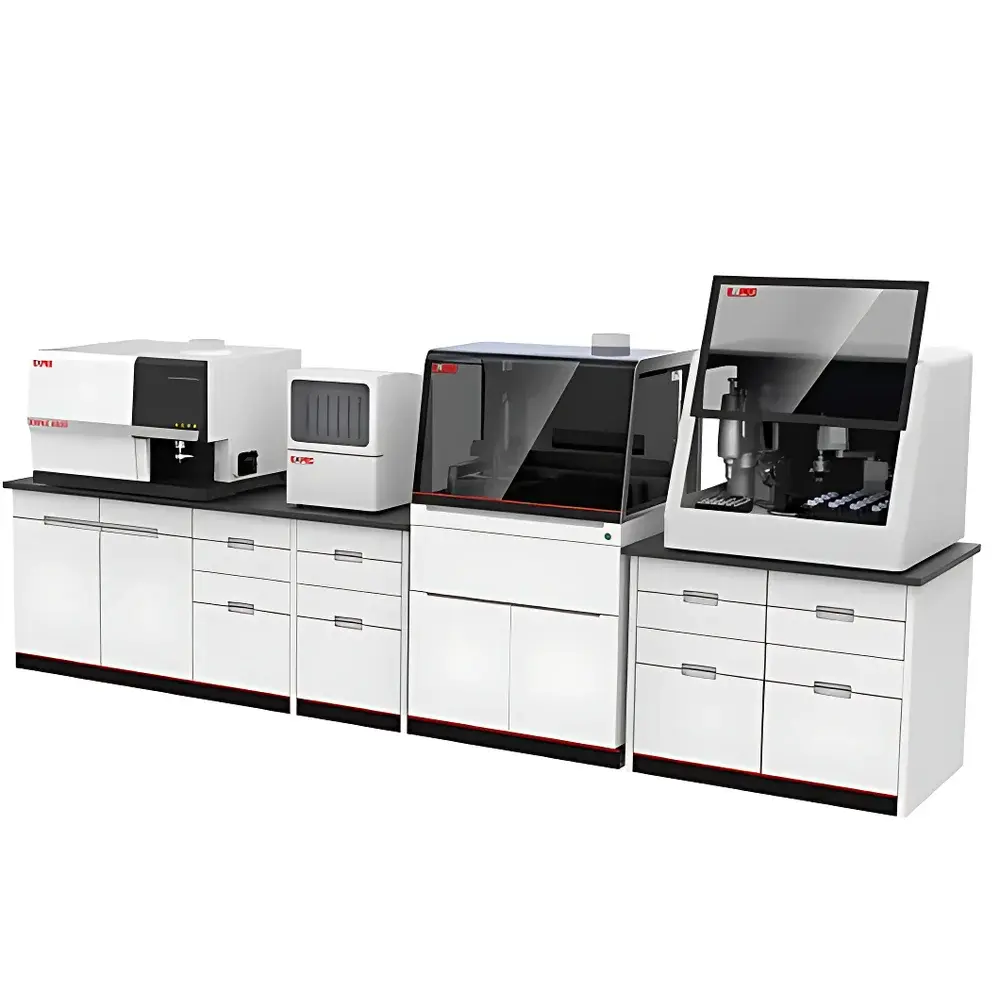
EXPEC SUPEC 6020 Fully Automated Heavy Metal Analysis System (ICP-OES)
| Brand | EXPEC |
|---|---|
| Origin | Zhejiang, China |
| Manufacturer Type | Authorized Distributor |
| Product Category | Domestic |
| Model | SUPEC 6020 |
| Instrument Type | Full-Spectrum Direct-Reading ICP-OES |
| Detection Limit | Not Specified |
| Precision (RSD) | Not Specified |
| Stability | Not Specified |
| Wavelength Range | Not Specified |
| Optical Resolution | Not Specified |
Overview
The EXPEC SUPEC 6020 Fully Automated Heavy Metal Analysis System is an integrated ICP-OES platform engineered for end-to-end automation in elemental quantification. It combines a high-fidelity inductively coupled plasma optical emission spectrometer with synchronized sample preparation modules—either fully automated graphite block digestion or advanced super-microwave digestion—to deliver unattended operation from solid/liquid sample introduction through final quantitative reporting. Unlike conventional ICP-OES workflows requiring manual digestion, dilution, filtration, and calibration, the SUPEC 6020 implements closed-loop process control based on real-time sensor feedback (ultrasonic volume detection, pressure/temperature monitoring, plasma ignition status, and peristaltic flow validation). The system operates under argon plasma conditions optimized for multi-element analysis across the UV–visible spectrum (165–900 nm typical range for ICP-OES), enabling simultaneous detection of over 70 elements—including As, Cd, Cr, Cu, Hg, Ni, Pb, and Zn—at trace to ultra-trace concentrations. Designed for compliance-driven environments, its architecture supports audit-ready operation in accordance with GLP, ISO/IEC 17025, and EPA Method 200.7/6010D frameworks.
Key Features
- Fully automated digestion-integrated workflow: Selectable integration with EXPEC’s automated graphite digestion module (for routine environmental/biological matrices) or super-microwave digestion system (for refractory solids, soils, and alloys), eliminating manual acid handling and open-vessel evaporation.
- Intelligent reagent management: Corrosion-resistant fluidic pathways compatible with HNO₃, HCl, HF, and HClO₄; programmable acid addition, spiking, and lid actuation (sealing/unsealing) controlled via pressure-sensing valves and stepper-driven syringes.
- Precision volumetric handling: Ultrasonic liquid-level sensing combined with high-accuracy syringe pumps enables automatic final volume adjustment (5–50 mL range) with ≤0.025 mL volumetric tolerance and bubble-assisted homogenization.
- Self-optimizing plasma operation: Automatic torch ignition, RF power ramping, nebulizer gas flow tuning, and viewing height optimization prior to analysis—executed without user intervention.
- Autonomous calibration & QC execution: On-the-fly standard curve generation using multi-point calibration standards; automated introduction of blanks, certified reference materials (CRMs), and method detection limit (MDL) check solutions.
- Safety-critical shutdown protocol: Plasma quenching, cooling delay, and exhaust purge sequence triggered upon completion or fault detection—ensuring operator safety and instrument longevity.
Sample Compatibility & Compliance
The SUPEC 6020 accommodates heterogeneous sample types—including aqueous extracts, digested soil leachates, biological tissues, food homogenates, and industrial effluents—without manual preprocessing. Its digestion modules comply with ASTM D3974 (microwave-assisted digestion of environmental samples) and ISO 11047 (graphite furnace digestion of sediments). All automated liquid handling steps meet ISO 8655-5 requirements for piston-type dispensers. Data integrity safeguards include electronic signatures, time-stamped audit trails, and configurable user access levels aligned with FDA 21 CFR Part 11 principles. System validation documentation supports IQ/OQ/PQ protocols required for regulated laboratories.
Software & Data Management
The proprietary EXPEC Analytical Suite provides a unified interface for method development, real-time monitoring, and regulatory reporting. It features interactive calibration curve visualization with element-switching capability, outlier flagging based on RSD thresholds (<5% default), and CPS (counts per second) trend logging. All raw spectral data (intensity vs. wavelength) and processed results (concentration, recovery %, MDL) are stored in vendor-neutral .csv and .xml formats. Built-in QC decision logic allows configurable responses to failure events—e.g., auto-repeat analysis, skip to next sample, or halt run—with full traceability of each action. Data export supports LIMS integration via ASTM E1384-compliant interfaces.
Applications
The system is validated for use in environmental monitoring (EPA SW-846 Methods 3050B, 3051A, 3052), food safety testing (GB 5009.268–2016, EU 2023/1482), clinical toxicology (blood/urine metal screening), and geochemical surveying. Its throughput—up to 40 samples per 8-hour shift including digestion—makes it suitable for contract testing labs operating under ISO/IEC 17025 accreditation. Custom method templates can be developed for niche applications such as catalyst residue analysis in petrochemicals or rare earth element profiling in battery recycling streams.
FAQ
Does the SUPEC 6020 support regulatory compliance for GLP or GMP environments?
Yes—the system logs all critical parameters (plasma power, gas flows, integration times, calibration history) with immutable timestamps and user attribution, satisfying GLP Annex 11 and GMP Annex 11 data integrity expectations.
Can third-party CRM materials be used for automated QC checks?
Yes—users may define custom CRM catalogs with certified concentration values; the software calculates recovery rates and flags deviations against predefined acceptance criteria (e.g., ±10% for EPA 200.7).
Is remote monitoring supported during unattended runs?
Yes—via secure HTTPS web interface with live status dashboard showing digestion progress, plasma stability metrics, and real-time spectral background noise levels.
What maintenance routines are required for long-term operational reliability?
Scheduled tasks include quarterly torch cleaning, semiannual nebulizer inspection, and annual spectrometer wavelength calibration using internal Hg/Ar emission lines—documented within the built-in maintenance log.
How is method transfer handled between instruments?
Method files (.exm) encapsulate all instrument parameters, digestion protocols, and calibration models; they are portable across SUPEC 6020 units and backward-compatible with EXPEC’s SUPEC 6000 series.




