
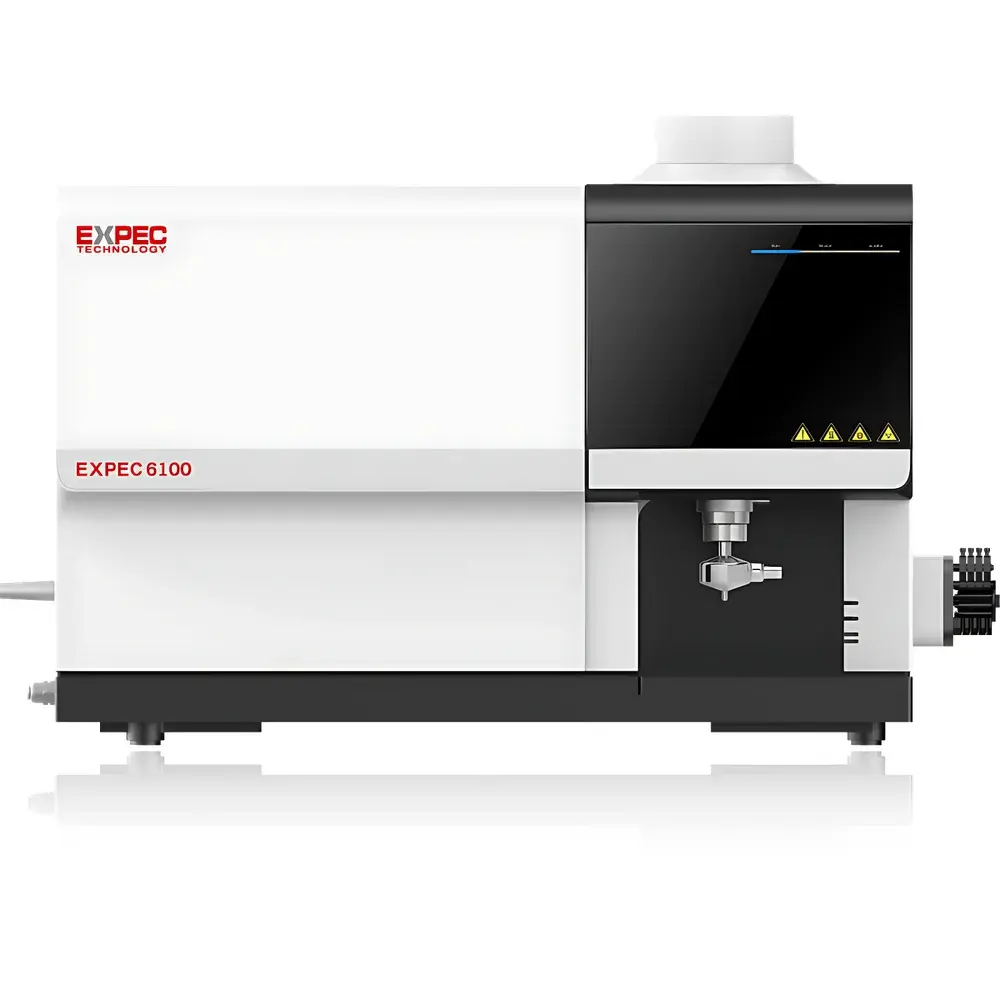
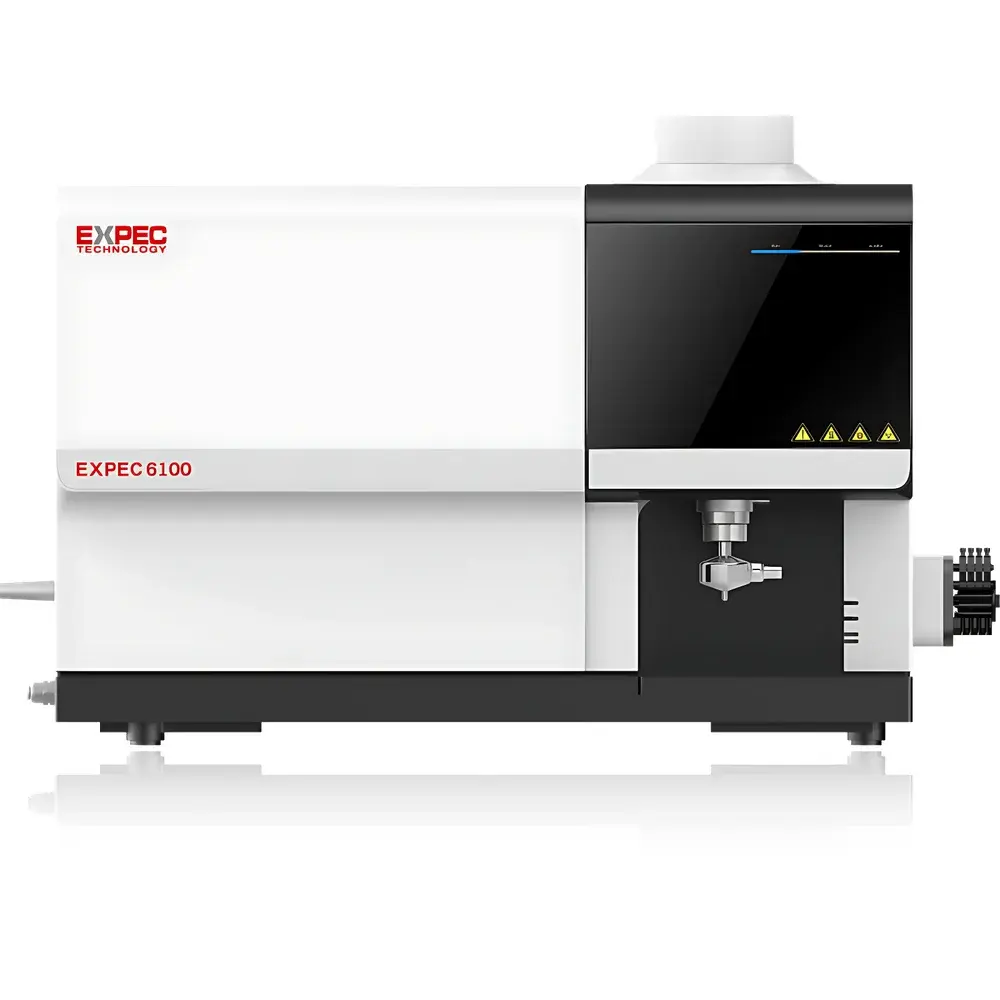
EXPEC 6100 Inductively Coupled Plasma Optical Emission Spectrometer (ICP-OES)
| Brand | EXPEC/SpectrumLab |
|---|---|
| Origin | Zhejiang, China |
| Manufacturer Type | Authorized Distributor |
| Regional Classification | Domestic (China) |
| Model | EXPEC 6100 |
| Pricing | Upon Request |
| Instrument Type | Full-Spectrum Simultaneous Readout |
Overview
The EXPEC 6100 Inductively Coupled Plasma Optical Emission Spectrometer (ICP-OES) is a full-spectrum simultaneous detection system engineered for high-precision elemental analysis across environmental, industrial, and research laboratories. It operates on the fundamental principle of inductively coupled plasma optical emission spectroscopy: liquid samples are nebulized into fine aerosols, transported into a high-temperature argon plasma (~6,000–10,000 K), where atoms and ions are excited and emit element-specific photons upon relaxation. These emissions are dispersed by a high-resolution echelle grating spectrometer and captured by a thermoelectrically cooled CCD detector, enabling simultaneous acquisition of the entire UV-Vis spectral range (165–900 nm) with sub-pixel wavelength registration.
Designed for robust routine operation, the EXPEC 6100 integrates a self-excited all-solid-state RF generator with fully digital power control (700–1,600 W, continuously adjustable), ensuring stable plasma ignition and exceptional tolerance to matrix variations—including high-salt, organic, and variable-acid-content samples. Its vertical torch configuration supports both axial and radial viewing geometries, offering users flexibility to optimize sensitivity (axial) or minimize polyatomic interferences (radial) without hardware reconfiguration.
Key Features
- Self-excited all-solid-state RF generator with real-time digital feedback control, delivering superior plasma stability and extended operational lifetime under continuous duty cycles
- Vertically oriented ICP torch with dual-view capability: axial observation for sub-µg/L detection limits; radial observation for improved robustness against complex matrices (e.g., seawater, digested sludge, refinery effluents)
- Echelle grating-based two-dimensional dispersion system with temperature-stabilized optical bench, minimizing thermal drift and enabling long-term wavelength reproducibility (<0.5 pm/h)
- Triple-stage thermoelectrically cooled CCD detector (–45 °C operating temperature), optimized for low-noise, high-dynamic-range signal acquisition and overflow suppression during intense line emissions
- Modular sample introduction: integrated multi-channel digital mass flow controllers for precise argon gas regulation (plasma, auxiliary, nebulizer); high-accuracy peristaltic pump supporting internal standard addition, hydride generation, and organic solvent compatibility via optional accessories
- Tool-free, self-aligning segmented torch assembly—center tube replacement only required for method-specific optimization—reducing consumable costs and downtime
Sample Compatibility & Compliance
The EXPEC 6100 accommodates aqueous solutions (including 20% v/v HNO₃, HCl, and HF-digested matrices), organic solvents (with optional spray chamber and torch upgrades), and semi-solid digests (via ultrasonic nebulization or microflow systems). It complies with core analytical standards including ASTM D1976, ISO 11885, EPA Methods 200.7 and 6010D, and EN 14802 for trace metal quantification in water, soil, and waste streams. The instrument’s architecture supports GLP/GMP-aligned workflows: audit trails, user-level access controls, electronic signatures, and data integrity features align with FDA 21 CFR Part 11 requirements when deployed with validated software configurations.
Software & Data Management
Element V — the native Windows-based software platform — provides intuitive method development, real-time spectral visualization, and automated calibration curve generation. Its adaptive integration algorithm dynamically adjusts dwell times per emission line based on intensity, preserving precision across concentration ranges spanning six orders of magnitude (from sub-pptr to % w/w). The built-in method library includes pre-validated protocols for EPA, ISO, and Chinese HJ standards. Data export conforms to ASTM E1382-compliant ASCII formats and supports LIMS integration via ASTM E1482 or OPC UA interfaces. Optional modules enable seamless interfacing with autosamplers, online digestion units, and hydride generation systems—facilitating unattended batch analysis and method scalability.
Applications
The EXPEC 6100 delivers reliable quantification of over 70 elements (Li–U) in diverse sample types: municipal and industrial wastewater (As, Cd, Cr, Pb, Hg), acid-digested soils and sediments (Al, Fe, Mn, rare earths), petroleum products (Na, V, Ni, Ca), metallurgical slags and alloys (Co, Mo, Ti, Zr), high-purity semiconductor materials (B, P, Cu, Na), and airborne particulate filters (Sb, Zn, Ba). Its dual-view design and matrix-tolerant plasma make it especially suited for regulatory compliance testing, resource recovery analytics, catalyst characterization, and method development in contract and academic laboratories.
FAQ
Does the EXPEC 6100 support hydride generation or cold vapor techniques?
Yes—through dedicated pneumatic interfaces and software-triggered valve sequencing, the system integrates with commercial HG-AFS and CV-AAS modules for ultra-trace As, Se, Sb, Bi, Hg, and Cd analysis.
What is the typical detection limit for key elements in aqueous standards?
Using axial view and 15 s integration, typical 3σ DLs are: Mg (0.08 µg/L), Ca (0.03 µg/L), Fe (0.12 µg/L), Cd (0.005 µg/L), and Pb (0.01 µg/L) — values vary with matrix, nebulizer type, and integration strategy.
Is the software compliant with 21 CFR Part 11 for regulated environments?
Element V supports role-based permissions, electronic signatures, and full audit trail logging; formal validation documentation and IQ/OQ protocols are available upon request for GxP deployment.
Can the EXPEC 6100 analyze organic solvents such as kerosene or xylene?
Yes—with optional quartz torch, chilled spray chamber, and oxygen ashing accessory, the system achieves stable plasma operation and accurate quantification in hydrocarbon matrices up to 30% v/v.
How does the FSC (Fast Spectrum Calibration) technology improve long-term measurement stability?
FSC performs real-time wavelength recalibration using internal reference lines (e.g., Ar II 404.41 nm) at sub-second intervals, compensating for mechanical drift and thermal expansion—ensuring peak centering accuracy remains within ±0.002 nm over 8-hour runs.





