
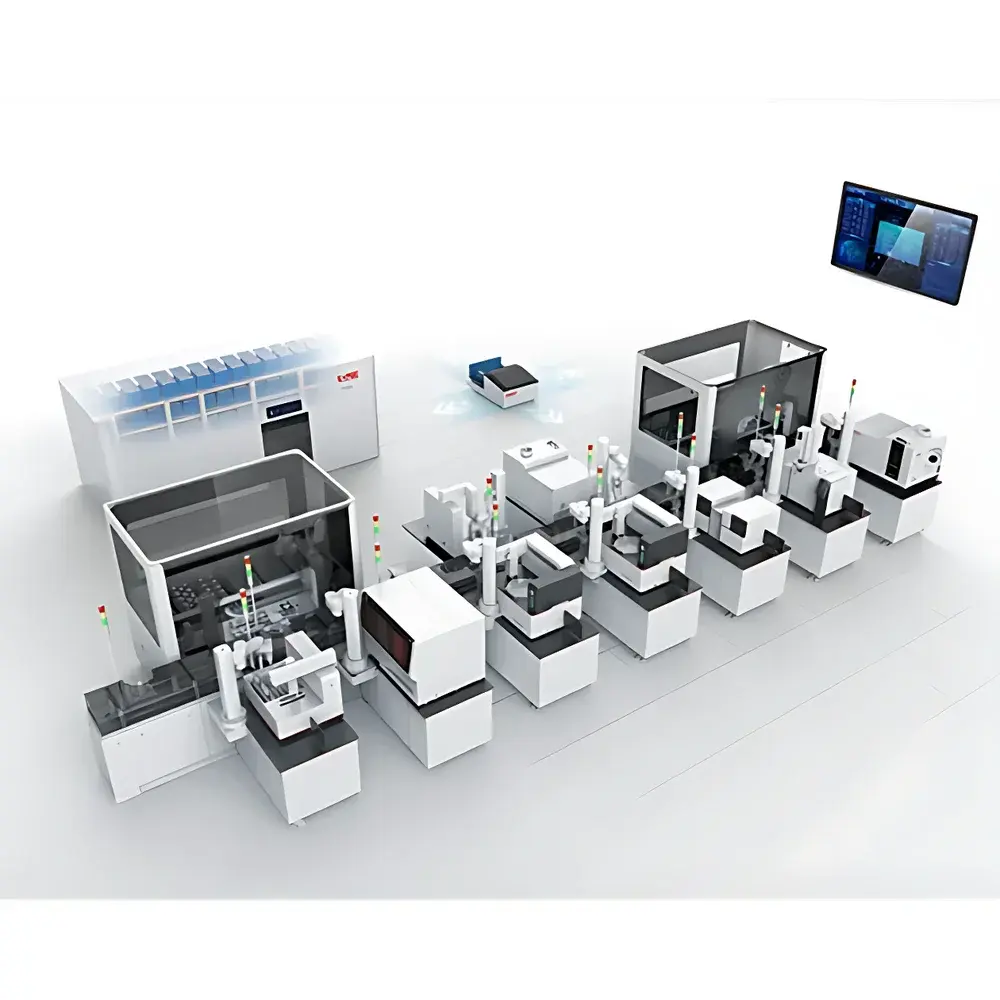
EXPEC SUPEC 8000 Fully Automated Water Quality Laboratory Analysis System
| Brand | EXPEC |
|---|---|
| Origin | Zhejiang, China |
| Manufacturer Type | Authorized Distributor |
| Country of Origin | China |
| Model | SUPEC 8000 |
| Pricing | Available Upon Request |
Overview
The EXPEC SUPEC 8000 Fully Automated Water Quality Laboratory Analysis System is an integrated, modular laboratory automation platform engineered for high-throughput, regulatory-compliant water quality monitoring. Built upon a distributed architecture of synchronized robotic workstations and centralized intelligent control, the system implements standardized liquid handling, sample routing, analytical execution, and data governance across the entire analytical lifecycle—from sample receipt and refrigerated storage to multi-parameter instrumental analysis, report generation, and audit-ready traceability. Its core operational principle relies on deterministic robotic motion control, gravimetric and volumetric precision dispensing, and time-temperature-controlled reaction modules (e.g., for COD digestion or phosphorus persulfate oxidation), ensuring strict adherence to ISO 5667, HJ/T 91–2019, and EPA Method 410.5/365.2 protocols. Designed for municipal water utilities, environmental monitoring stations, and third-party testing laboratories operating under GLP or ISO/IEC 17025 frameworks, the SUPEC 8000 eliminates manual intervention in repetitive pre-analytical and post-analytical tasks while maintaining full compliance with data integrity requirements under FDA 21 CFR Part 11.
Key Features
- Fully automated cold-chain sample management: 4–8 °C refrigerated storage with barcode-tracked sample入库/出库, integrated with LIMS-compatible sample metadata logging.
- Robotic liquid handling station with ±0.5% volumetric accuracy for sample aliquoting, dilution, reagent addition, homogenization, cap actuation, and tip washing—validated per ISO 8655-6.
- Modular analytical workflow orchestration: seamless handoff of prepared samples to configurable analyzers (COD, permanganate index, TP, TN, NH₃-N, heavy metals via ICP-OES or AAS) via conveyor-based or AGV-assisted transport.
- Centralized intelligent control workstation running real-time scheduling, inter-device synchronization, fault diagnostics, and dynamic priority queue management.
- Integrated quality assurance layer: automated QC sample insertion at user-defined intervals, duplicate analysis triggering, spike recovery tracking, and real-time deviation flagging aligned with ISO/IEC 17025 Clause 7.7.
- Self-sustaining ancillary systems: auto-replenishment of consumables (tubes, tips, reagents), closed-loop waste liquid collection with level monitoring, and programmable ultrasonic/chemical cleaning cycles for all fluidic pathways.
Sample Compatibility & Compliance
The SUPEC 8000 accommodates standard 10–100 mL polypropylene or borosilicate glass sample vials (with screw caps or septa), as well as 50–200 mL reagent bottles and waste containers compliant with UN-certified chemical storage specifications. All wetted materials—including tubing, valves, and probe surfaces—are chemically inert (e.g., PTFE, PEEK, sapphire) and resistant to common oxidants (e.g., K₂Cr₂O₇, KMnO₄) and acidic digestants (H₂SO₄/H₃PO₄ mixtures). The system supports method validation documentation packages per ISO/IEC 17025 Annex A and provides electronic audit trails meeting ALCOA+ principles (Attributable, Legible, Contemporaneous, Original, Accurate, Complete, Consistent, Enduring, Available). It interfaces natively with major LIMS platforms (e.g., LabWare, STARLIMS) via ASTM E1578-compliant API and supports CSV/Excel export for external QA review.
Software & Data Management
The embedded EXPEC LabOS™ control software provides role-based access control (RBAC), electronic signature capability, and full 21 CFR Part 11 compliance—including secure user authentication, immutable audit logs, and automatic backup of raw instrument files, processed results, and system event records. All analytical data—including timestamps, instrument parameters, calibration curves, QC metrics, and outlier flags—are stored in a relational database with configurable retention policies (≥10 years). Automated report generation adheres to ISO 17025 reporting clauses and includes uncertainty estimation per GUM (Guide to the Expression of Uncertainty in Measurement). Data reconciliation workflows support parallel comparison against reference methods, trend analysis across batches, and automatic flagging of non-conformance per pre-set action limits.
Applications
- Regulatory environmental monitoring: routine analysis of surface water, groundwater, wastewater effluents, and drinking water sources per national and provincial discharge standards (e.g., GB 3838–2002, GB 5749–2022).
- Process control in water treatment plants: real-time tracking of influent/effluent quality parameters to optimize coagulation, disinfection, and filtration processes.
- Contract laboratory services: high-volume batch processing for certified environmental testing with full chain-of-custody documentation and ISO/IEC 17025 accreditation readiness.
- Research and method development: flexible configuration for evaluating new analytical protocols, cross-platform method transfer studies, and long-term stability testing of reagents and standards.
- Emergency response labs: rapid deployment mode enabling prioritized analysis of contamination events (e.g., heavy metal spills, organic pollutant releases) with accelerated turnaround time and minimal operator exposure.
FAQ
Does the SUPEC 8000 support integration with existing LIMS or ERP systems?
Yes—it provides RESTful API and ODBC/JDBC connectivity, along with HL7 and ASTM E1384 message mapping for bidirectional data exchange.
Can the system perform method validation and verification per ISO/IEC 17025 requirements?
Yes—built-in tools include repeatability assessment, intermediate precision evaluation, limit of detection (LOD) calculation, and linearity verification with NIST-traceable standards.
What maintenance protocols are required for uninterrupted operation?
Scheduled preventive maintenance includes quarterly calibration of liquid handlers, biannual inspection of pneumatic actuators and refrigeration units, and daily automated self-diagnostics with email alerts for critical faults.
Is remote monitoring and troubleshooting supported?
Yes—the system supports secure TLS-encrypted remote desktop access and real-time dashboard viewing via EXPEC’s cloud-based LabView Connect portal (optional subscription).
How is data security and user accountability enforced?
All user actions trigger timestamped, digitally signed entries in an immutable audit trail; password policies enforce complexity, expiration, and lockout rules per NIST SP 800-63B.




