
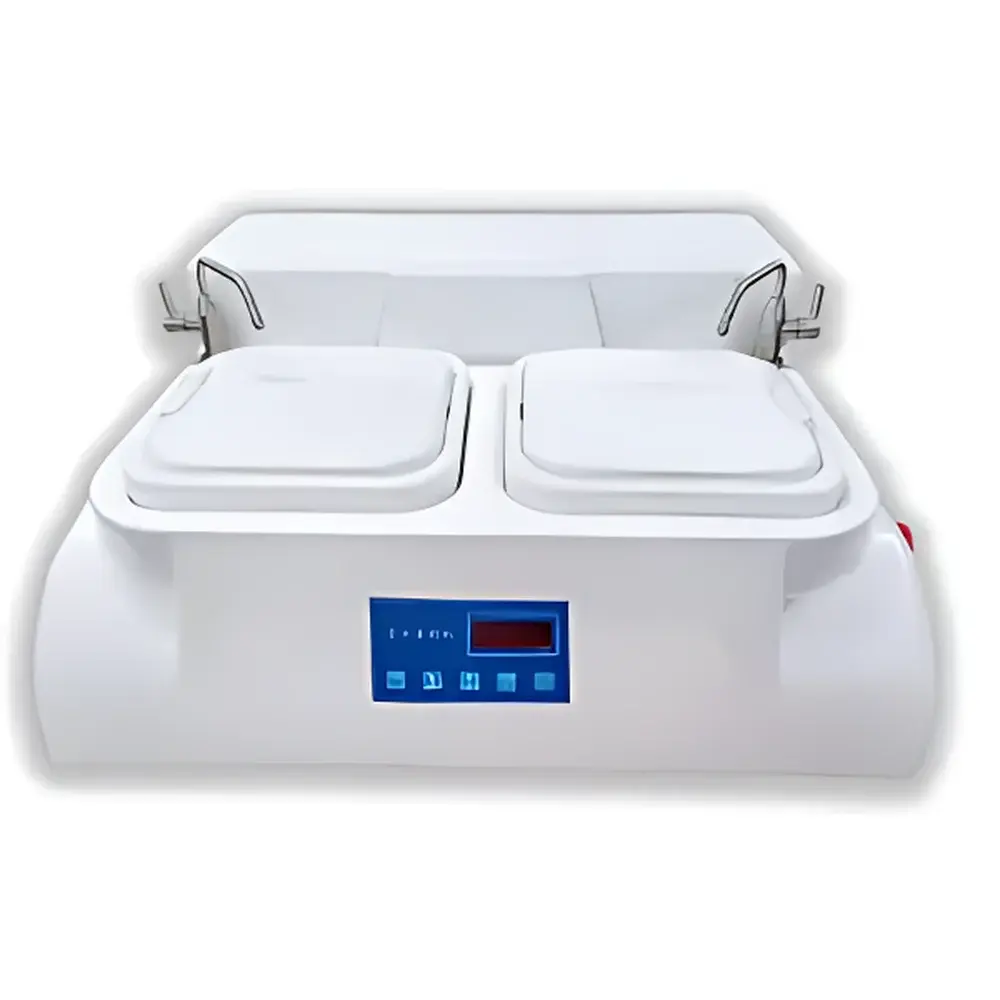
Caikon YMP-2C Dual-Station Variable-Speed Metallographic Grinding and Polishing Machine
| Brand | Caikon |
|---|---|
| Origin | Shanghai, China |
| Manufacturer Type | Direct Manufacturer |
| Region of Origin | Domestic (China) |
| Model | YMP-2C |
| Price | USD 920 (approx.) |
| Dimensions (L×W×D) | 810 × 750 × 350 mm |
| Weight | 51 kg |
| Number of Grinding/Polishing Plates | 2 |
| Plate Diameter | 230 mm |
| Speed Range | 50–1500 rpm (infinitely variable) |
| Motor Power | 350 W |
| Input Voltage/Frequency | 220 V, 50 Hz |
| Control Interface | LED digital display with membrane keypad |
| Cooling System | Integrated water supply & drainage with adjustable flow |
| Bearing Protection | Sealed main shaft design for extended service life |
| Structural Material | Molded ABS housing with reinforced base plate |
Overview
The Caikon YMP-2C Dual-Station Variable-Speed Metallographic Grinding and Polishing Machine is an engineered solution for precision sample preparation in metallurgical, materials science, and failure analysis laboratories. Designed around the fundamental requirements of metallographic specimen conditioning—namely planar uniformity, surface integrity preservation, and reproducible material removal—the YMP-2C implements a dual-plate architecture based on controlled rotational abrasion mechanics. Each 230 mm diameter plate operates independently, enabling simultaneous or sequential grinding and polishing under precisely regulated speed profiles (50–1500 rpm). The machine adheres to core principles of mechanical sample preparation: consistent normal force application via weighted carrier systems (not included but compatible), controlled abrasive particle engagement through regulated slurry delivery, and thermal management via integrated water cooling to suppress localized heating that may induce phase transformation, recrystallization, or plastic deformation in sensitive microstructures.
Key Features
- Dual independent control stations allow asynchronous operation of two 230 mm plates—ideal for parallel coarse grinding and fine polishing, or comparative method validation.
- Infinitely variable speed drive (50–1500 rpm) enables precise adaptation to abrasive media characteristics: low speeds (50–300 rpm) for delicate polishing with diamond suspensions or alumina slurries; higher speeds (600–1500 rpm) for rapid silicon carbide paper-based grinding.
- Sealed main shaft assembly with labyrinth sealing minimizes coolant ingress into bearing housings—extending mean time between failures (MTBF) and reducing maintenance frequency.
- Molded ABS structural housing provides chemical resistance against common metallographic reagents (e.g., ammoniacal peroxide, ferric chloride etchants) while maintaining dimensional stability under continuous lab use.
- Integrated water management system includes inlet and drain tubing, flow-adjustable nozzle, and splash-resistant basin design—supporting both clockwise and counterclockwise plate rotation for optimized slurry dispersion and debris evacuation.
- Digital LED display with membrane keypad interface delivers intuitive parameter setting and real-time speed verification—compatible with routine calibration logging per ISO/IEC 17025 quality management requirements.
Sample Compatibility & Compliance
The YMP-2C accommodates standard metallographic specimens up to 40 mm in diameter (with optional holders) and supports all conventional consumables: 230 mm silicon carbide papers (P80–P2500), 230 mm diamond-impregnated grinding discs, and 250 mm woven or non-woven polishing cloths. Its mechanical configuration aligns with ASTM E3-22 (“Standard Guide for Preparation of Metallographic Specimens”) and ISO 16337:2018 (“Metallic materials — Metallographic specimen preparation”). While not certified to GLP or GMP out-of-the-box, the device’s stable speed control, traceable digital interface, and documented maintenance intervals support integration into auditable workflows under ISO 9001 or laboratory-specific SOPs.
Software & Data Management
The YMP-2C operates as a standalone electromechanical instrument without embedded firmware or network connectivity. All operational parameters—including set speed, runtime, and direction—are manually entered and retained only during active session. For laboratories requiring electronic recordkeeping, external data loggers (e.g., USB-connected tachometers or PLC-integrated I/O modules) may be deployed to capture speed stability profiles over time. The absence of proprietary software eliminates cybersecurity concerns related to remote access or firmware updates—making it suitable for secure environments where air-gapped instrumentation is mandated.
Applications
- Routine metallographic sectioning support for ferrous alloys (steels, cast irons), non-ferrous metals (Al, Cu, Ti), and advanced composites (MMC, CMC).
- Preparation of cross-sections for SEM-EDS analysis, where topographic flatness and subsurface damage minimization are critical.
- Quality control labs performing ASTM E112 grain size evaluation or ISO 643 inclusion rating—requiring repeatable surface finish across batches.
- Academic teaching laboratories needing robust, low-maintenance equipment for undergraduate metallurgy courses and technician training programs.
- Failure analysis workflows involving fracture surface replication or weld zone characterization, where thermal artifact avoidance is essential.
FAQ
Is the YMP-2C compliant with CE or UL safety standards?
No—this model is manufactured to Chinese GB/T standards and lacks third-party certification for EU or North American regulatory markets. Users intending export deployment must engage local compliance partners for adaptation.
Can the machine operate continuously for extended periods?
Yes—rated for intermittent duty cycles up to 8 hours/day at ≤75% of maximum speed; sustained operation above 1200 rpm requires 15-minute cooldown intervals to maintain motor thermal limits.
What is the recommended maintenance schedule?
Lubrication of the gear reduction unit every 500 operating hours; inspection of O-rings and hose fittings quarterly; replacement of worn abrasives and polishing cloths per ASTM E3 usage guidelines.
Does Caikon provide OEM or custom mounting solutions?
Yes—Caikon offers optional vacuum specimen holders, automated dosing pumps, and bench-mounting brackets upon request, subject to MOQ and lead time confirmation.
Is technical documentation available in English with metrological traceability statements?
Full English user manual, parts diagrams, and electrical schematics are supplied; however, factory calibration certificates with NIST-traceable speed verification are available only as a paid add-on service.



