
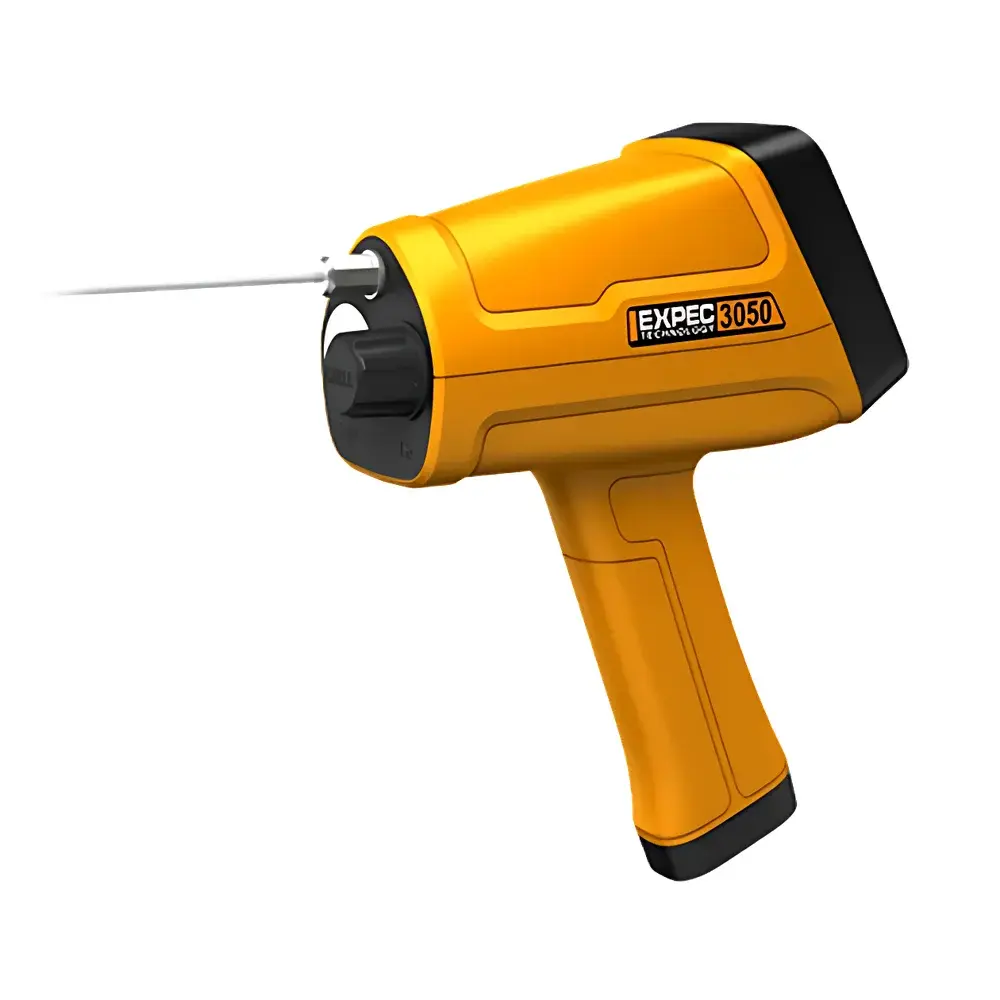
EXPEC 3050 Handheld VOC Analyzer with Flame Ionization Detection (FID)
| Brand | EXPEC |
|---|---|
| Origin | Zhejiang, China |
| Model | EXPEC 3050 |
| Instrument Type | Portable Gas Chromatograph with Integrated FID |
| Weight | ~2.0 kg |
| Compliance | GB 37822–2019, HJ 733–2014, HJ 1019–2019 |
| Optional Configuration | FID + PID dual-detector mode |
| Power Supply | Rechargeable Li-ion battery (operational runtime ≥ 4 h) |
| Detection Principle | Catalytic combustion-assisted flame ionization detection |
Overview
The EXPEC 3050 Handheld VOC Analyzer is a field-deployable, battery-powered gas chromatographic system integrating a miniaturized flame ionization detector (FID) for quantitative measurement of volatile organic compounds (VOCs) in ambient air, soil headspace, and industrial emission streams. Unlike conventional handheld photoionization detectors (PIDs), the EXPEC 3050 employs true FID-based quantification—leveraging hydrocarbon-specific ionization in a hydrogen-air flame—to deliver measurement accuracy and linear dynamic range comparable to laboratory-grade benchtop GC-FID systems. Engineered for regulatory field compliance, it supports real-time, on-site screening without sample pre-concentration or laboratory turnaround. Its compact architecture incorporates a micro-GC column module, precision mass flow control, and thermally stabilized FID chamber—all optimized for robustness under variable environmental conditions (5–40 °C, 20–90% RH non-condensing).
Key Features
- True FID Quantification: Utilizes a miniature, low-power FID with integrated hydrogen generation via metal hydride storage—eliminating pressurized gas cylinders while maintaining ASTM D2887-equivalent response factors for C1–C12 hydrocarbons.
- Field-Optimized Portability: Total instrument mass ≤ 2.0 kg; ergonomic single-hand operation; IP54-rated enclosure for dust and splash resistance during outdoor deployment.
- Two-Step Operational Workflow: Initiate analysis via dedicated hardware button; automatic carrier gas purge, column heating, FID ignition, and peak integration completed within < 90 seconds.
- Dual-Detector Flexibility: Modular design allows field-upgrade to FID+PID configuration—enabling simultaneous detection of aromatic and chlorinated VOCs (PID-sensitive) alongside aliphatic and olefinic species (FID-optimized).
- Onboard Data Integrity: Internal flash memory stores chromatograms, calibration logs, and operator metadata with timestamping; audit trail compliant with GLP-aligned documentation requirements.
- Safety-Certified Hydrogen Management: Solid-state hydrogen reservoir uses reversible metal hydride alloy (LaNi5-based), rated for UN 3472 transport classification and certified per IEC 60079-0 for non-sparking operation in Zone 2 hazardous locations.
Sample Compatibility & Compliance
The EXPEC 3050 is validated for direct analysis of gaseous samples collected via Tedlar® bags, sorbent tubes (thermal desorption optional), or real-time ambient draws. It meets performance criteria specified in Chinese national standards GB 37822–2019 (unorganized VOC emissions monitoring), HJ 733–2014 (leak detection and repair protocols), and HJ 1019–2019 (soil and groundwater VOC sampling). While not CE-marked or FDA 510(k)-cleared, its measurement traceability aligns with ISO/IEC 17025 principles through factory calibration against NIST-traceable propane and benzene standards. Method validation reports support method transfer to ISO 11890-2 and EPA Method 25A equivalents for total hydrocarbon reporting.
Software & Data Management
Instrument control and data review are performed via a 5-inch capacitive touchscreen running embedded Linux OS. The EXPEC FieldSuite™ software provides: real-time chromatogram visualization with baseline correction algorithms; user-defined calibration curves (linear, quadratic, or multi-point); automated retention time alignment across sequential runs; and export of .csv and .cdf files compatible with third-party chromatography data systems (CDS). All calibration events, detector status logs, and firmware version stamps are cryptographically signed and stored locally—supporting 21 CFR Part 11–aligned electronic record integrity when paired with optional cloud synchronization (EXPEC CloudLink™, TLS 1.3 encrypted).
Applications
- Rapid screening of fugitive emissions from flanges, valves, pumps, and connectors in petrochemical, refining, and pharmaceutical facilities.
- Unannounced compliance audits of unorganized VOC release points per GB 37822–2019 Annex A protocols.
- Soil vapor intrusion assessment at brownfield sites using headspace analysis of grab soil samples.
- Performance verification of VOC abatement technologies—including activated carbon beds, thermal oxidizers, and biofilters—via inlet/outlet differential measurements.
- Mobile monitoring along pipeline right-of-ways and at gasoline dispensing facilities to quantify evaporative losses during refueling operations.
FAQ
What VOC compounds does the EXPEC 3050 detect with FID?
It responds quantitatively to virtually all organic compounds containing C–H bonds—including alkanes, alkenes, aromatics, ketones, and esters—with near-uniform sensitivity (±15% RSD across C2–C10). Non-hydrocarbon species (e.g., CO, CO2, NOx) yield negligible signal.
Is hydrogen refilling required in the field?
No. The integrated metal hydride reservoir is recharged via the onboard electrolytic hydrogen generator powered by the main battery—requiring only deionized water replenishment every 40–60 analyses.
Can the instrument be calibrated using external gas standards?
Yes. Built-in span calibration supports dynamic dilution of certified gas mixtures (e.g., 1–100 ppmv propane in air) via the integrated mass flow controller; zero calibration uses synthetic air or nitrogen.
Does it support remote data transmission?
Optional LTE/Wi-Fi module enables secure upload of analysis reports, chromatograms, and GPS-tagged location metadata to EXPEC’s cloud platform for centralized fleet management and regulatory reporting dashboards.
What maintenance intervals are recommended?
FID nozzle cleaning every 200 runs; column bake-out weekly if used daily; annual factory recalibration recommended per ISO/IEC 17025 Clause 6.4.3 for accredited applications.
Related Products





