
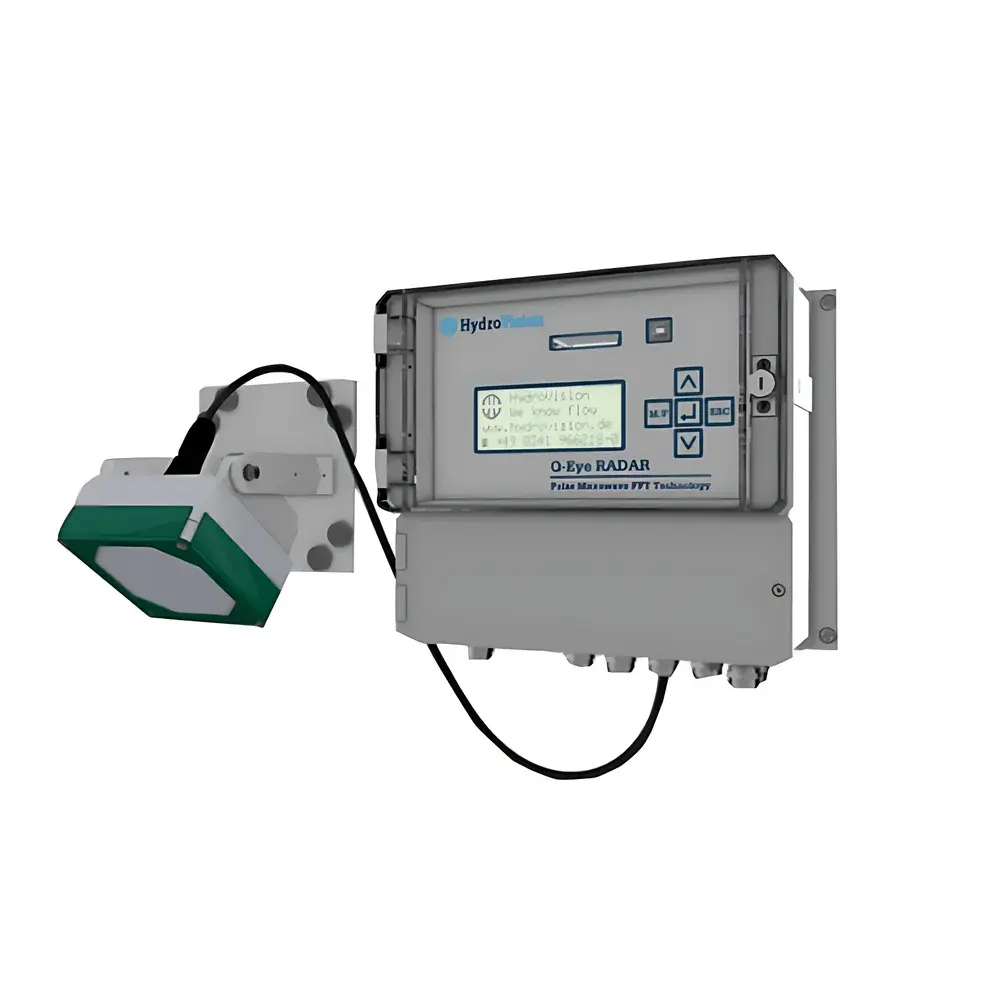
DSE Q-Eye Radar Surface Velocity Sensor
| Brand | DSE |
|---|---|
| Origin | Zhejiang, China |
| Manufacturer Type | Authorized Distributor |
| Country of Origin | China |
| Model | Q-Eye |
| Pricing | Available Upon Request |
Overview
The DSE Q-Eye Radar Surface Velocity Sensor is a non-contact, pulsed Doppler radar instrument engineered for continuous, real-time measurement of surface water velocity and water level in open channels, rivers, stormwater conduits, and irrigation canals. Operating at K-band (24 GHz), the sensor emits short-duration microwave pulses and analyzes the frequency shift (Doppler effect) of the reflected signal from moving water surfaces to compute instantaneous surface velocity. Simultaneously, it employs time-of-flight (ToF) radar ranging to determine water level with high temporal resolution. Unlike optical or acoustic methods, the Q-Eye is immune to turbidity, suspended solids, sediment load, foam, or surface debris—making it uniquely suited for flood-stage monitoring, emergency hydrological assessment, and long-term unattended deployment in harsh environmental conditions.
Key Features
- Non-contact dual-parameter sensing: Simultaneous acquisition of surface velocity (0.1–15 m/s typical range) and water level (0.5–15 m measurement span) without physical immersion or calibration drift.
- Pulsed Doppler radar architecture: High immunity to electromagnetic interference, solar radiation, and ambient light; operational in rain, fog, snow, and low-visibility conditions.
- Integrated mounting and alignment system: Compact, weatherproof IP67-rated housing with adjustable tilt-angle bracket and integrated bubble level for rapid field installation on bridges, weirs, or channel banks.
- Low-power operation: Designed for solar-battery hybrid power systems; typical average current draw 6 months of autonomous operation with standard 24 Ah battery packs.
- Robust environmental resilience: Operating temperature range: −25 °C to +70 °C; corrosion-resistant aluminum alloy housing with UV-stabilized polymer lens cover.
Sample Compatibility & Compliance
The Q-Eye is validated for use across heterogeneous hydraulic environments—including turbulent flood flows, shallow overland runoff, and low-gradient irrigation channels—with minimal dependence on surface roughness or wave pattern. It complies with IEC 60529 (IP67 ingress protection), EN 61000-6-3 (EMC emission standards), and EN 61000-6-2 (immunity requirements). While not certified to ISO/IEC 17025 for metrological traceability, its output data are compatible with national hydrological monitoring frameworks including China’s SL 337–2006 (Technical Specifications for Radar-Based Flow Measurement) and aligns with principles outlined in ISO 748:2019 (Measurement of liquid flow in open channels — Velocity-area method).
Software & Data Management
The sensor outputs ASCII-formatted serial data (RS-485 Modbus RTU or SDI-12 protocol) containing timestamped velocity vector magnitude, water level, signal quality index, and internal diagnostics. It integrates natively with industry-standard SCADA platforms (e.g., Ignition, Siemens Desigo, Campbell Scientific LoggerNet) and cloud-based telemetry systems (LoRaWAN, NB-IoT, 4G LTE-M). Firmware supports remote configuration, firmware-over-the-air (FOTA) updates, and configurable data logging intervals (1 s to 1 h). Audit-trail functionality—including parameter change logs and firmware version history—is retained locally for GLP-aligned field validation and QA/QC reporting.
Applications
- Flood forecasting and real-time river stage monitoring during extreme events
- Bridge-mounted mobile velocity profiling for rapid reconnaissance surveys (e.g., post-storm assessment)
- Urban drainage network surveillance for CSO event detection and hydraulic model calibration
- Irrigation district flow accounting and gate control feedback
- Environmental compliance monitoring at wastewater outfalls and regulated discharge points
- Research-grade hydrometric data collection in sediment-laden or algae-covered streams where traditional ADCPs or float methods fail
FAQ
Does the Q-Eye require calibration against a reference velocity standard?
No routine field calibration is required. Factory calibration is performed using controlled open-channel flume testing per SL 337–2006. Users may perform optional verification using known-flow test sections or cross-check with portable ADCP measurements.
Can it measure velocity under ice cover?
No. The sensor requires an exposed water surface for radar signal coupling; it is not designed for under-ice or submerged operation.
What is the minimum detectable velocity and how is direction handled?
The Q-Eye reports scalar surface velocity magnitude only. Directional information is inferred from installation geometry (i.e., known channel orientation); no built-in directional discrimination is provided.
Is the device suitable for regulatory reporting under EPA or EU Water Framework Directive requirements?
Data generated by the Q-Eye may be used as supplementary evidence in regulatory contexts but must be accompanied by documented uncertainty analysis and site-specific validation per local authority guidelines (e.g., UK Environment Agency’s “Guidance on Use of Radar for Flow Measurement”).
How does signal quality degrade in heavy rainfall?
Rain attenuation at 24 GHz is minimal for short-range deployments (< 30 m). Signal-to-noise ratio decreases marginally during intense downbursts, but the embedded adaptive thresholding algorithm maintains stable tracking above 0.3 m/s velocity thresholds.
Related Products







