
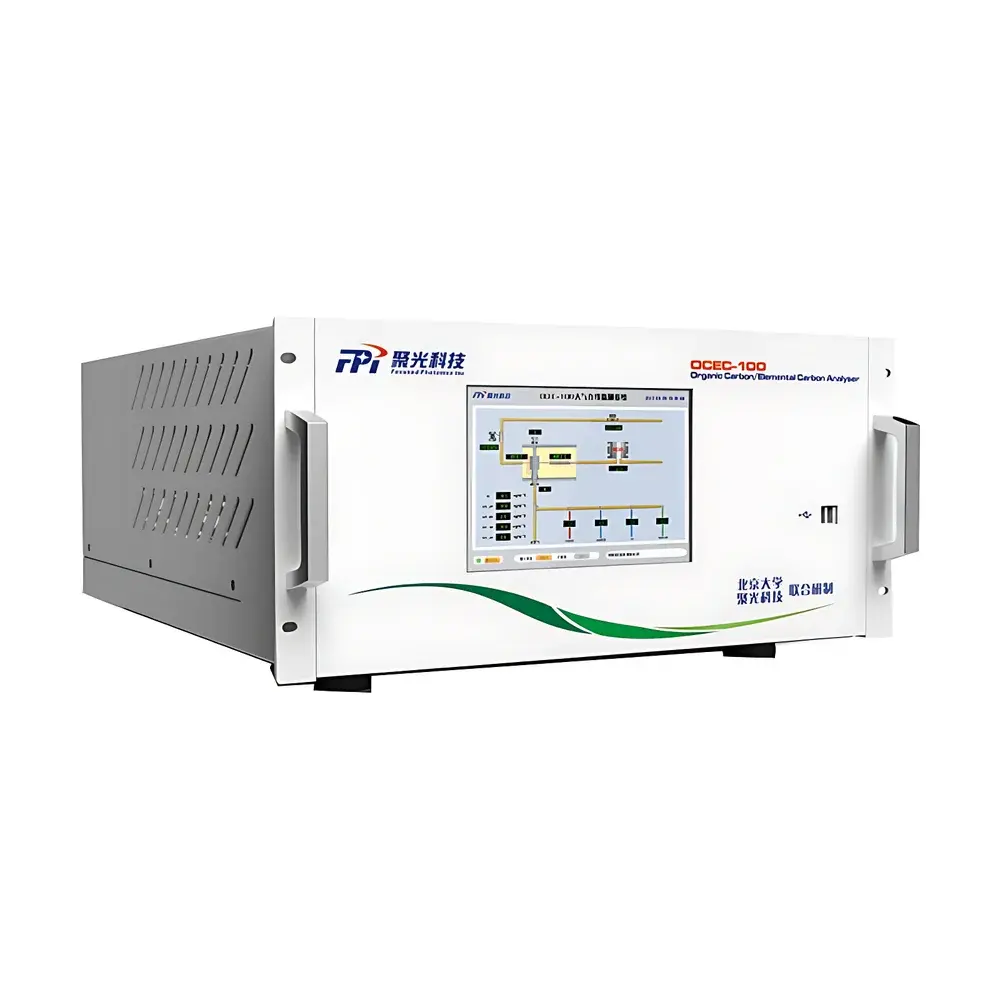
FPI OCEC-100 Online Atmospheric Organic and Elemental Carbon Analyzer
| Brand | FPI |
|---|---|
| Origin | Zhejiang, China |
| Manufacturer Type | Original Equipment Manufacturer (OEM) |
| Country of Origin | China |
| Model | OCEC-100 |
| Instrument Principle | Thermal-Optical Transmission/Reflection (TOT/TOR) |
| Configuration | Continuous Online Monitoring System |
| Compliance | Designed for ASTM D7520, IMPROVE_A, NIOSH 5040, EUSAAR-2 protocol alignment |
| Data Output | Real-time OC/EC mass concentration (µg/m³), split point identification, charring correction trace |
Overview
The FPI OCEC-100 is a fully automated, continuous online analyzer engineered for the speciated quantification of organic carbon (OC) and elemental carbon (EC) in ambient particulate matter (PM2.5 and PM10). It implements the thermal-optical analysis (TOA) principle—specifically the dual-mode thermal-optical transmission (TOT) and thermal-optical reflection (TOR) methodologies—to resolve the long-standing analytical challenge of OC/EC partitioning in atmospheric aerosols. Unlike standalone thermal desorption or optical absorption techniques, the OCEC-100 integrates controlled stepwise heating under inert (He) and oxidative (He/O2) atmospheres with real-time laser transmittance and reflectance monitoring at 635 nm. This enables dynamic, optically guided correction of pyrolytic charring—a critical interference where thermally labile OC decomposes to char that mimics EC—and thereby delivers metrologically traceable OC and EC mass concentrations aligned with internationally accepted protocols including IMPROVE_A, NIOSH Method 5040, and EUSAAR-2.
Key Features
- Dual optical correction architecture: Simultaneous TOT and TOR measurement channels provide cross-validated charring compensation, enhancing robustness across diverse aerosol compositions (e.g., biomass burning, traffic emissions, secondary organic aerosol).
- Integrated pyrolysis-oxidation furnace design: Eliminates intermediate transfer lines and cold zones between thermal desorption and catalytic oxidation stages, preventing condensation of semi-volatile OC fragments and minimizing artifact formation.
- Precision temperature control: PID-regulated furnace heating combined with duty-cycle modulation ensures ramp rate stability (±0.5°C/min) and setpoint accuracy (±1°C) across the full operational range (room temperature to 850°C), extending heater lifetime and ensuring inter-run reproducibility.
- Embedded industrial control architecture: Combines an industrial PC (IPC) for data acquisition and visualization, a dedicated microcontroller unit (MCU) for real-time thermal sequence execution, and hardened analog/digital I/O circuits—enabling unattended 7×24 operation with hardware-level fault detection.
- Modular filter handling: Supports standardized 47-mm quartz fiber filters; automated filter loading/unloading with position encoding ensures alignment repeatability and minimizes operator intervention.
Sample Compatibility & Compliance
The OCEC-100 is validated for use with gravimetrically pre-collected PM samples on quartz-fiber filters (e.g., Pallflex Tissuquartz™), compatible with standard ambient air sampling platforms including high-volume samplers (EPA TO-13A), low-volume sequential samplers, and integrated PM monitoring stations. Its analytical output meets data quality objectives specified in U.S. EPA Guidance for OC/EC Methods (EPA/600/R-10/076), supports compliance reporting under EU Air Quality Directive (2008/50/EC) Annex XI, and provides audit-ready records suitable for GLP environments. All thermal sequences and optical baselines are programmable per protocol—users may select IMPROVE_A, NIOSH 5040, EUSAAR-2, or custom step profiles—and raw laser signal traces, temperature logs, and CO2 detector outputs are retained for full method transparency.
Software & Data Management
The instrument is operated via FPI’s proprietary OC/EC Control Suite—a Windows-based application supporting multilingual UI, role-based access control, and electronic signature capability. Software enforces 21 CFR Part 11–compliant audit trails: every parameter change, calibration event, run initiation, and data export is timestamped, user-logged, and immutable. Quantitative results are exported in CSV and XML formats compliant with ISO/IEC 17025 data exchange standards. Optional integration with SCADA or LIMS systems is supported via Modbus TCP and OPC UA protocols. All raw optical and thermal time-series data are stored locally on redundant SSDs with automatic daily backup to network-attached storage (NAS).
Applications
- Ambient air quality monitoring networks requiring regulatory-grade OC/EC speciation for source apportionment modeling (e.g., CMB, PMF).
- Field studies investigating carbonaceous aerosol evolution during wildfire events, dust storms, or urban pollution episodes.
- Long-term trend analysis in national monitoring programs (e.g., China’s National Ambient Air Quality Monitoring Network, U.S. IMPROVE network).
- Method validation laboratories performing inter-comparison exercises or reference material certification.
- Research institutions conducting chamber studies on secondary organic aerosol (SOA) formation and aging kinetics.
FAQ
What thermal-optical protocols does the OCEC-100 support?
It natively implements IMPROVE_A, NIOSH 5040, and EUSAAR-2 thermal ramp profiles, with user-defined protocol configuration enabled via the control software.
Is the instrument suitable for unattended operation in remote field sites?
Yes—designed for continuous deployment, it features wide-temperature-range electronics (-20°C to 50°C), surge-protected power input, and onboard data storage with remote diagnostics via Ethernet or optional 4G LTE module.
How is charring correction performed during analysis?
By continuously monitoring laser transmittance (TOT) and reflectance (TOR) through the filter substrate during pyrolysis; the intersection point of the two optical signals defines the OC/EC split threshold, dynamically correcting for char formation in real time.
Does the system require external gas supplies?
Yes—it requires ultra-high-purity helium (99.999%) for inert-phase heating and a certified He/O2 mixture (typically 2% O2) for oxidation-phase combustion; all gas flow rates and switching are internally regulated.
Can the OCEC-100 be integrated into existing air quality data platforms?
Yes—through native Modbus TCP and OPC UA interfaces, it delivers real-time OC/EC concentration values, status flags, and diagnostic codes directly to central data acquisition systems without middleware.







