
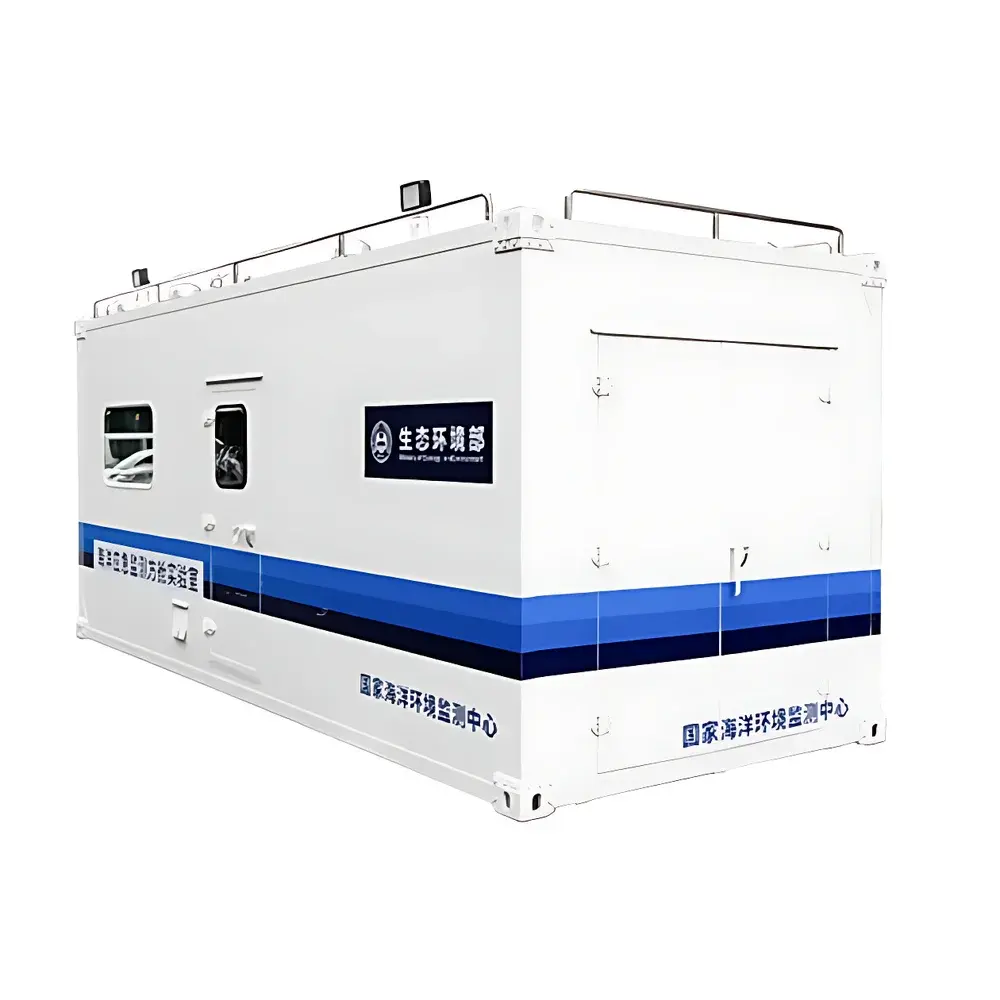
EXPEC Mobile Containerized Laboratory for ICP-MS, GC-MS, and LC-MS/MS
| Brand | EXPEC (Puyu Technology) |
|---|---|
| Origin | Zhejiang, China |
| Manufacturer Type | Authorized Distributor |
| Model | Mobile Containerized Laboratory |
| Pricing | Upon Request |
Overview
The EXPEC Mobile Containerized Laboratory is a fully integrated, ISO/IEC 17025–informed mobile analytical platform engineered to deploy high-end mass spectrometry instrumentation—including inductively coupled plasma mass spectrometry (ICP-MS), gas chromatography–mass spectrometry (GC-MS), and liquid chromatography–tandem mass spectrometry (LC-MS/MS)—into field-deployable environments without compromising analytical rigor. Unlike conventional portable kits or benchtop adaptations, this laboratory is constructed within a standardized 20- or 40-foot ISO shipping container, structurally reinforced for transport by road, rail, marine vessel, or trailer-mounted chassis. It incorporates climate-controlled HVAC with HEPA filtration (ISO Class 7 cleanroom capability), uninterruptible power supply (UPS) with dual-grid and generator redundancy, inert gas (Ar, N₂, He) manifold distribution, purified water generation (Type I, ≤18.2 MΩ·cm), and exhaust abatement systems compliant with local emission regulations. The platform adheres to ASTM E3198–21 (Standard Guide for Mobile Laboratory Operations) and GB/T 33251–2016 (Chinese Standard for Mobile Environmental Monitoring Laboratories), ensuring method equivalence with fixed-site accredited laboratories.
Key Features
- Modular Instrument Integration: Pre-aligned, vibration-isolated mounting frames for ICP-MS, GC-MS, and LC-MS/MS systems—designed to maintain factory calibration stability during transit and rapid re-deployment.
- Environmental Control: Dual-stage HVAC with temperature stability ±0.5°C and humidity control (40–60% RH), validated per ISO 14644-1 for particulate containment.
- Power & Utility Infrastructure: 3-phase 380 V AC input with automatic transfer switch (ATS), 60 kVA diesel generator backup, and real-time power quality monitoring (THD <3%).
- Gas Supply System: Centralized high-purity gas manifold (99.999% Ar for ICP-MS; 99.9999% He for GC-MS; 99.999% N₂ for LC-MS/MS), pressure-regulated and leak-tested to ≤1×10⁻⁶ mbar·L/s.
- Structural Compliance: Seismic bracing (IEC 60068-2-64), anti-vibration flooring (transmissibility <5% at 10–100 Hz), and IP54-rated electrical enclosures.
- Networked Data Security: Gigabit Ethernet backbone with VLAN segmentation, TLS 1.2+ encrypted LIMS communication, and local data caching with AES-256 encryption.
Sample Compatibility & Compliance
The laboratory supports solid, liquid, and gaseous matrices across environmental, food safety, and public health domains. Sample introduction interfaces include autosamplers compatible with EPA Methods 200.8, 524.4, and 1694; ISO 17294-2 for multi-element ICP-MS analysis; and USP dissolution testing protocols where applicable. All workflows are traceable to NIST-traceable reference materials (e.g., SRM 1640a, 1643f, 3127a). The system architecture complies with FDA 21 CFR Part 11 requirements for electronic records and signatures, supporting audit trails, user role-based access control (RBAC), and instrument-specific electronic lab notebook (ELN) integration. Full documentation packages—including IQ/OQ/PQ protocols, risk assessments (per ISO 14971), and method validation reports—are provided for GLP/GMP-aligned deployments.
Software & Data Management
The onboard Laboratory Information Management System (LIMS) is built on a Dockerized microservices architecture, supporting concurrent operation of Thermo Fisher, Agilent, and Waters instrument control software via standardized OPC UA and ASAM ODS interfaces. Raw data acquisition, peak integration, library matching (NIST MS Search, Wiley Registry, MassBank), and quantitation (internal standard, isotope dilution, standard addition) occur in near real time. Data export conforms to ASTM E1910 (Analytical Data Exchange Standard) and mzML 1.2.0 format. Cybersecurity controls include mandatory MFA login, quarterly penetration testing reports, and automated log retention for ≥18 months—aligned with ISO/IEC 27001 Annex A.8.2.3 (Information Security in Application Systems).
Applications
- Environmental Emergency Response: Rapid deployment for heavy metal (As, Cd, Pb, Hg, U) quantification in drinking water (per EPA 200.8), VOCs in ambient air (EPA TO-15), and PFAS in soil leachates (EPA 1633).
- Regulatory Field Enforcement: On-site verification of industrial effluent compliance (ISO 11885, ISO 17294-2), wastewater treatment plant performance auditing, and cross-border shipment screening.
- Foodborne Illness Investigation: Targeted and suspect-screening workflows for mycotoxins, pesticide residues, veterinary drug markers, and emerging contaminants using LC-MS/MS MRM and HRAM modes.
- Maritime Incident Support: Shipboard deployment for ballast water analysis (IMO G8), oil spill fingerprinting (GC×GC-TOFMS), and marine biotoxin detection (e.g., saxitoxin, domoic acid).
- Public Health Surveillance: Mobile testing for heavy metals in infant formula (ISO 13877), arsenic speciation in rice (EN 16802), and antibiotic resistance gene profiling (qPCR + LC-MS/MS confirmation).
FAQ
Can the containerized laboratory be certified to ISO/IEC 17025?
Yes—upon successful completion of on-site assessment by an ILAC-accredited body, including method validation, uncertainty evaluation, and staff competency demonstration.
What is the typical deployment-to-first-result timeline?
Under standard conditions, full operational readiness—including instrument warm-up, calibration verification, and QC sample analysis—is achieved within 4 hours of arrival and leveling.
Is remote diagnostics and software update support available?
All instruments and LIMS modules support secure, encrypted remote access via vendor-managed jump host; updates are staged during maintenance windows with rollback capability.
How is data integrity maintained during network outages?
Local storage retains raw data, audit trails, and processed results for ≥72 hours; synchronization resumes automatically upon network restoration with hash-verified delta transfer.
Are consumables and spare parts stocked onboard?
A configurable consumables module (up to 30 days of routine usage) is integrated into the container’s utility bay, with inventory tracked via RFID-tagged bins and LIMS replenishment alerts.
Related Products





