
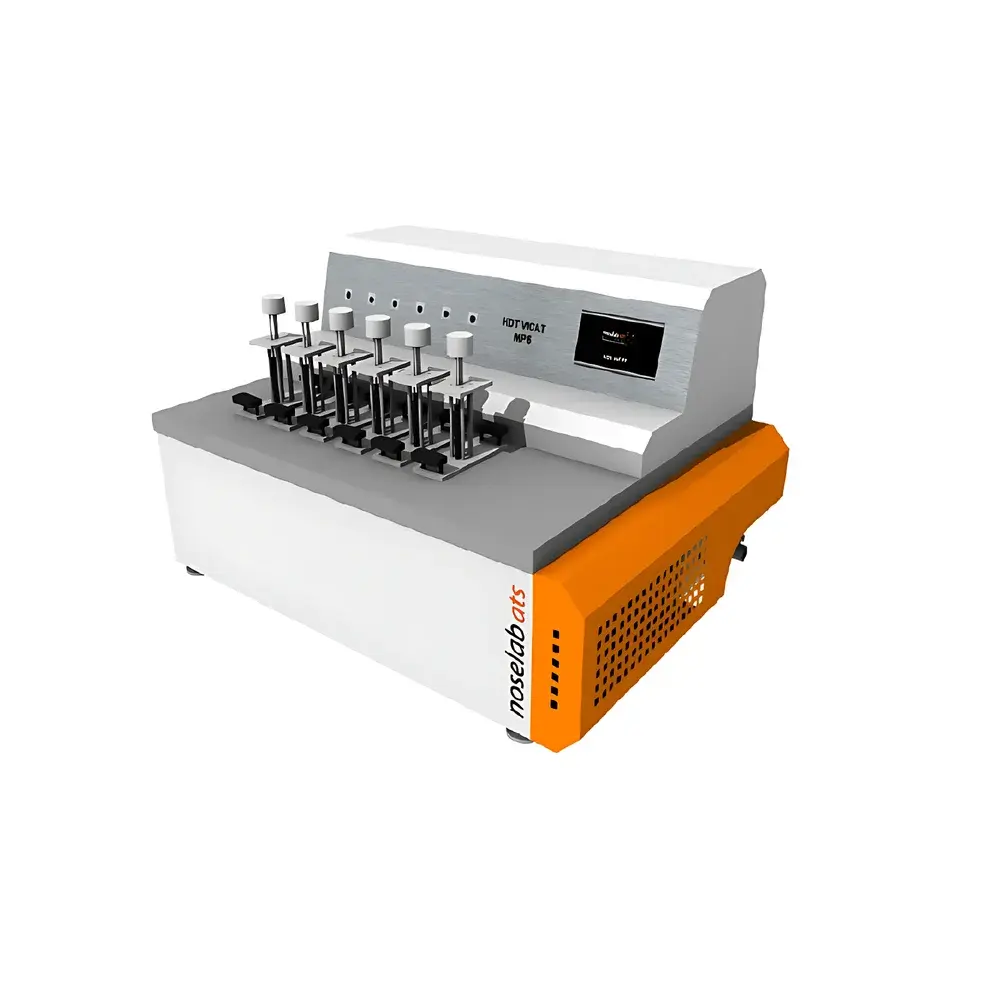
NOSELAB ATS HDT/VICAT Thermal Deformation and Vicat Softening Point Tester
| Brand | NOSELAB ATS |
|---|---|
| Origin | Italy |
| Model | HDT/VICAT |
| Maximum Temperature | 300 °C |
| Temperature Accuracy | ±0.1 °C |
| Temperature Uniformity | ≤0.2 °C |
| Temperature Stability (Oil Bath Fluctuation) | ±0.2 °C |
| Heating Rates | 50 °C/hr, 120 °C/hr, or Custom |
| Displacement Resolution | 0.001 mm |
| Displacement Accuracy | <0.01 mm |
| Sample Immersion Depth | ≥35 mm |
| Span Between Supports (HDT) | 100 mm (optional 64 mm) |
| Sample Length (HDT) | Up to 102 mm |
| Test Stations | 6 independent positions |
| Weight Load Range | 1–2048 g (binary HDT weights), plus 10 N and 50 N VICAT needles |
| Cooling System | Integrated stainless-steel water-jacketed oil bath with external 18 °C coolant |
| Safety Features | Nitrogen purge interface, physical barrier (mesh screen) between heating/stirring components and sample zone, dual stirrers and heater isolated from test chamber |
| Compliance | ASTM D648, ASTM D1525, ISO 75-1/2/3, ISO 306, GB/T 1634, GB/T 1633, DIN 53461 |
Overview
The NOSELAB ATS HDT/VICAT Thermal Deformation and Vicat Softening Point Tester is a fully automated, dual-method benchtop instrument engineered for precise determination of heat deflection temperature (HDT) and Vicat softening temperature (VST) in thermoplastic and thermosetting polymers. It operates on two standardized thermal-mechanical principles: for HDT, it measures the temperature at which a standardized test specimen deflects under a specified flexural load while immersed in a thermally controlled silicone oil bath; for VST, it determines the temperature at which a flat-ended needle of defined cross-section (1 mm² or 30 mm²) penetrates the material surface to a depth of 1 mm under a fixed axial force (10 N or 50 N). The system integrates high-stability temperature control, sub-millimeter displacement metrology, and synchronized multi-station operation—enabling concurrent execution of both HDT and VST tests across up to six independent samples per run. Its architecture conforms to core requirements of ASTM D648, ASTM D1525, ISO 75-1/2/3, and ISO 306, supporting routine quality control, R&D validation, and regulatory submission workflows in polymer manufacturing and materials certification labs.
Key Features
- Six independent test stations with fully autonomous thermal and mechanical control—each equipped with calibrated binary-weight sets (1–2048 g) for HDT and dual-standard VICAT needles (10 N / 50 N)
- Dual-stirrer, double-walled stainless-steel oil bath with integrated water-jacket cooling; achieves rapid thermal equilibration and uniformity ≤0.2 °C across all zones
- High-resolution digital linear transducer (0.001 mm resolution, <0.01 mm accuracy) coupled with platinum RTD temperature sensors traceable to NIST standards
- Automated zero-point calibration before each test cycle; automatic start/stop logic triggered by user-defined endpoint criteria (e.g., 0.25 mm deflection for HDT, 1 mm penetration for VST)
- Nitrogen purge interface for inert atmosphere operation above 200 °C—mitigating oxidation and thermal degradation of sensitive specimens
- Physical isolation via stainless-steel mesh screens between heating elements, stirrers, and the sample immersion zone—ensuring operational integrity even if specimens are accidentally dropped into the bath
- Configurable support span (100 mm standard, optional 64 mm) and HDT test bar length (up to 102 mm) to accommodate diverse specimen geometries per ISO 75 and ASTM D648
Sample Compatibility & Compliance
The instrument accommodates standard rectangular test bars (ASTM D648: 127 × 13 × 3 mm; ISO 75: 80 × 10 × 4 mm) as well as thicker or longer specimens up to 102 mm in length. It supports both Method A (1.82 MPa) and Method B (0.45 MPa) HDT testing, and VICAT methods using either 10 N (ISO 306 Type A) or 50 N (ISO 306 Type B) loads. All mechanical fixtures—including alignment jigs for HDT loading pins and centering tools for VICAT needles—are supplied as standard. The system meets essential safety and metrological requirements for GLP-compliant environments: temperature sensors are individually calibrated across the full 20–300 °C range; displacement sensors undergo factory blank-run compensation; and thermal uniformity is verified per ISO/IEC 17025-accredited procedures. Optional 6-channel temperature monitoring provides real-time station-specific thermal validation for audit-ready documentation.
Software & Data Management
The embedded color touchscreen interface enables intuitive method setup, parameter entry (load, rate, endpoint criteria), and real-time visualization of temperature and displacement curves per station. All raw data—including time-stamped temperature, deflection/penetration, and calculated endpoint values—is stored internally with UTC timestamps and unique test IDs. Via RS-232 or USB interface, the instrument connects to external PCs running NOSELAB’s certified data acquisition software, which supports FDA 21 CFR Part 11 compliance features: electronic signatures, role-based access control, audit trail logging, and immutable data archiving. The software generates PDF reports containing metadata, calibration certificates, raw curves, statistical summaries (mean, SD, CV%), and pass/fail flags against user-defined specification limits. Export formats include CSV, XML, and image-rendered curve overlays suitable for inclusion in regulatory dossiers.
Applications
This tester serves critical functions across polymer development, production QA/QC, and third-party certification laboratories. It is routinely deployed to evaluate thermal resistance of engineering plastics (e.g., PEEK, PEI, PPS), reinforced composites, biopolymers, and flame-retardant formulations. In automotive applications, it validates under-hood component stability; in medical device manufacturing, it verifies sterilization tolerance of polymeric housings and connectors. The dual-method capability streamlines comparative studies—e.g., assessing how plasticizer content affects both HDT (bulk stiffness) and VST (surface softening)—while the six-station throughput reduces per-sample cost in high-volume testing environments. Its precision and repeatability make it suitable for round-robin interlaboratory studies referenced in ISO/IEC 17043 proficiency testing schemes.
FAQ
What international standards does this instrument fully support?
It is configured and validated for ASTM D648 (HDT), ASTM D1525 (VST), ISO 75-1/2/3 (HDT), ISO 306 (VST), GB/T 1634, GB/T 1633, and DIN 53461—with mechanical fixtures, load calibration, and thermal profiles aligned to each standard’s normative annexes.
Can the instrument perform HDT and VST tests simultaneously?
Yes—each of the six stations can be independently assigned to either HDT or VST mode, allowing mixed-method runs without hardware reconfiguration.
Is nitrogen purging mandatory for operation above 200 °C?
Not mandatory, but strongly recommended for oxidative stability of silicone oil and specimen integrity; the integrated purge port supports continuous low-flow N₂ delivery with pressure regulation.
How is temperature uniformity verified across all six stations?
During factory acceptance testing, a 6-channel calibrated probe array measures spatial deviation at multiple setpoints (e.g., 80 °C, 150 °C, 250 °C); results are documented in the Certificate of Conformance and remain within ≤0.2 °C per ISO 75-2 Annex B.
Does the system support 21 CFR Part 11 compliance for regulated pharmaceutical or medical device labs?
Yes—when used with the optional PC software package, it provides full electronic record and signature functionality, including audit trails, user authentication, and data immutability, meeting baseline requirements for FDA-regulated environments.





