
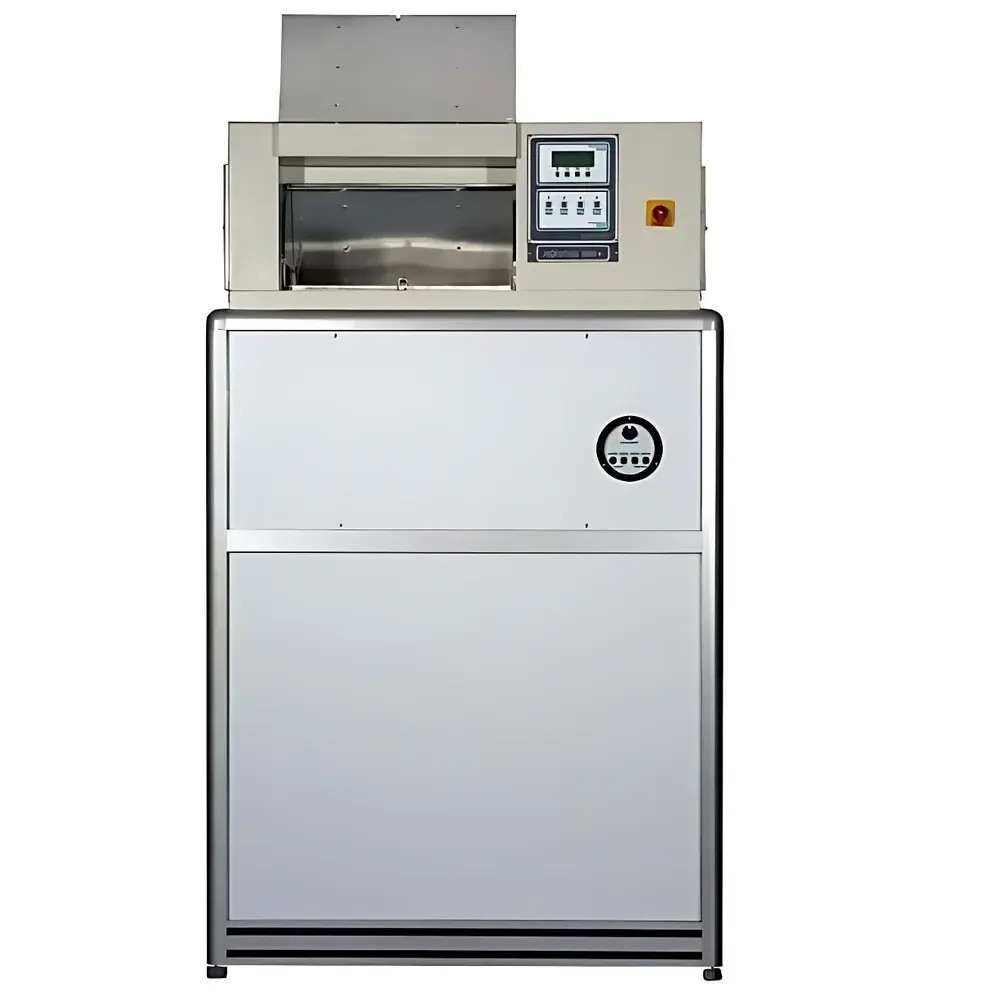
COFOMEGRA SOLARBOX Xe/R.H. Xenon Arc Weathering Test Chamber
| Brand | COFOMEGRA |
|---|---|
| Origin | Italy |
| Model | SOLARBOX Xe/R.H. |
| Chamber Volume | 40 L (SOLARBOX 1500e) / 75 L (SOLARBOX 3000e) |
| Temperature Range | 35–100 °C |
| Humidity Control | Optional Relative Humidity Monitoring |
| Irradiance Control | Continuous, Closed-Loop via Integrated Radiometer |
| UV Cut-off Filters | 280 nm, 300 nm, 310 nm, and IR-reducing filter |
| Sample Capacity | ≥120 pcs (15 × 30 mm) for 1500e |
| Programmable Cycles | Up to 15 multi-step programs |
| Interface | RS232-C for data logging and remote control |
| Compliance | ASTM G155, ISO 4892-2, ISO 11341, SAE J2527, DIN 75220, UNI EN 13523-13 |
Overview
The COFOMEGRA SOLARBOX Xe/R.H. Xenon Arc Weathering Test Chamber is an engineered solution for accelerated weathering simulation under controlled laboratory conditions. Based on the principle of xenon arc irradiation, it replicates the full solar spectrum—including ultraviolet (UV), visible, and near-infrared (NIR) radiation—enabling precise evaluation of material degradation mechanisms induced by sunlight, heat, and moisture. Unlike narrow-band UV fluorescent sources, the air-cooled single-tube xenon lamp delivers spectrally continuous output, closely matching natural sunlight when paired with optical filters. The parabolic reflector geometry ensures uniform irradiance distribution across the sample plane without mechanical rotation, eliminating positional bias in exposure. Real-time radiometric feedback, coupled with microprocessor-based regulation, maintains irradiance stability within ±5% of setpoint throughout testing. This architecture supports reproducible, traceable aging studies aligned with internationally recognized photochemical acceleration models.
Key Features
- Air-cooled 1.5 kW or 3.0 kW xenon arc lamp with parabolic reflector for spatially uniform irradiance (no sample rotation required)
- Interchangeable optical filters enabling spectral tailoring: 280 nm (full UV), 300 nm (direct sun), 310 nm (glass-filtered sun), and IR-reducing filter for thermal load management
- Closed-loop irradiance control system with integrated broadband radiometer (calibratable per NIST-traceable standards)
- Microprocessor-controlled temperature regulation (35–100 °C), monitored via black standard thermometer (BST) positioned adjacent to sample plane
- Optional humidity monitoring (relative humidity sensor) compatible with ISO 4892-2 Annex B requirements
- Programmable exposure sequences: up to 15 independent cycles with user-defined irradiance, temperature, and timing parameters
- Integrated water immersion system (optional): adjustable immersion interval (1–999 min), water temperature control (30–50 °C), and synchronized lamp on/off logic during wet phases
- RS232-C interface for automated data export to PC or thermal printer; audit-ready logging of irradiance, BST temperature, chamber temperature, and program status
Sample Compatibility & Compliance
The SOLARBOX Xe/R.H. accommodates flat and low-profile specimens up to 15 × 30 mm, with capacity for ≥120 samples in the 1500e variant (40 L chamber) and ≥180 in the 3000e (75 L chamber). Its robust stainless-steel and PVC-construction chamber resists corrosion from repeated immersion and condensation cycles. All operational parameters—including irradiance setpoints, temperature profiles, and immersion timing—are fully configurable to meet test matrix requirements defined in ASTM G155 (Practice for Operating Xenon Arc Light Apparatus), ISO 4892-2 (Plastics — Methods of Exposure to Laboratory Light Sources — Part 2: Xenon-Arc Sources), ISO 11341 (Paints and Varnishes — Artificial Weathering and Exposure to Artificial Radiation), and SAE J2527 (Surface Vehicle Recommended Practice). Calibration protocols follow ISO/IEC 17025 principles, with radiometer and BST sensors traceable to national metrology institutes. System validation documentation supports GLP-compliant study execution and FDA 21 CFR Part 11 readiness when paired with validated software environments.
Software & Data Management
The SOLARBOX Xe/R.H. features a built-in 4-line LCD interface with intuitive menu navigation for real-time parameter display and manual operation. For advanced protocol management, the embedded controller stores up to 15 multi-step programs—each comprising irradiance level (W/m²), BST temperature target, duration, and optional immersion triggers. All operational data are timestamped and stored internally, then exported via RS232-C to external systems using ASCII-delimited format. Exported logs include irradiance deviation history, BST and chamber temperature traces, program step transitions, and immersion event markers—enabling full experimental reconstruction. While no proprietary software is bundled, raw data files are compatible with common spreadsheet and statistical analysis platforms (e.g., Excel, JMP, Python pandas). Optional third-party LIMS integration is supported through standard serial communication protocols.
Applications
This chamber serves as a primary tool for predictive durability assessment across regulated and industrial sectors. In polymer science, it quantifies UV-induced chain scission, yellowing, and embrittlement in automotive interior trim, exterior cladding, and packaging films. Textile laboratories use it to evaluate colorfastness and tensile retention in outdoor fabrics per ISO 105-B02. Paint and coating formulators rely on its spectral fidelity to benchmark gloss loss, chalking, and adhesion failure against OEM specifications (e.g., GMW14124, Ford CETP). Electronics manufacturers assess conformal coating integrity and printed circuit board laminate stability under combined thermal-photochemical stress. Pharmaceutical packaging developers apply it to verify UV barrier performance of blister foils and HDPE containers per ICH Q1B photostability guidelines. Additional applications span architectural glazing, agricultural film, cosmetic packaging, and food contact materials—where regulatory submissions require documented correlation between accelerated exposure and real-world service life.
FAQ
What spectral range does the SOLARBOX Xe/R.H. replicate?
It reproduces the full solar spectrum from 280 nm to 800 nm, with selectable UV cut-offs (280 nm, 300 nm, 310 nm) and optional IR filtration to decouple photochemical and thermal degradation pathways.
Is relative humidity actively controlled or only monitored?
Relative humidity is monitored via optional sensor; active humidification is not provided. However, the integrated immersion system enables controlled wet/dry cycling per ISO 4892-2 Annex B.
How is irradiance calibrated and maintained over time?
Calibration uses a NIST-traceable broadband radiometer. The closed-loop control system continuously compares measured irradiance against setpoint and adjusts lamp power to maintain stability within ±5%, verified during routine maintenance.
Can the immersion system operate independently of irradiation?
Yes—the controller allows independent scheduling of immersion events, including lamp deactivation during wet phases to isolate hydrolytic effects.
Which international standards explicitly reference this instrument configuration?
ASTM G155 Type A (with water spray), ISO 4892-2 Method A (xenon arc, filtered), ISO 11341, SAE J2527, and DIN 75220 all specify test conditions achievable with the SOLARBOX Xe/R.H. platform when configured with appropriate filters and immersion accessories.
Related Products



