
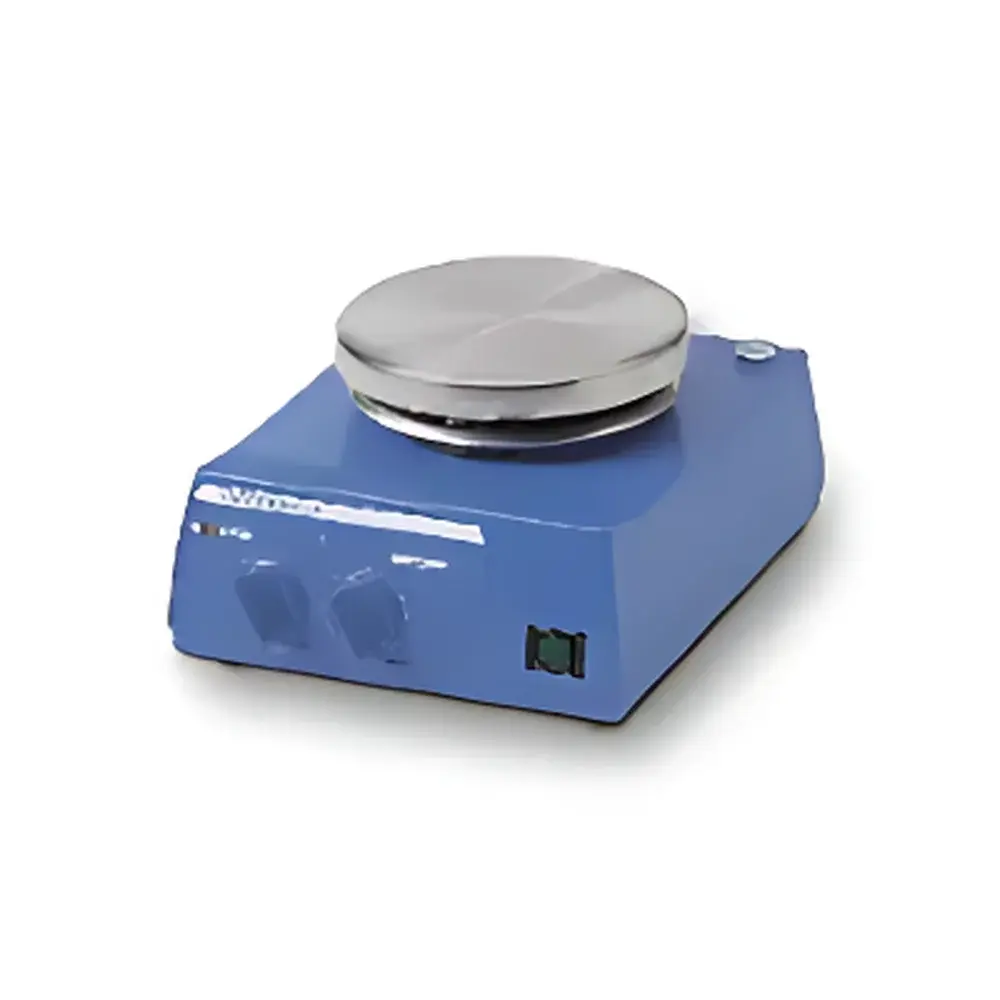
IKA RH basic 2 Magnetic Stirrer with Heating
| Brand | IKA |
|---|---|
| Origin | Germany |
| Model | RH basic 2 |
| Motor Output Power | 2 W |
| Speed Range | 100–2000 rpm |
| Speed Control | 6-step dial |
| Max. Stirring Volume (H₂O) | 10 L |
| Heating Power | 400 W |
| Heating Temperature Range | Ambient to 320 °C |
| Temp. Control | 6-step dial |
| Safety Overtemperature Cut-off | 400 °C |
| Plate Material | Stainless Steel 1.4301 |
| Plate Diameter | Ø 125 mm |
| Dimensions (W × D × H) | 168 × 105 × 220 mm |
| Weight | 2.4 kg |
| Permissible Ambient Temperature | 5–40 °C |
| Max. Relative Humidity | 80 % |
| Protection Class | IP21 (per DIN EN 60529) |
| Voltage | 220–240 V, 50/60 Hz |
| Total Input Power | 415 W |
| Optional Voltages | 115 V, 100 V |
| Start-up Characteristic | Smooth, jerk-free acceleration |
Overview
The IKA RH basic 2 is a compact, entry-level magnetic stirrer with integrated heating, engineered for routine laboratory applications requiring reliable mixing and precise thermal control. Based on the principle of rotating magnetic fields generated by a permanent magnet rotor beneath a ferromagnetic plate, the device induces rotation of PTFE- or glass-coated magnetic stir bars immersed in liquid samples. Its stainless steel heating plate (material grade 1.4301) provides uniform thermal distribution and chemical resistance, while the dual-control architecture—separate dials for speed and temperature—enables intuitive, analog operation without software dependency. Designed for stability under continuous operation, the RH basic 2 delivers consistent torque at low speeds and maintains thermal setpoints with minimal overshoot, making it suitable for dissolution testing, buffer preparation, reagent synthesis, and pre-heating steps in analytical workflows.
Key Features
- Robust stainless steel heating plate (Ø 125 mm) compliant with ISO 7207-1 for surface flatness and thermal homogeneity
- Smooth, jerk-free start-up sequence minimizes splashing and ensures reproducible bar engagement across viscosity ranges
- Dual independent control dials: 6-position speed selector (100–2000 rpm) and 6-position temperature selector (ambient to 320 °C)
- Fixed safety cut-off at 400 °C prevents thermal runaway and complies with IEC 61000-6-3 emission limits for laboratory environments
- IP21-rated enclosure per DIN EN 60529 ensures protection against vertically falling drips and solid objects ≥12.5 mm
- Universal voltage compatibility (100 V, 115 V, 220–240 V) supports deployment across global laboratory infrastructures without hardware modification
- Low motor output (2 W) optimized for energy efficiency in non-viscous aqueous media; total system input power remains ≤415 W
Sample Compatibility & Compliance
The RH basic 2 accommodates standard round-bottom and flat-bottom vessels up to 10 L capacity when using appropriately sized stir bars (e.g., 40 mm × 8 mm or larger). It is validated for use with water, aqueous buffers, alcohols, and dilute organic solvents—provided vessel geometry permits stable bar rotation and thermal conduction. The unit meets essential safety and electromagnetic compatibility requirements per EN 61326-1 (laboratory equipment), EN 61000-3-2 (harmonic current emissions), and EN 61000-3-3 (voltage fluctuations). While not certified for GMP or GLP environments out-of-the-box, its analog control architecture and absence of embedded firmware simplify validation protocols for regulated QC labs conducting method transfers under USP , ISO/IEC 17025, or internal SOPs.
Software & Data Management
The RH basic 2 operates exclusively via hardware-based analog controls and does not incorporate digital interfaces, data logging, or connectivity options (e.g., USB, RS232, or Bluetooth). This design eliminates cybersecurity risks, reduces qualification burden, and ensures long-term operational continuity without firmware updates or driver dependencies. Users record operating parameters manually—speed setting (1–6), temperature setting (1–6), and elapsed time—using standard lab notebooks or LIMS-integrated forms. For laboratories requiring audit trails, external temperature loggers (e.g., calibrated Pt100 probes with timestamped recording) may be deployed alongside the unit to satisfy FDA 21 CFR Part 11 documentation expectations where applicable.
Applications
- Preparation of standard solutions and calibration standards in analytical chemistry labs
- Dissolution testing of pharmaceutical tablets per USP , particularly during sink condition maintenance
- Heating and homogenization of culture media prior to sterilization in microbiology workflows
- Controlled warming of enzymatic reaction mixtures before assay initiation
- Supporting sample conditioning steps in elemental analysis (e.g., ICP-OES acid digestions)
- General-purpose mixing in teaching laboratories where simplicity, durability, and cost-efficiency are prioritized
FAQ
Does the RH basic 2 support external temperature probe feedback control?
No. Temperature regulation is open-loop, based solely on the 6-step dial setting and internal thermistor monitoring of the plate surface.
Can it be used with corrosive acids such as concentrated HNO₃ or HCl?
Only with appropriate containment: the stainless steel plate resists mild corrosion, but direct contact with boiling fuming acids is not recommended; use glass or ceramic vessels with adequate ventilation.
Is the 400 °C safety cutoff adjustable?
No. The overtemperature protection is hardwired and non-configurable, per EN 61000-1-2 functional safety requirements.
What stir bar size is optimal for maximum 10 L mixing efficiency?
A 60 mm × 10 mm elliptical PTFE-coated bar is recommended for high-volume aqueous systems; bar selection must account for vessel depth and expected viscosity.
Does the unit include a stir bar?
No. Stir bars are sold separately; IKA recommends catalog numbers RW 20 or RW 25 for compatibility with the RH basic 2’s magnetic field profile.



