
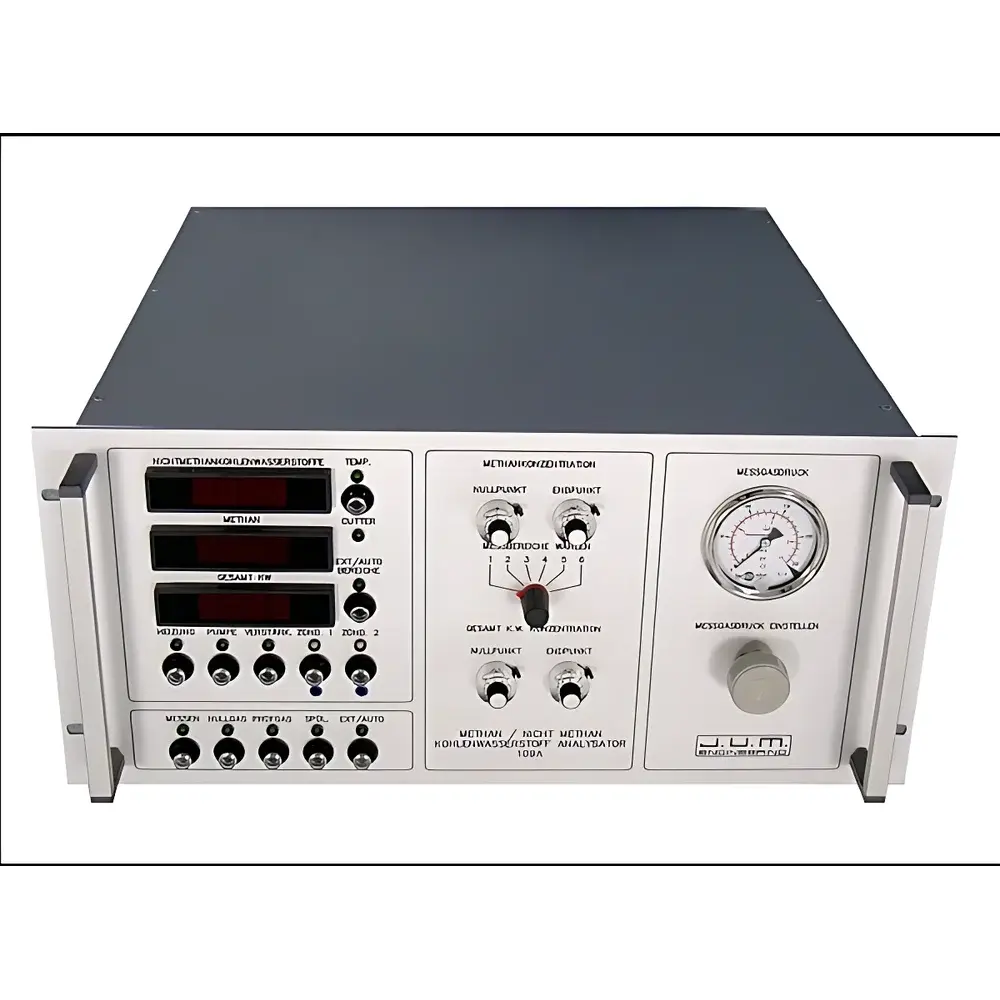
J.U.M. 109A-1 Non-Methane Hydrocarbons Analyzer with Dual Heated FID
| Brand | J.U.M. |
|---|---|
| Origin | Germany |
| Model | 109A-1 |
| Detection Principle | Flame Ionization Detection (FID) |
| Instrument Type | Online Continuous Emission Monitoring (CEM) Analyzer |
| Typical Configuration | Total Volatile Organic Compounds (TVOC) Analyzer |
| Measurement Range | 0–100,000 ppm (as propane or methane equivalent) |
| Resolution | 100 ppb |
| Accuracy | ±5% of reading |
| Response Time (T90) | <1 s |
| Operating Temperature of Sample Path & Detectors | 190 °C |
| Filter Material | Stainless Steel |
| Filter Pore Size | 2 µm |
| Purge Gas | Compressed Air or Nitrogen |
| Integrated Combustion Air Supply | Yes |
| Sample Pump | Integrated |
| Zero/Calibration Gas Management | Overload Protection with Automatic Calibration Sequence |
Overview
The J.U.M. 109A-1 Non-Methane Hydrocarbons (NMHC) Analyzer is a rigorously engineered online gas chromatography–free analytical system designed for continuous, high-reliability measurement of total hydrocarbons (THC) and methane (CH₄) in industrial exhaust streams, ambient air, and process gases. Utilizing dual, temperature-stabilized flame ionization detectors (FIDs), the instrument implements a differential measurement principle: one FID quantifies total hydrocarbons, while the second—coupled with a catalytic methane converter—measures CH₄ specifically; NMHC is derived by real-time subtraction. All sample-wetted components—including sampling line, filter, flow path, and detectors—are maintained at a constant 190 °C to prevent condensation of heavy hydrocarbons and ensure quantitative transfer of C₂–C₁₂ species. This architecture eliminates cold spots and mitigates adsorption losses, making the 109A-1 particularly suitable for regulatory-grade CEM applications compliant with EN 15267, MCERTS, and EPA Method 25A.
Key Features
- Dual heated FID configuration: Independent THC and CH₄ detection channels, each housed within a thermally isolated 190 °C oven for maximum reproducibility and minimal drift.
- Permanent stainless-steel sintered filter (2 µm pore size) integrated directly into the heated sample chamber; cleaned automatically via programmable reverse-purge using onboard compressed air or external nitrogen.
- No external combustion air cylinder required: Internal diaphragm compressor delivers regulated, oil-free air to both FIDs, reducing infrastructure dependency and operational complexity.
- Heated back-panel sample inlet design eliminates hydrocarbon condensation at entry points; field-adjustable without tools—accessible from right-side service panel.
- Integrated sample pump with pressure-regulated flow control ensures stable aspiration across variable stack conditions (±10 kPa dynamic pressure range).
- Microprocessor-based controller with PID temperature regulation, real-time diagnostics, and event-logged fault tracing (e.g., flame-out, filter clog, temperature deviation).
- Auto-zero and span calibration sequence with overload protection for zero air and calibration gas; supports remote initiation via dry-contact or Modbus RTU.
- Fast response performance: T90 < 1 second for step changes across full scale, validated per IEC 61298-2 for dynamic gas analyzers.
Sample Compatibility & Compliance
The 109A-1 accepts gaseous samples with moisture content ≤ 30 g/m³ (non-condensing at 190 °C) and particulate loading ≤ 5 mg/m³. It is certified for use in Zone 2 hazardous areas (ATEX II 2G Ex db IIB T4 Gb) when equipped with optional explosion-proof housing. The analyzer meets key international standards for emissions monitoring: EN 14181 (QAL1/QAL2), EN 15267-3 (type approval), and is referenced in German TA Luft Annex 4 for NMHC determination. Its dual-FID architecture satisfies the technical requirements of EPA Performance Specification 8A (PS-8A) for FID-based hydrocarbon analyzers and supports GLP-compliant data integrity through audit-trail-enabled firmware (21 CFR Part 11 ready with optional software package).
Software & Data Management
The embedded controller provides local display of real-time concentration (ppm NMHC), detector currents, temperatures, purge status, and alarm logs. Analog outputs (4–20 mA) are assignable to NMHC, CH₄, or THC channels with HART protocol support. Digital communication is available via RS-485 (Modbus RTU) or optional Ethernet/IP interface. Optional J.U.M. AnalyzePro software enables remote configuration, historical trend visualization (≥30 days buffered), automated report generation (PDF/CSV), and secure user-level access control (admin/operator/viewer). All calibration events, maintenance alerts, and system faults are timestamped and stored with SHA-256 hash integrity verification—fully traceable for regulatory audits.
Applications
- Continuous emission monitoring (CEM) of NMHC from thermal oxidizers, incinerators, and chemical reactors per EU Industrial Emissions Directive (IED) and US Clean Air Act Subpart TT.
- Environmental air quality networks measuring background NMHC and photochemical ozone precursor concentrations (e.g., VOCs contributing to smog formation).
- Pharmaceutical and semiconductor cleanroom ambient monitoring where low-level hydrocarbon contamination must be tracked against ISO 14644-8 Class 5 limits.
- Refinery flare gas composition analysis and combustion efficiency assessment using real-time CH₄/THC ratios.
- Research laboratories conducting atmospheric chemistry studies requiring sub-ppb resolution and high-temperature sample handling stability.
FAQ
Does the 109A-1 require external combustion air cylinders?
No—the analyzer includes an integrated, oil-free diaphragm compressor delivering precisely regulated combustion air to both FIDs.
How is the sample filter maintained?
The permanent 2 µm stainless-steel filter is cleaned automatically via timed reverse-purge using internal compressed air; no disassembly or consumables are required.
Can the instrument measure methane separately from total hydrocarbons?
Yes—via dual FID configuration: one measures THC directly; the second measures CH₄ after catalytic oxidation of non-methane species, enabling real-time NMHC calculation.
What is the minimum detectable level for NMHC?
With 100 ppb resolution and ±5% accuracy, the effective lower limit of quantitation (LLOQ) is 500 ppb under typical operating conditions.
Is the 109A-1 compatible with existing CEM data acquisition systems?
Yes—it supports standard 4–20 mA analog outputs, Modbus RTU over RS-485, and optional Ethernet/IP for seamless integration into plant DCS or EMS platforms.







