
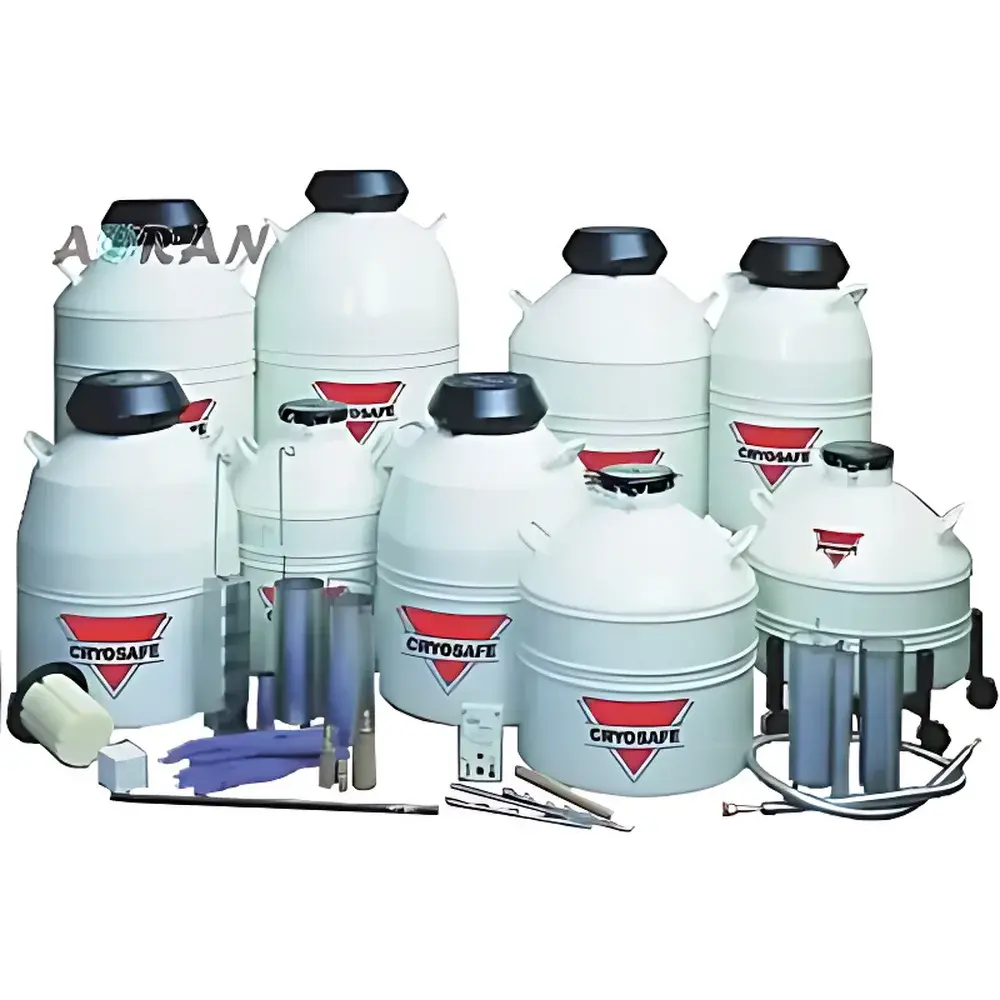
Cryosafe SSC Series Liquid Nitrogen Storage Tanks
| Brand | Cryosafe |
|---|---|
| Origin | USA |
| Model | SSC |
| Price | $4,000 |
| Capacity Range | 20.5–47.4 L |
| Evaporation Rate | 0.095–0.39 L/day |
| Holding Time | 53–193 days |
| Canister Capacity | 210–5,216 × 0.5 mL straws (loose) |
| Neck Diameter | 55.4–127 mm |
| Height | 438–875 mm |
| Outer Diameter | 368–508 mm |
| Empty Weight | 10.5–19 kg |
| Full Weight | 27–54.6 kg |
Overview
The Cryosafe SSC Series Liquid Nitrogen Storage Tanks are engineered for long-term, ultra-low-temperature biological sample preservation at –185 °C in the liquid phase. Designed and manufactured in the United States, these static-phase cryogenic storage systems utilize high-efficiency vacuum insulation and optimized neck geometry to minimize liquid nitrogen (LN2) boil-off—ensuring stable thermal performance across a broad capacity range (20.5–47.4 L). Unlike vapor-phase systems, the SSC series maintains samples fully submerged in LN2, eliminating temperature gradients and providing consistent, validated cold chain integrity essential for sensitive cell lines, embryos, oocytes, stem cells, and genomic material. Each unit complies with international design principles for cryogenic containment per ISO 21028-1 (cryogenic vessels — safety requirements) and incorporates structural features aligned with Good Laboratory Practice (GLP) and biobanking best practices (ISBER Best Practices, 4th Edition).
Key Features
- Ultra-low evaporation rate: As low as 0.095 L/day (SSC 20 model), enabling up to 193 days of autonomous operation without refilling under controlled ambient conditions (20 °C, minimal opening frequency).
- Optimized thermal architecture: Multi-layer superinsulation (MLI), high-vacuum jacket, and low-conductivity neck seals reduce heat ingress while preserving mechanical stability during repeated handling.
- Modular canister configuration: Standard stainless-steel canisters support configurable rack layouts—including 10-straw barcoded strips, loose straw trays, and specialized vial carriers—to accommodate diverse biobank workflows.
- Robust physical construction: Seamless inner vessel, reinforced outer shell, and corrosion-resistant stainless steel (304/316) components ensure durability in high-humidity or cleanroom environments.
- Scalable footprint: Compact vertical designs (e.g., SSC 21: Ø368 mm × H438 mm) coexist with high-capacity units (e.g., SSC 47-10: Ø508 mm × H673 mm), facilitating space-efficient deployment in core facilities and satellite labs.
Sample Compatibility & Compliance
The SSC series is validated for long-term storage of primary human tissues, peripheral blood mononuclear cells (PBMCs), induced pluripotent stem cells (iPSCs), and cryopreserved semen/embryos per ASTM F1723-22 (Standard Guide for Cryopreservation of Mammalian Embryos). All models maintain ≤±0.5 °C temperature uniformity within the liquid phase zone when operated within specified ambient limits (15–25 °C, <60% RH). Optional accessories—including CE-marked low-level LN2 alarms (IEC 61000-6-3 EMC compliant) and ISO 13485-certified freeze-thaw monitoring kits—support regulatory traceability under FDA 21 CFR Part 11 and EU Annex 11 requirements for electronic records and signatures.
Software & Data Management
While the base SSC system operates autonomously without embedded electronics, optional digital integration modules enable seamless interoperability with laboratory information management systems (LIMS). The Cryosafe Connect™ interface (sold separately) supports RS-485/Modbus RTU communication for real-time LN2 level telemetry, automated refill scheduling, and audit-trail generation—including timestamped events for lid opening, temperature excursions, and alarm activation. All data logs comply with ALCOA+ principles (Attributable, Legible, Contemporaneous, Original, Accurate, Complete, Consistent, Enduring, Available) for GLP/GMP-aligned biorepository operations.
Applications
- Long-term archival storage of clinical-grade cell therapies and regenerative medicine products.
- Biobanking infrastructure supporting large-scale epidemiological cohorts (e.g., UK Biobank, All of Us).
- Assisted reproductive technology (ART) laboratories requiring uninterrupted embryo/oocyte viability over extended cycles.
- Pharmaceutical R&D repositories maintaining reference standards, master cell banks (MCBs), and working cell banks (WCBs) per ICH Q5D.
- Academic core facilities managing high-throughput cryopreservation workflows with multi-user access control and inventory tracking.
FAQ
What is the difference between liquid-phase and vapor-phase storage in LN2 tanks?
Liquid-phase storage submerges samples directly in LN2, ensuring uniform –196 °C exposure and minimizing thermal stress during freeze-thaw cycles. Vapor-phase systems maintain samples above the liquid surface (typically –150 °C to –190 °C), offering reduced contamination risk but greater temperature variability.
Can the SSC tanks be integrated into a centralized cryo-monitoring network?
Yes—when equipped with the Cryosafe Connect™ module, units support Modbus RTU protocol and integrate with enterprise LIMS platforms via OPC UA gateways for centralized dashboard visualization and predictive maintenance alerts.
Are the canisters autoclavable?
Stainless-steel canisters are compatible with steam sterilization (121 °C, 15 psi, 30 min); however, repeated autoclaving may degrade elastomeric gasket materials—replacement gaskets are available as consumables.
Does Cryosafe provide validation documentation for IQ/OQ/PQ protocols?
Yes—factory-issued Installation Qualification (IQ) templates, Operational Qualification (OQ) test scripts, and Performance Qualification (PQ) guidance documents are supplied with each unit, aligned with ISO/IEC 17025 and GAMP 5 standards.
What safety certifications apply to the SSC series?
All models meet UL 1709 (rapid-rise fire resistance), PED 2014/68/EU (Pressure Equipment Directive), and carry CE marking for non-electrical cryogenic equipment; optional alarm systems include RoHS and REACH compliance declarations.




