
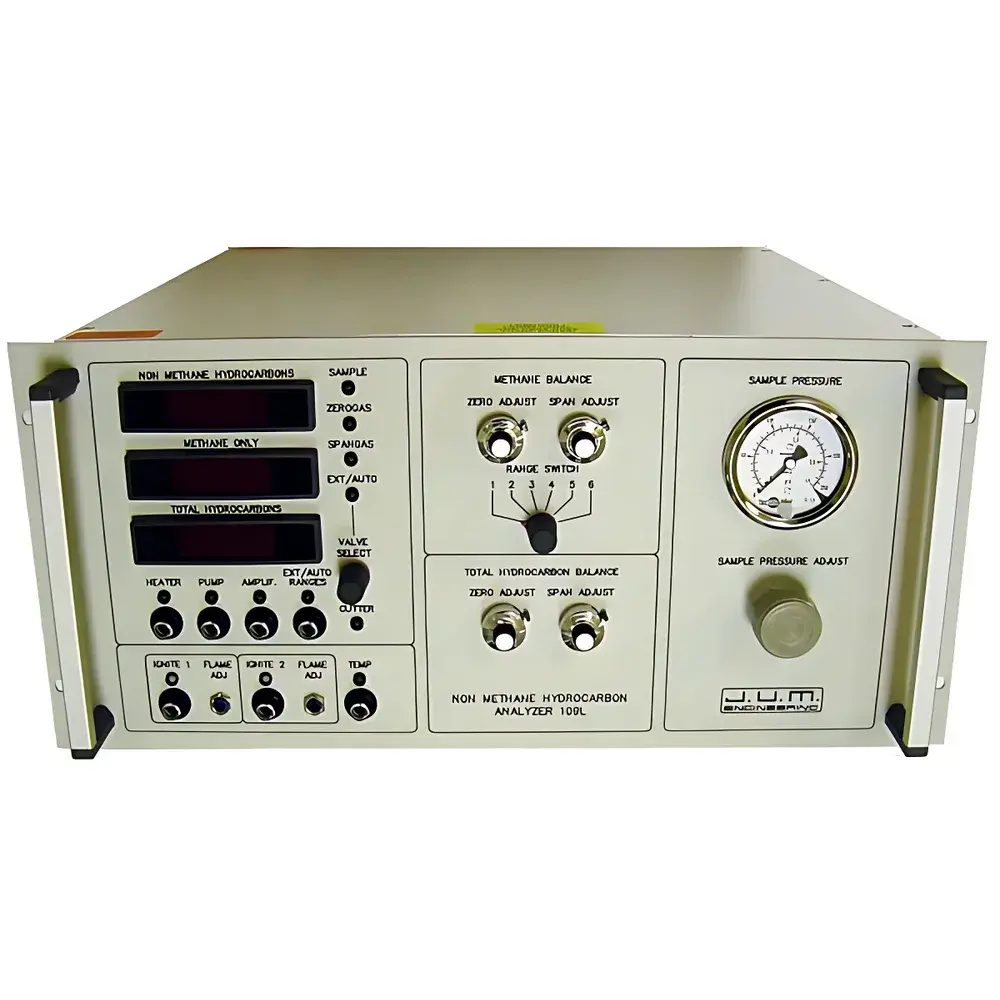
J.U.M. 109L Online VOC and Non-Methane Hydrocarbons Analyzer
| Brand | J.U.M. |
|---|---|
| Origin | Germany |
| Model | 109L |
| Detection Principle | Flame Ionization Detection (FID) |
| Instrument Type | Online Continuous Analyzer |
| Configuration | Total VOC / THC / NMHC / CH₄ Analyzer |
| Measurement Range | 0–1000 ppm (selectable up to 100,000 ppm) |
| Resolution | 0.1 ppm |
| Accuracy | ±5% of reading |
| Response Time (T90) | <60 s |
| Heating Chamber Temperature | 190 °C |
| Detector Sensitivity | ≤1 ppm full-scale for CH₄ |
| Carrier/Air Supply | Integrated zero-air generator |
Overview
The J.U.M. 109L Online VOC and Non-Methane Hydrocarbons Analyzer is a certified, rack-mounted (19″) continuous emission monitoring system engineered for regulatory-compliant measurement of total hydrocarbons (THC), methane (CH₄), and non-methane hydrocarbons (NMHC) in industrial exhaust streams and ambient air. Based on dual-flame ionization detection (dual-FID) architecture, the instrument simultaneously quantifies CH₄ and NMHC by subtracting methane signal from total hydrocarbon response—eliminating chromatographic separation while maintaining trace-level sensitivity and high temporal resolution. Its fully heated sample path—from inlet fitting through reaction chamber to detector—operates at a stable 190 °C to prevent condensation of higher molecular weight VOCs (e.g., C₆–C₁₂ aliphatics and aromatics), thereby ensuring measurement integrity across variable dew points and process conditions. Designed for unattended operation in harsh industrial environments, the 109L meets stringent requirements for stack gas monitoring, combustion efficiency evaluation, and fugitive emission verification.
Key Features
- Dual-FID configuration enabling concurrent real-time measurement of THC, CH₄, and NMHC without GC column switching or calibration drift compensation
- Integrated zero-air generator with catalytic purification and pressure regulation—no external compressed air source required
- Full-path heated sample system (190 °C) minimizing adsorption losses and condensation artifacts for heavy VOCs including xylenes, ethylbenzene, and n-hexane
- Modular range selection: user-selectable spans from 0–10 ppm to 0–100,000 ppm (CH₄-equivalent), programmable via front-panel interface or remote command
- Robust 19″ rack-mount chassis compliant with EN 61000-6-2/6-4 (EMC) and IP54-rated enclosure for installation in control rooms or field shelters
- Self-diagnostic firmware with live status reporting for detector temperature, flame stability, zero/span validation, and flow integrity
Sample Compatibility & Compliance
The 109L is validated for use with hot, humid, and particulate-laden sample gases typical of boiler flue gas, incinerator exhaust, chemical reactor vents, and automotive test cell emissions. It complies with major international regulatory frameworks including German BImSchV Ordinances No. 2, 13, and 17; European standards EN 12619 (automated measuring systems for gaseous emissions) and EN 13526 (performance criteria for FID-based hydrocarbon analyzers); and U.S. EPA Methods 25A (total gaseous organic concentration) and Method 503 (NMHC determination). The analyzer supports QAL2 (Quality Assurance Level 2) certification per EN 14181 and is compatible with TÜV-certified data acquisition systems for continuous emission monitoring system (CEMS) integration. All calibration and maintenance records are timestamped and exportable to meet GLP/GMP audit requirements.
Software & Data Management
The 109L operates with embedded firmware supporting Modbus RTU/TCP, Profibus DP, and analog 4–20 mA outputs (isolated, HART-enabled optional). Local configuration and diagnostics are accessible via a high-contrast LCD interface with intuitive menu navigation. Remote supervision is enabled via Ethernet connection using J.U.M.’s proprietary WebConfig tool—allowing secure access to real-time concentration plots, calibration logs, alarm history, and system health metrics. Data storage includes onboard non-volatile memory retaining ≥30 days of 1-minute averaged values. Export formats include CSV and XML, compatible with common SCADA platforms (e.g., Siemens Desigo, Honeywell Experion) and environmental data management systems (EDMS). Audit trails comply with FDA 21 CFR Part 11 requirements when paired with validated user access controls and electronic signature modules.
Applications
- Continuous monitoring of regulated NMHC emissions from thermal oxidizers, catalytic incinerators, and regenerative thermal oxidizers (RTOs)
- Real-time THC/NMHC profiling during engine dynamometer testing (EPA Tier 3, Euro 6d, China 6b)
- Process optimization in petrochemical cracking units, polymer reactors, and solvent recovery systems
- Verification of abatement device performance under varying load conditions (e.g., start-up, shutdown, transient operation)
- Ambient air quality stations requiring speciated hydrocarbon data for ozone precursor analysis
- Leak detection and repair (LDAR) program support with rapid-response screening capability
FAQ
Does the 109L require external zero-air or calibration gas sources?
No—the unit integrates a catalytically purified zero-air generator and supports span calibration using certified CH₄-in-air standards (NIST-traceable). Optional automatic calibration sequencer available.
Can the 109L distinguish between individual VOC compounds?
No—it measures total hydrocarbon mass concentration as methane-equivalent (ppm C₁). For compound-specific identification, GC-FID or GC-MS systems are required.
What maintenance intervals are recommended for routine operation?
Detector cleaning and FID jet inspection every 6 months; zero-air catalyst replacement every 12–18 months; annual QAL2 verification per EN 14181.
Is the 109L suitable for high-dust applications such as cement kiln exhaust?
Yes—when configured with an optional heated probe and ceramic filter assembly (up to 300 °C), it maintains operational stability in particulate concentrations up to 100 mg/m³.
How is data integrity ensured during power interruption or network outage?
Onboard flash memory retains all measurements and event logs. Upon recovery, timestamps remain synchronized via NTP or internal RTC with ±10 s/year accuracy.







