
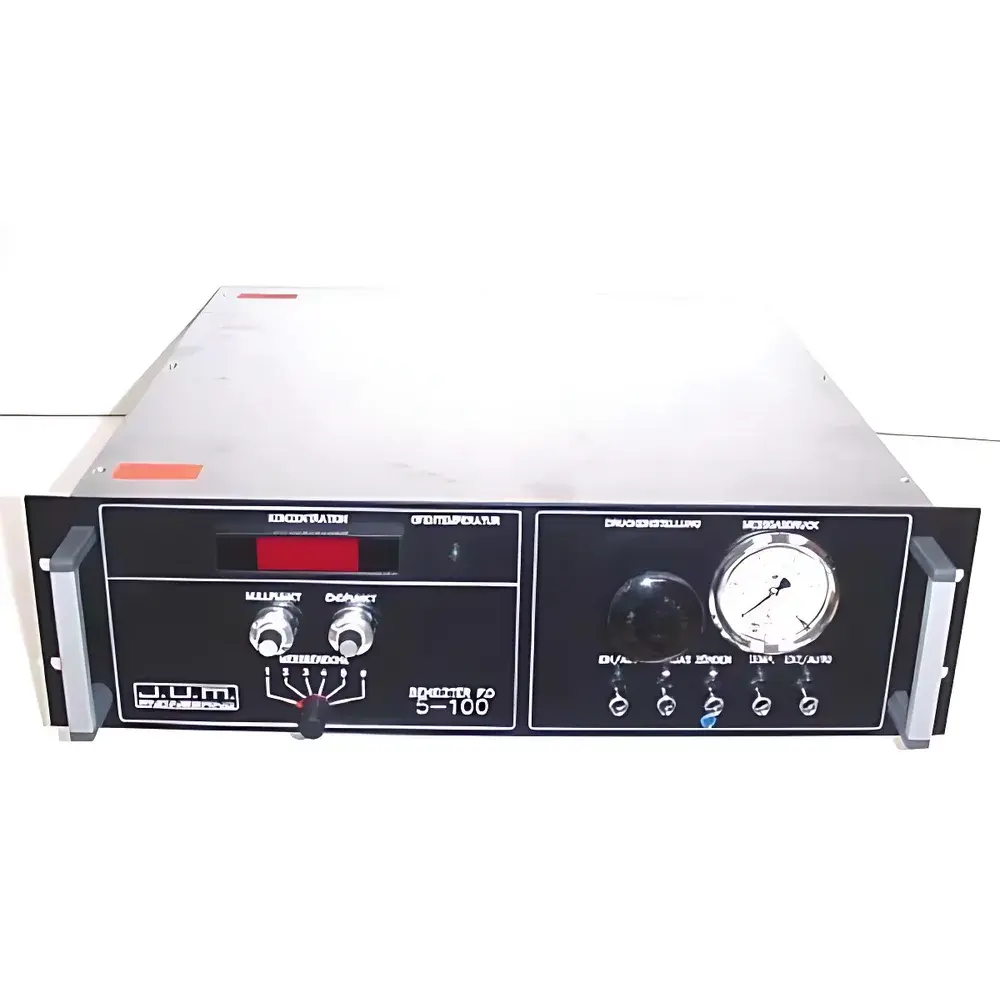
CHINYEE 5-100 Rack-Mounted Pressurized Gas Total Hydrocarbons Analyzer with FID Detection
| Brand | CHINYEE |
|---|---|
| Origin | Germany |
| Manufacturer Type | Authorized Distributor |
| Origin Category | Imported |
| Model | 5-100-1 |
| Instrument Type | Online Analyzer |
| Typical Configuration | TVOC Analyzer |
| Detection Range | 0–1000 ppm |
| Resolution | 0.1 ppm |
| Accuracy | ±5% of reading |
| Response Time | <60 s |
| Detection Principle | Flame Ionization Detection (FID) |
| Sensitivity (CH₄) | ≤1 ppm full-scale |
| Detector Heating Zone Temperature | 190 °C |
| Carrier/Combustion Air Supply | Integrated zero-air generator |
| Measurement Ranges (selectable) | 0–10, 0–100, 0–1,000, 0–10,000, 0–100,000 ppm (as C₁ equivalent) |
Overview
The CHINYEE 5-100 Rack-Mounted Pressurized Gas Total Hydrocarbons Analyzer is an online, continuous-monitoring instrument engineered for trace-level hydrocarbon quantification in pressurized industrial gas streams. It employs a flame ionization detector (FID), a universally accepted detection principle for total hydrocarbons (THC) and volatile organic compounds (VOCs) based on carbon-specific ionization efficiency in a hydrogen–air flame. Unlike photometric or metal-oxide semiconductor sensors, the FID delivers linear, stoichiometric response across a broad range of aliphatic and aromatic hydrocarbons — from methane to heavy C₁₀+ species — without compound-specific calibration drift. The analyzer integrates JUM (Joint Uniform Monitoring) whole-chamber heating technology, maintaining the entire sample path—including transfer lines, valves, and detector oven—at a precisely controlled 190 °C. This eliminates condensation of high-boiling-point hydrocarbons (e.g., xylene, decane, or heavier VOCs), ensuring quantitative recovery and measurement fidelity in high-purity gas matrices such as CO₂, N₂, O₂, Ar, and He.
Key Features
- Rack-mount 19-inch form factor compliant with EN 60297-3-100 and IEC 60297 standards for integration into centralized control cabinets or gas purity monitoring skids.
- FID detector with integrated zero-air supply system: eliminates external compressed air dependency and ensures stable combustion conditions under variable ambient humidity or pressure.
- Full-path thermal management: heated sample line, heated valve manifold, and heated detector chamber prevent adsorption, condensation, and memory effects — critical for sub-ppm THC monitoring in ultra-high-purity gases.
- Selectably scalable measurement ranges (0–10 ppm to 0–100,000 ppm as methane-equivalent) via software-configurable gain settings and digital signal processing.
- Real-time response time <60 seconds (T₉₀) for dynamic process monitoring; intrinsic detector response <0.2 s enables rapid transient detection during purge cycles or system upsets.
- Robust architecture designed for 24/7 operation in Class 1 Div 2 or ATEX Zone 2 environments (certification documentation available upon request).
Sample Compatibility & Compliance
The 5-100 analyzer is validated for direct analysis of pressurized gas streams up to 10 bar(g), with inlet pressure regulation and flow control integrated into the sample conditioning module. It complies with ISO 8573-5:2010 (compressed air purity — oil vapor content), ASTM D6348-15 (standard test method for determination of gaseous compounds by gas chromatography/FID), and supports GLP/GMP data integrity requirements through audit-trail-enabled firmware. While not a GC-FID system, its fixed-range FID output meets USP and EP 2.2.47 specifications for residual hydrocarbon verification in pharmaceutical-grade nitrogen and carbon dioxide. All wetted materials are electropolished 316L stainless steel or perfluoroelastomer (FFKM) sealed — compatible with semiconductor-grade gas purity standards (SEMI F57, SEMI F63).
Software & Data Management
The embedded Linux-based controller provides Modbus TCP, RS-485 (Modbus RTU), and optional Profibus DP interfaces for integration into DCS/SCADA systems. Data logging includes timestamped concentration values, detector baseline stability metrics, heater temperature logs, and alarm status history — all stored locally for ≥30 days. Optional CHINYEE Analytical Suite software enables remote configuration, trend visualization, automated calibration scheduling, and export of CSV/Excel reports compliant with FDA 21 CFR Part 11 (electronic records and signatures) when paired with user authentication and audit trail activation. Calibration verification routines support span-check protocols using certified methane-in-nitrogen standards traceable to NIST SRM 1650b.
Applications
- Monitoring residual hydrocarbons in bulk ultra-high-purity (UHP) gases supplied to semiconductor fab tools (e.g., etch, CVD, ALD chambers).
- Continuous verification of hydrocarbon breakthrough in activated carbon beds used for gas purification in cryogenic air separation units.
- Real-time THC tracking during catalyst regeneration cycles in petrochemical reforming or hydrogen production units.
- Validation of purge effectiveness in inert gas blanketing systems for pharmaceutical lyophilizers and sterile filling lines.
- Compliance testing for ISO 8573-1 Class 0 certification of instrument air and process gases in aerospace and medical device manufacturing.
FAQ
Does the 5-100 require carrier gas or external hydrogen supply?
No. It uses an integrated zero-air generator for combustion air and operates with ambient hydrogen (supplied via standard 50 mL/min H₂ cylinder or on-site generator); no separate carrier gas is needed.
Can it measure individual VOCs or only total hydrocarbons?
It measures total ionizable carbon (as methane-equivalent) only. For speciated VOC analysis, a coupled GC-FID or GC-MS system is required.
Is the unit suitable for outdoor installation?
It is rated for indoor cabinet mounting (IP20). Outdoor deployment requires climate-controlled sheltering and additional inlet filtration per ISO 8573-1 Class 2 particulate specification.
What calibration standards are recommended?
Certified methane-in-nitrogen standards at 10%, 50%, and 90% of selected range, traceable to NIST or PTB, with uncertainty ≤2% k=2.
How is detector contamination mitigated during long-term operation?
The heated sample path and auto-burn-off cycle (activated after extended low-concentration exposure) minimize carbon buildup; routine maintenance intervals are specified at 6 months or 2,000 operating hours.







