
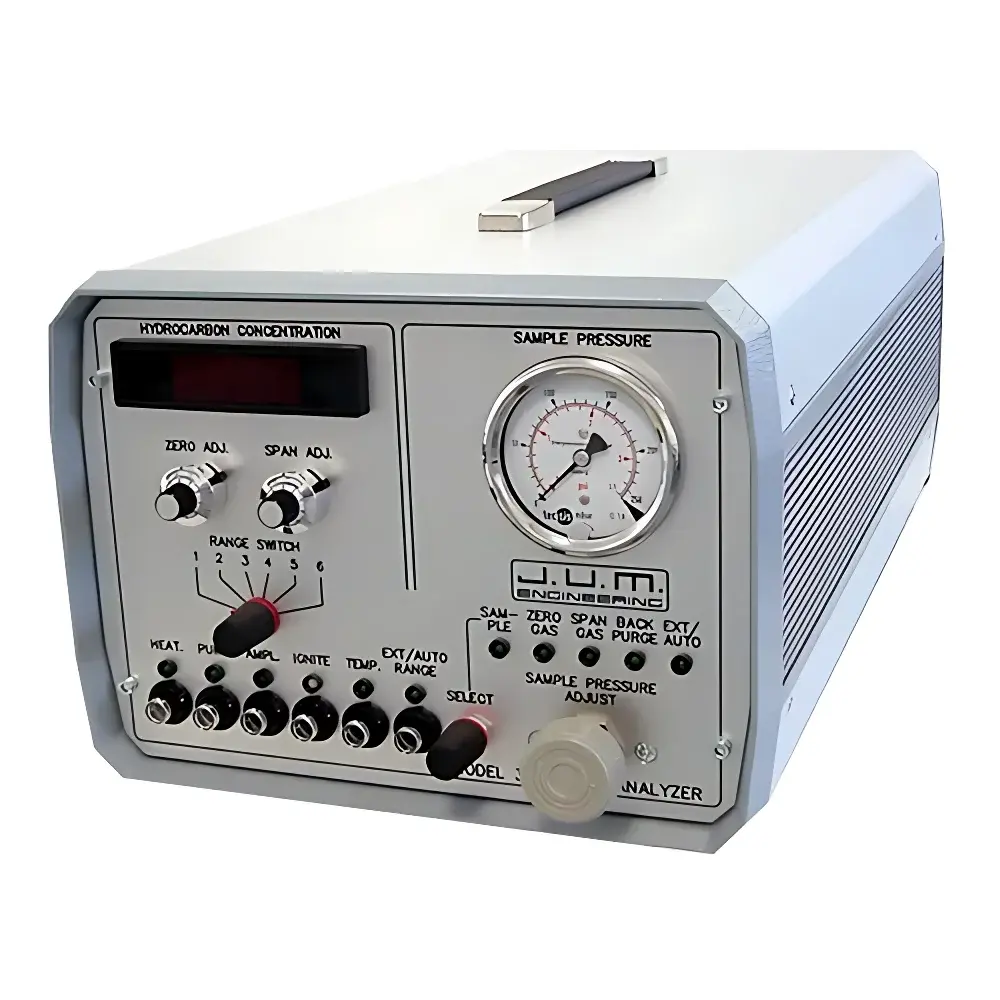
J.U.M. 3-200 Portable Heated Flame Ionization Detector (FID) for Total Hydrocarbon Analysis
| Brand | J.U.M. |
|---|---|
| Origin | Germany |
| Model | 3-200 |
| Detection Principle | Flame Ionization Detection (FID) |
| Operating Temperature | 190 °C (heated sample path & detector chamber) |
| Response Time | < 1 s |
| Fuel | Hydrogen (low-pressure metal-hydride cartridge, 40 h runtime) |
| Combustion Air | Integrated air generator (no external cylinder required) |
| Sample Filtration | 2 µm stainless steel filter (permanent or replaceable) |
| Filter Cleaning | Automated compressed air or nitrogen back-purge (measurement uninterrupted) |
| Compliance | EPA Method 25A, EN 12619, ISO 8573-1 (gas purity), GLP/GMP-ready data handling |
Overview
The J.U.M. 3-200 is a field-deployable, fully heated flame ionization detector (FID) system engineered for accurate, interference-free total hydrocarbon (THC) measurement across demanding industrial and environmental applications. Unlike conventional ambient-temperature FIDs, the 3-200 maintains its entire sample pathway—including sample inlet, filter, transfer lines, flow control valves, and FID detector chamber—at a constant 190 °C. This elevated temperature architecture prevents condensation of heavier hydrocarbons (C₆–C₁₂), eliminates adsorption losses on metallic surfaces, and ensures quantitative recovery of volatile and semi-volatile organic compounds. Designed originally as a robust replacement for fixed online FID analyzers, the 3-200 has demonstrated operational reliability in continuous service for over 38 years—validated across more than 1,000 installations worldwide. Its compact 19-inch rack-mountable chassis supports both portable deployment (e.g., stack testing, fugitive emission surveys) and permanent benchtop or panel-integrated operation within process control environments.
Key Features
- Fully heated sample train at 190 °C: Eliminates cold spots, minimizes memory effects, and preserves C₅+ hydrocarbon integrity during transit to the detector.
- Integrated zero-air generator: Produces high-purity combustion air on demand—no reliance on external cylinders, synthetic air supplies, or zero-gas generators.
- Dual-filter configuration: Standard 2 µm sintered stainless-steel filter (permanent, back-purge capable); optional removable filter module for rapid field exchange without tools.
- Automated back-purge system: Compressed air or nitrogen pulse cleans the filter in situ; sample flow and measurement continuity are maintained throughout purge cycles.
- Low-consumption hydrogen supply: Optional metal-hydride hydrogen reservoir delivers up to 40 hours of continuous operation at 30 bar inlet pressure; refilling requires only a standard H₂ cylinder with calibrated regulator.
- Microprocessor-based control: PID-regulated temperature management, real-time flame status monitoring, auto-ignition sequence, and flame-out detection with optional solenoid fuel cutoff.
- Sub-second response time (< 1 s T₉₀): Enables dynamic profiling of transient emissions during start-up, load changes, or intermittent process events.
- Remote I/O interface: Standard digital and analog ports support remote triggering of zero/calibration, back-purge initiation, range switching, and alarm signaling per site SCADA or DCS integration.
Sample Compatibility & Compliance
The 3-200 is validated for direct analysis of hot, wet, and particulate-laden gas streams—including raw flue gas, biogas, landfill emissions, refinery off-gas, and ambient air—without external conditioning or probe filtration. All wetted materials (316L SS, high-temp ceramics, gold-plated electrodes) are compatible with corrosive matrices and trace sulfur species. Regulatory alignment includes full adherence to U.S. EPA Method 25A for stationary source THC quantification, EN 12619 for automated flue gas analyzers, and ISO 8573-1 Class 2 purity requirements for instrument air. Data acquisition supports audit-trail functionality compliant with 21 CFR Part 11 when paired with J.U.M.’s optional certified software suite, satisfying GLP and GMP laboratory documentation standards.
Software & Data Management
The 3-200 operates with embedded firmware supporting configurable calibration sequences (span/zero), automatic drift correction, and user-defined alarm thresholds (e.g., flame failure, temperature deviation, signal saturation). Optional PC-based software provides real-time graphical display, event logging, CSV export, and report generation aligned with ISO/IEC 17025 documentation templates. All calibration events, maintenance actions, and system diagnostics are timestamped and stored internally with non-volatile memory retention exceeding 12 months. Remote firmware updates are supported via Ethernet or USB, ensuring long-term compliance with evolving regulatory interpretation and method revisions.
Applications
- Regulatory stack testing per EPA 25A, MCERTS, and TA Luft protocols
- Continuous emission monitoring system (CEMS) commissioning and QA/QC verification
- Fugitive VOC surveying in petrochemical, pharmaceutical, and semiconductor facilities
- Biogas and syngas quality assurance in anaerobic digestion and gasification plants
- Calibration transfer standard for fixed online FID analyzers
- Research-grade hydrocarbon speciation support (when coupled with GC pre-separation)
FAQ
Does the 3-200 require external zero air or calibration gas cylinders?
No—the integrated air generator produces combustion-grade air continuously; zero and span gases are introduced via dedicated solenoid valves and do not require pressurized storage.
Can the instrument measure methane separately from non-methane hydrocarbons (NMHC)?
Not natively—the 3-200 reports total hydrocarbons as ppmC or mg/m³. For NMHC determination, a parallel methane-specific analyzer (e.g., NDIR or GC-FID) and subtraction protocol must be applied per EPA guidelines.
What maintenance intervals are recommended for field operation?
Filter back-purge frequency depends on particulate loading; typical intervals range from 2–24 hours. Annual verification of FID jet geometry, detector gain stability, and temperature sensor calibration is advised.
Is the heated sample line option compatible with all configurations?
The heated sample line mounting plate is mutually exclusive with the OVE32 auxiliary electronics module due to spatial constraints within the chassis.
How is data integrity ensured during extended unattended operation?
Internal EEPROM stores all critical parameters and logs with power-fail protection; optional SD card logging provides redundant archival independent of host PC connectivity.







